|
|
|||||||
 |
 |
|
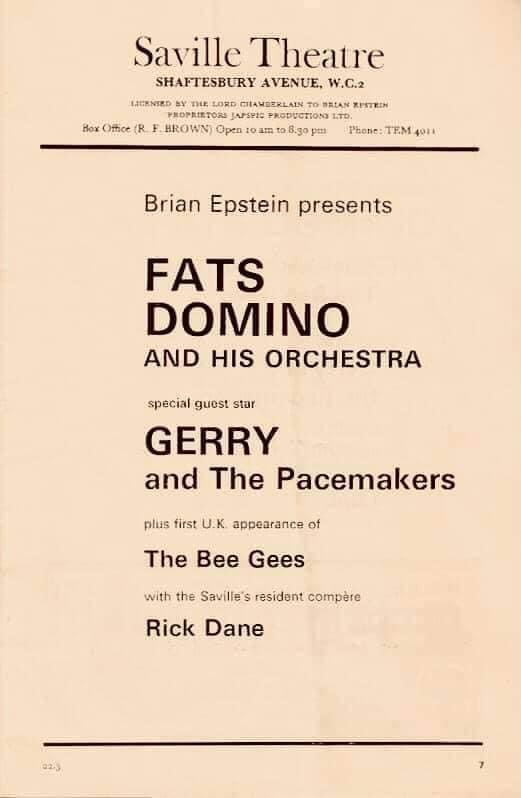
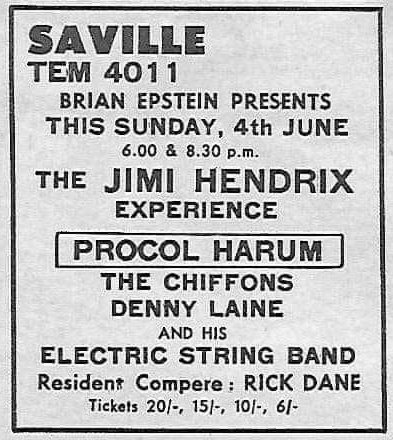
| Saville Theatre adverts mentioning compère Rick Dane, shared on Facebook by Tony Bramwell. Click to enlarge. |
||
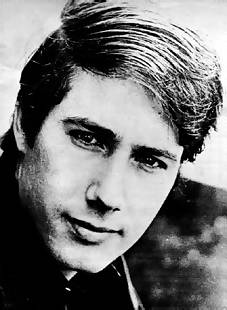 Rick Dane There seems to be some confusion as to where and when Rick was born. Who's Who In Pop Radio says it was Cape Town, South Africa. John Venmore-Rowland's
Radio Caroline claims Port Louis, Mauritius, on 22nd February 1941. A 1967 profile in the New Musical Express says Mauritius but prefers the birth year of 1945. The article also gives his real name as Randal Gautier.
All agree that, while still a teenager, he worked on Springbok Radio in South Africa as well as compèring touring pop package shows. Rick came to England and studied acting at the Webber Douglas Academy, performing in a
stage version of The Knack and acting alongside Vanessa Redgrave in The World's Baby at London's Royal Court Theatre. After a spell as resident DJ at the Wimbledon Palais, Rick joined Radio Caroline in early 1966.
He worked on both ships and had a couple of different theme tunes: All For You by Earl Van Dyke and In The Midnight Hour by Little Mac and the Boss Sounds. He
was involved in a drama at sea when, in May 1966, he helped rescue two female sailors when their catamaran got into trouble near Caroline South. After he left the ship at the end of 1966, Rick continued to be heard on the station
via the pre-recorded Lucky Birthday Bonanza competition. He was involved in the promotion of concerts at London's Saville Theatre, then owned by Beatles manager Brian Epstein, and was one of the many ex-pirates to join
Radio One at its launch in September 1967. He co-hosted an edition of Top Gear with Pete Drummond
on 22nd October 1967 and presented a series called Radio One O'Clock the following year but did not stay with the station for long. He also appeared in a 1967 movie The Mini Affair (also known as ‘The Mini-Mob’) alongside singer Georgie Fame and a cast that included Clement Freud, Clive Dunn, Roy Kinnear and Willie Rushton. Rick worked in club promotion,
both in the UK and on the continent, later running a company that installed audio-visual equipment to the hospitality industry, based in Miami, Florida. To see a picture of Rick in action in the Caroline South studio, see
Keith Hampshire's photo album. (This photo was issued by The Caroline Club. Thanks to Mike Barraclough.)
Rick Dane There seems to be some confusion as to where and when Rick was born. Who's Who In Pop Radio says it was Cape Town, South Africa. John Venmore-Rowland's
Radio Caroline claims Port Louis, Mauritius, on 22nd February 1941. A 1967 profile in the New Musical Express says Mauritius but prefers the birth year of 1945. The article also gives his real name as Randal Gautier.
All agree that, while still a teenager, he worked on Springbok Radio in South Africa as well as compèring touring pop package shows. Rick came to England and studied acting at the Webber Douglas Academy, performing in a
stage version of The Knack and acting alongside Vanessa Redgrave in The World's Baby at London's Royal Court Theatre. After a spell as resident DJ at the Wimbledon Palais, Rick joined Radio Caroline in early 1966.
He worked on both ships and had a couple of different theme tunes: All For You by Earl Van Dyke and In The Midnight Hour by Little Mac and the Boss Sounds. He
was involved in a drama at sea when, in May 1966, he helped rescue two female sailors when their catamaran got into trouble near Caroline South. After he left the ship at the end of 1966, Rick continued to be heard on the station
via the pre-recorded Lucky Birthday Bonanza competition. He was involved in the promotion of concerts at London's Saville Theatre, then owned by Beatles manager Brian Epstein, and was one of the many ex-pirates to join
Radio One at its launch in September 1967. He co-hosted an edition of Top Gear with Pete Drummond
on 22nd October 1967 and presented a series called Radio One O'Clock the following year but did not stay with the station for long. He also appeared in a 1967 movie The Mini Affair (also known as ‘The Mini-Mob’) alongside singer Georgie Fame and a cast that included Clement Freud, Clive Dunn, Roy Kinnear and Willie Rushton. Rick worked in club promotion,
both in the UK and on the continent, later running a company that installed audio-visual equipment to the hospitality industry, based in Miami, Florida. To see a picture of Rick in action in the Caroline South studio, see
Keith Hampshire's photo album. (This photo was issued by The Caroline Club. Thanks to Mike Barraclough.)
 Rick Dane on Sunday morning 13th August 1966 on Radio Caroline South and presenting an edition of Lucky Birthday Bonanza from 2nd June 1967. The first tape is courtesy of Ray Andrews, the second kindly provided by
Steve Kirby (duration 3 minutes 4 seconds)
Rick Dane on Sunday morning 13th August 1966 on Radio Caroline South and presenting an edition of Lucky Birthday Bonanza from 2nd June 1967. The first tape is courtesy of Ray Andrews, the second kindly provided by
Steve Kirby (duration 3 minutes 4 seconds)
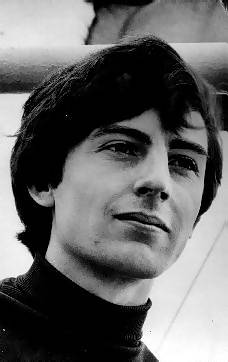 Roger Day Born 29th March 1945 in Cheltenham, Gloucestershire, Roger was living in Kent during the sixties. His first brush with fame came with an appearance on Southern TV's
Pop The Question music quiz, hosted by Muriel Young in 1965. By the following year he was working as an accountant by day and part-time DJ at night. Dave Cash told Roger that some Americans were
in London, recruiting for a new radio station. He went to see them and was invited to join “Swinging” Radio England. One of the original team on day one, he was the only one to survive until the station closed down a
turbulent six months later. After a few months playing records in boxer Billy Walker's Uppercut Club, he joined Caroline South in July 1967. Known as “Roger ‘Twiggy’ Day, your thinner record spinner”,
he opened every show with brief clips of Let's Go Trippin' and Shut Down Part II, both by the Beach Boys,
followed by his theme tune, The Ventures' Green Grass. His catch-phrase was “Hi, hello, how are you?” Roger was on board the Mi Amigo on the day the ship was
towed away by creditors in March 1968. He then worked for Radio Luxembourg before returning to the water with Radio Northsea International (see The Pirate Radio Hall of Fame
‘Seventies Supplement’). He has since been heard on Piccadilly Radio in Manchester, BRMB in Birmingham, Radio West in Bristol, Invicta in Canterbury, Pirate-FM Cornwall, Jazz-FM London and
County Sound Guildford, among others. In June 2003 Roger started presenting programmes on the internet incarnation of Radio Caroline but had to stop when he joined Birmingham's Saga Radio. He then moved to BBC Radio Kent
where he presented a popular weekday evening show. Unfortunately this was dropped due to BBC budget cuts and Roger was reduced to just a Saturday evening programme. He set-up an internet station called UnCool Radio, supported by
contributions from listeners. These programmes were also heard on Caroline Flashback and Delux Radio. Roger moved to Spain and, for a time, continued with the Radio Kent show but it has now stopped. He can currently be heard
on Boom Radio. He also hosts the syndicated Sixties Vinyl Countdown programme. His website is www.rogerday.co.uk.
He published his autobiography Pirate of the Airwaves in July 2023. For more photos and recordings, check out Spotlight On Roger Day. In March 2004
Roger organised Caroline's fortieth birthday party. There are pictures of the event here. Pictures of the 45th birthday party, five years later, are here. He has also written about
his memories of joining his first station for our feature on Radio England and Britain Radio and we have some pictures taken at their 40th anniversary reunion, the
Radio Academy Celebration of Offshore Radio and the Offshore 50 reunion. (This promotional photo was issued by Radio England / Britain Radio. Many thanks to Roger for his
help. Theme tune details courtesy of Kees Brinkerink, Frank van Heerde and Alan Field.)
Roger Day Born 29th March 1945 in Cheltenham, Gloucestershire, Roger was living in Kent during the sixties. His first brush with fame came with an appearance on Southern TV's
Pop The Question music quiz, hosted by Muriel Young in 1965. By the following year he was working as an accountant by day and part-time DJ at night. Dave Cash told Roger that some Americans were
in London, recruiting for a new radio station. He went to see them and was invited to join “Swinging” Radio England. One of the original team on day one, he was the only one to survive until the station closed down a
turbulent six months later. After a few months playing records in boxer Billy Walker's Uppercut Club, he joined Caroline South in July 1967. Known as “Roger ‘Twiggy’ Day, your thinner record spinner”,
he opened every show with brief clips of Let's Go Trippin' and Shut Down Part II, both by the Beach Boys,
followed by his theme tune, The Ventures' Green Grass. His catch-phrase was “Hi, hello, how are you?” Roger was on board the Mi Amigo on the day the ship was
towed away by creditors in March 1968. He then worked for Radio Luxembourg before returning to the water with Radio Northsea International (see The Pirate Radio Hall of Fame
‘Seventies Supplement’). He has since been heard on Piccadilly Radio in Manchester, BRMB in Birmingham, Radio West in Bristol, Invicta in Canterbury, Pirate-FM Cornwall, Jazz-FM London and
County Sound Guildford, among others. In June 2003 Roger started presenting programmes on the internet incarnation of Radio Caroline but had to stop when he joined Birmingham's Saga Radio. He then moved to BBC Radio Kent
where he presented a popular weekday evening show. Unfortunately this was dropped due to BBC budget cuts and Roger was reduced to just a Saturday evening programme. He set-up an internet station called UnCool Radio, supported by
contributions from listeners. These programmes were also heard on Caroline Flashback and Delux Radio. Roger moved to Spain and, for a time, continued with the Radio Kent show but it has now stopped. He can currently be heard
on Boom Radio. He also hosts the syndicated Sixties Vinyl Countdown programme. His website is www.rogerday.co.uk.
He published his autobiography Pirate of the Airwaves in July 2023. For more photos and recordings, check out Spotlight On Roger Day. In March 2004
Roger organised Caroline's fortieth birthday party. There are pictures of the event here. Pictures of the 45th birthday party, five years later, are here. He has also written about
his memories of joining his first station for our feature on Radio England and Britain Radio and we have some pictures taken at their 40th anniversary reunion, the
Radio Academy Celebration of Offshore Radio and the Offshore 50 reunion. (This promotional photo was issued by Radio England / Britain Radio. Many thanks to Roger for his
help. Theme tune details courtesy of Kees Brinkerink, Frank van Heerde and Alan Field.)
Roger Day in manic mode on an evening show from “Swinging” Radio England in October 1966. Tape kindly provided by Stuart Russell (duration 1 minute 47 seconds)
Roger Day almost a year later, at the end of August 1967, presenting the 3-6pm show on Radio Caroline South International. This tape courtesy of Ray Andrews (duration 2 minutes 53 seconds)
The Pirate Radio Hall of Fame needs your
|
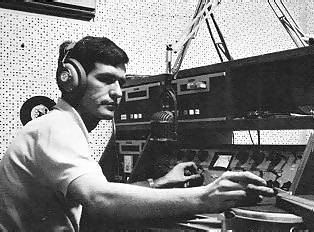 Larry Dean “Swinging” Radio England launched in May 1966 with a predominantly American DJ crew, three of the team coming from the same town of Moultrie in Georgia.
Larry was one of them, the other two being Ron O'Quinn and Jerry Smithwick. Larry's real name was Frank Laseter. He had started working in radio at the age of 15 while
still at school. He had gone on to a number of different stations and, like many of his fellow American broadcasters, had used various names on air. He says: “I first started using Larry Dean as an air name in June of 1963
when I was hired at WVLD in Valdosta, Georgia. I continued to use that name until I left in September of the next year. When I took the new job in Tampa, Florida, they decided that I should use ‘James Bond’. Not what I
would have wanted but it was a job. I returned to Larry Dean when I departed for WPTR the summer of the following year.” WPTR in Albany, New York, had a fine jingle package produced by PAMS of Dallas and when Larry left there
to join “Swinging” Radio England, he brought a copy of the jingle master tape with him. These jingles were too good to waste and a number of his new colleagues chose their DJ names from the tape.
Chuck Blair, Johnnie Walker, Greg Warren and Boom Boom Brannigan were all WPTR broadcasters who, unknowingly, had identically named colleagues
on this side of the Atlantic. Radio England did not last long and Larry did not stay for its full term. In late summer 1966 he returned to America and resumed his career there. His last job was as the morning news man on country music
station WSOC in Charlotte, North Carolina, where he used his real name. You can hear more of Larry in our feature on Radio England and Britain Radio and see pictures taken at the Radio England
40th anniversary reunion. In later years he suffered from poor health, losing his eyesight and battling cancer. He died in August 2018. There is a fine tribute on the
Radio London website. (Photo from ‘Who's Who In Pop Radio’, published by The New English Library. With many thanks to Alan
Field and Svenn Martinsen for their help.)
Larry Dean “Swinging” Radio England launched in May 1966 with a predominantly American DJ crew, three of the team coming from the same town of Moultrie in Georgia.
Larry was one of them, the other two being Ron O'Quinn and Jerry Smithwick. Larry's real name was Frank Laseter. He had started working in radio at the age of 15 while
still at school. He had gone on to a number of different stations and, like many of his fellow American broadcasters, had used various names on air. He says: “I first started using Larry Dean as an air name in June of 1963
when I was hired at WVLD in Valdosta, Georgia. I continued to use that name until I left in September of the next year. When I took the new job in Tampa, Florida, they decided that I should use ‘James Bond’. Not what I
would have wanted but it was a job. I returned to Larry Dean when I departed for WPTR the summer of the following year.” WPTR in Albany, New York, had a fine jingle package produced by PAMS of Dallas and when Larry left there
to join “Swinging” Radio England, he brought a copy of the jingle master tape with him. These jingles were too good to waste and a number of his new colleagues chose their DJ names from the tape.
Chuck Blair, Johnnie Walker, Greg Warren and Boom Boom Brannigan were all WPTR broadcasters who, unknowingly, had identically named colleagues
on this side of the Atlantic. Radio England did not last long and Larry did not stay for its full term. In late summer 1966 he returned to America and resumed his career there. His last job was as the morning news man on country music
station WSOC in Charlotte, North Carolina, where he used his real name. You can hear more of Larry in our feature on Radio England and Britain Radio and see pictures taken at the Radio England
40th anniversary reunion. In later years he suffered from poor health, losing his eyesight and battling cancer. He died in August 2018. There is a fine tribute on the
Radio London website. (Photo from ‘Who's Who In Pop Radio’, published by The New English Library. With many thanks to Alan
Field and Svenn Martinsen for their help.)
Larry Dean playing much more music on “Swinging” Radio England from the afternoon of 19th June 1966. Recording kindly provided by Svenn Martinsen (duration 4 minute 46 seconds)
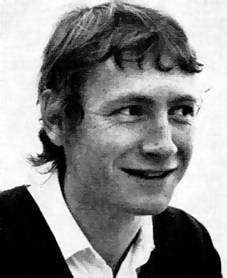 Alexander Dee Real name Dennis Swinnerton, born in Birmingham in 1944, Alex trained to be an actor for two years after finishing school but, instead of finding fame on the
stage or silver screen, it was offshore radio that brought him success. He joined Radio City in 1965. This station, on Shivering Sands fort off the Kent coast, had a huge turnover of staff, as various presenters were given a
one week trial and then paid off with a fiver for their troubles. But Alex stayed for a year. In 1966 he transferred north to Radio 270, where he hosted the 9pm-midnight show. His theme tune on Radio City was
Manhattan Spiritual by Eric Delaney & his band. On Radio 270 it was Along the Boulevard by Joe Loss and
his Orchestra. Alex left 270 in November 1966 after expressing doubts about the ship's sea-worthiness to a newspaper. In 1969 he was back on Radio City's old fort, not for broadcasting purposes but to start a “hippy”
commune. It is thought that he was later heard on BBC local radio but, when contacted by Monitor magazine in 1972, was working as a shop assistant. We have been told that sadly Alex died in 1995. (Photo from ‘Who's
Who In Pop Radio’, published by The New English Library. Our thanks to Hans Knot, Roger Kemp and Martin van der Ven for the theme tune information.)
Alexander Dee Real name Dennis Swinnerton, born in Birmingham in 1944, Alex trained to be an actor for two years after finishing school but, instead of finding fame on the
stage or silver screen, it was offshore radio that brought him success. He joined Radio City in 1965. This station, on Shivering Sands fort off the Kent coast, had a huge turnover of staff, as various presenters were given a
one week trial and then paid off with a fiver for their troubles. But Alex stayed for a year. In 1966 he transferred north to Radio 270, where he hosted the 9pm-midnight show. His theme tune on Radio City was
Manhattan Spiritual by Eric Delaney & his band. On Radio 270 it was Along the Boulevard by Joe Loss and
his Orchestra. Alex left 270 in November 1966 after expressing doubts about the ship's sea-worthiness to a newspaper. In 1969 he was back on Radio City's old fort, not for broadcasting purposes but to start a “hippy”
commune. It is thought that he was later heard on BBC local radio but, when contacted by Monitor magazine in 1972, was working as a shop assistant. We have been told that sadly Alex died in 1995. (Photo from ‘Who's
Who In Pop Radio’, published by The New English Library. Our thanks to Hans Knot, Roger Kemp and Martin van der Ven for the theme tune information.)
Alexander Dee on Radio City, one afternoon in August 1965. This clip is part of a longer recording shared by The Offshore Radio Archive (duration 2 minutes 35 seconds)
Alex on Radio 270 from 1966. Tape kindly provided by Stuart Russell (duration 1 minute 44 seconds)
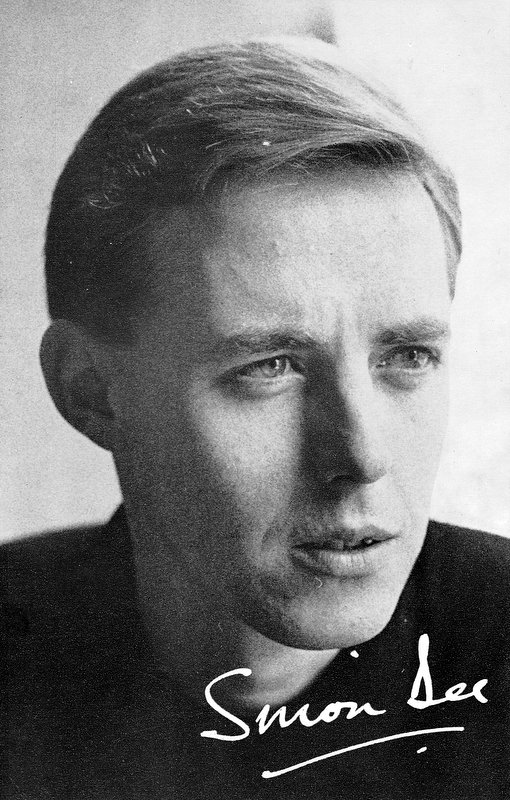 Simon Dee Simon's official Radio Caroline biography, released by the press office in 1964, said that he was born Carl Henty-Dodd in Ottawa, Canada, on 28th July 1935 and came
to Britain at the age of 11. In fact this was not true. The book Whatever Happened To Simon Dee? reveals that he was actually
Cyril Nicholas Henty-Dodd and was born in England. In fact, traditionally, all the males in the Henty-Dodd family had Cyril as a first name so they were called by their second name to differentiate them. So Simon Dee was
known as Nicholas or Nicky to family and friends. The rest of the Caroline biography is largely accurate. Simon was educated at Shrewsbury public school (albeit briefly) and had previously worked as a bouncer in a coffee
bar, an actor, a photographic assistant to Lord Snowdon, designer for Christian Dior and vacuum cleaner salesman, among many other things, before joining Radio Caroline for day one at Easter 1964. He had also studied acting with
Caroline boss Ronan O'Rahilly which was how his came to be the first voice heard on the station on Easter Saturday, welcoming listeners to the station before handing over to the first programme which was presented by the only other
DJ on the ship, Chris Moore. Simon was the first star of offshore radio. His theme tune was On The Sunny Side Of The Street by the Tommy
Dorsey Orchestra. The (now defunct?) Thank Your Lucky Stars website reported that Simon was the guest DJ on this legendary Saturday evening ITV pop music television show on 27th February 1965. Later that year he was the first
pirate broadcaster to become a national radio personality when the BBC offered him a show on the Light Programme which, to use his catch-phrase, “can't be bad”. He also had a flourishing TV career and his BBC chat show
Dee Time was an enormous success. For a time he could do no wrong. He appeared in a number of films including cult classic The
Italian Job with Michael Caine. In 1970 London Weekend Television made him a lucrative offer to present a late night chat show. Sadly this new programme did not work out and his contract was prematurely terminated after
just a few months. It was the end of his position as media golden boy. That same year he joined with his former Caroline boss, Ronan O'Rahilly, to campaign against the jamming of the Swiss-owned pirate ship, Radio Northsea
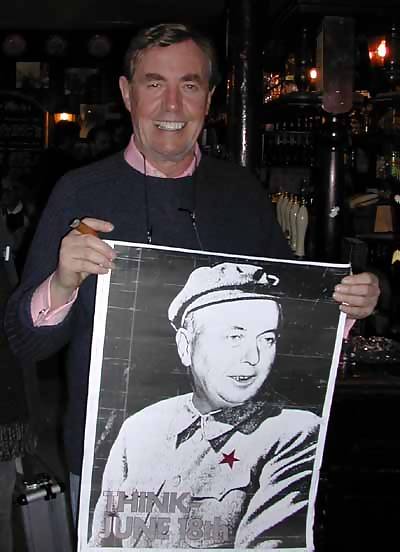
International. This campaign issued a poster of Prime Minister Harold Wilson which caused some controversy. (There is a picture of Simon with a copy of it here.) Official papers, released under the thirty
year rule, show that he came close to prosecution for his part in the campaign. Simon then did a number of jobs, including working as a bus driver and journalist. Although his career never returned to its former glory, he did present
a series on sixties pop for BBC Radio Two in the late eighties. In December 2003 Channel 4 Television devoted two programmes to him, scheduled back to back. The first, Dee Construction, told the story of his rise and fall
while the second, after 33 years, was a revival of Dee Time. Simon was one of the many DJs to attend Caroline's fortieth birthday party in March 2004. There are photos here. He died of bone cancer
after a short illness in August 2009. Our tribute to him is here. He was 74. (There is a series of articles from ‘Titbits’ magazine, written by Simon in 1966, here
and some photos from 1965 here. This photo was issued by The Caroline Club. Thanks to Nigel Fell.)
Simon Dee Simon's official Radio Caroline biography, released by the press office in 1964, said that he was born Carl Henty-Dodd in Ottawa, Canada, on 28th July 1935 and came
to Britain at the age of 11. In fact this was not true. The book Whatever Happened To Simon Dee? reveals that he was actually
Cyril Nicholas Henty-Dodd and was born in England. In fact, traditionally, all the males in the Henty-Dodd family had Cyril as a first name so they were called by their second name to differentiate them. So Simon Dee was
known as Nicholas or Nicky to family and friends. The rest of the Caroline biography is largely accurate. Simon was educated at Shrewsbury public school (albeit briefly) and had previously worked as a bouncer in a coffee
bar, an actor, a photographic assistant to Lord Snowdon, designer for Christian Dior and vacuum cleaner salesman, among many other things, before joining Radio Caroline for day one at Easter 1964. He had also studied acting with
Caroline boss Ronan O'Rahilly which was how his came to be the first voice heard on the station on Easter Saturday, welcoming listeners to the station before handing over to the first programme which was presented by the only other
DJ on the ship, Chris Moore. Simon was the first star of offshore radio. His theme tune was On The Sunny Side Of The Street by the Tommy
Dorsey Orchestra. The (now defunct?) Thank Your Lucky Stars website reported that Simon was the guest DJ on this legendary Saturday evening ITV pop music television show on 27th February 1965. Later that year he was the first
pirate broadcaster to become a national radio personality when the BBC offered him a show on the Light Programme which, to use his catch-phrase, “can't be bad”. He also had a flourishing TV career and his BBC chat show
Dee Time was an enormous success. For a time he could do no wrong. He appeared in a number of films including cult classic The
Italian Job with Michael Caine. In 1970 London Weekend Television made him a lucrative offer to present a late night chat show. Sadly this new programme did not work out and his contract was prematurely terminated after
just a few months. It was the end of his position as media golden boy. That same year he joined with his former Caroline boss, Ronan O'Rahilly, to campaign against the jamming of the Swiss-owned pirate ship, Radio Northsea
International. This campaign issued a poster of Prime Minister Harold Wilson which caused some controversy. (There is a picture of Simon with a copy of it here.) Official papers, released under the thirty
year rule, show that he came close to prosecution for his part in the campaign. Simon then did a number of jobs, including working as a bus driver and journalist. Although his career never returned to its former glory, he did present
a series on sixties pop for BBC Radio Two in the late eighties. In December 2003 Channel 4 Television devoted two programmes to him, scheduled back to back. The first, Dee Construction, told the story of his rise and fall
while the second, after 33 years, was a revival of Dee Time. Simon was one of the many DJs to attend Caroline's fortieth birthday party in March 2004. There are photos here. He died of bone cancer
after a short illness in August 2009. Our tribute to him is here. He was 74. (There is a series of articles from ‘Titbits’ magazine, written by Simon in 1966, here
and some photos from 1965 here. This photo was issued by The Caroline Club. Thanks to Nigel Fell.)
Simon Dee on Radio Caroline's Soundtrack programme from April 1964. This is an edited version of a recording available from www.azanorak.com.
Our thanks to Ray Robinson (duration 3 minutes 1 second)
The first ever live music session on a British pirate station, from 1965. Simon Dee introduces the Jimmy Smith Trio. The group had to play out on the deck because Jimmy's Hammond organ was too big to get down the
companionway into the studio. Understandably, there is a certain amount of wind noise. Tape kindly provided by the late Dick Morecraft. For the second live music session, see Alan Black.
You can hear more of Simon on the Chris Moore airchecks (duration 2 minutes 54 seconds)
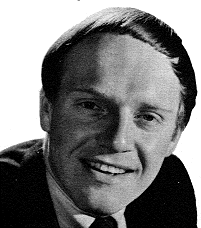 Chris Denning There has been some debate over whether Chris Denning should be allowed into The Pirate Radio Hall of Fame. The general
consensus seems to be that if he was an important contributor to sixties offshore radio (which he was) then he should be included, irrespective of what he got up to in his private life. Born in Hayes, Middlesex, on 10th May 1941,
Chris was a radio enthusiast from a very early age. As a teenager he appeared on a short wave radio station from the USA and on Radio Moscow. Keen to make a career for himself in broadcasting, he applied to the British Forces
Network, was accepted and posted to Kenya, where one of his colleagues was Keith Skues. On his return to the UK Chris became the first announcer on the new BBC-2 television channel. Radio Luxembourg
offered him a job in the Grand Duchy and he was with “the station of the stars” for nearly two years. In March 1966 he came back to Britain and, after meeting Ed Stewart in a club, was
invited to join Radio London. He was the first DJ on the station to be allowed to keep his own name. His theme tune was Right of Way by the Andrew Loog Oldham Orchestra. Chris left to join BBC radio in August 1966. The
following year he presented the ground-breaking Where It's At on the Light Programme which also featured his old Radio London colleagues Kenny Everett and Duncan
Johnson. He was part of the Radio One launch team but left the BBC to work for various record companies. He became a freelance voice-over and was heard reading the news on Capital Radio in London in 1980 during a journalists'
strike. Sexual indiscretions brought him to the regular attention of the police and he was jailed for offences in 1985, 1988 and 1996. In 1997 he was arrested in Prague and served a three and a half year prison sentence. In August
2005 he returned to the UK, was arrested at Heathrow Airport and, in February 2006, was given another jail sentence. Following his release in 2008 he was extradited to Slovakia to face child porn charges and in October that year
was sentenced by a district court in Bratislava to five years in prison. In London's Southwark Crown Court in November 2014 he pleaded guilty to a number of charges relating to sexual abuse committed between 1967 and 1987. He was
sentenced to 13 years in prison. In 2016 he was back in court and pleaded guilty to 21 further child sex offences committed between 1969 and 1986. He was jailed for another 13 years. He died on 24th June 2022 in a Bedford hospital
from a bacterial infection caused by diabetes. At that time he was serving his jail term at HMP Bedford. (Photo from ‘Who's Who In Pop Radio’, published by The New English Library.)
Chris Denning There has been some debate over whether Chris Denning should be allowed into The Pirate Radio Hall of Fame. The general
consensus seems to be that if he was an important contributor to sixties offshore radio (which he was) then he should be included, irrespective of what he got up to in his private life. Born in Hayes, Middlesex, on 10th May 1941,
Chris was a radio enthusiast from a very early age. As a teenager he appeared on a short wave radio station from the USA and on Radio Moscow. Keen to make a career for himself in broadcasting, he applied to the British Forces
Network, was accepted and posted to Kenya, where one of his colleagues was Keith Skues. On his return to the UK Chris became the first announcer on the new BBC-2 television channel. Radio Luxembourg
offered him a job in the Grand Duchy and he was with “the station of the stars” for nearly two years. In March 1966 he came back to Britain and, after meeting Ed Stewart in a club, was
invited to join Radio London. He was the first DJ on the station to be allowed to keep his own name. His theme tune was Right of Way by the Andrew Loog Oldham Orchestra. Chris left to join BBC radio in August 1966. The
following year he presented the ground-breaking Where It's At on the Light Programme which also featured his old Radio London colleagues Kenny Everett and Duncan
Johnson. He was part of the Radio One launch team but left the BBC to work for various record companies. He became a freelance voice-over and was heard reading the news on Capital Radio in London in 1980 during a journalists'
strike. Sexual indiscretions brought him to the regular attention of the police and he was jailed for offences in 1985, 1988 and 1996. In 1997 he was arrested in Prague and served a three and a half year prison sentence. In August
2005 he returned to the UK, was arrested at Heathrow Airport and, in February 2006, was given another jail sentence. Following his release in 2008 he was extradited to Slovakia to face child porn charges and in October that year
was sentenced by a district court in Bratislava to five years in prison. In London's Southwark Crown Court in November 2014 he pleaded guilty to a number of charges relating to sexual abuse committed between 1967 and 1987. He was
sentenced to 13 years in prison. In 2016 he was back in court and pleaded guilty to 21 further child sex offences committed between 1969 and 1986. He was jailed for another 13 years. He died on 24th June 2022 in a Bedford hospital
from a bacterial infection caused by diabetes. At that time he was serving his jail term at HMP Bedford. (Photo from ‘Who's Who In Pop Radio’, published by The New English Library.)
Chris Denning sitting in for Tony Windsor on the morning of Saturday 21st May 1966. Tape kindly provided by Stuart Russell (duration 3 minutes 8 seconds)
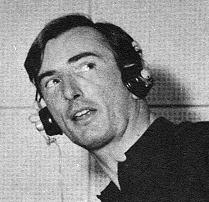 Dave Dennis After working briefly as a farmer, Dave trained as an actor at the Central School of Speech and Drama. He presented programmes on both Radio
Atlanta, the station that later became Caroline South, and on Radio Invicta, a low powered sweet music station which later became Radio 390. On both, he used his real name of Neil Spence.
He heard about the arrival of Radio London and sent them a demo tape. He got the job and a new name: Dave Dennis, otherwise known as “The Double D”. His catch phrase was a shouted “That's a lovely
one there, squire” which he scattered liberally throughout his lunchtime shows and his theme tune was Up A Lazy River by Si Zentner.
Along with his colleague Pete Brady he helped save USAF pilot John C. Winn who had been forced to eject from his Voodoo jet at almost supersonic speed and had landed in the icy North Sea
(see here). Dave left Radio London in December 1966, having released a record: Yes Virginia There Is A Santa Claus, written by his fellow DJ Tony Windsor.
Sadly, it was not a hit. He later ran the United Biscuits factory radio station, was Programme Director of Nottingham's Radio Trent and taught the next generation of DJs at the National Broadcasting School. He died in
December 2007 and there is a tribute to him here. (Photo from ‘Who's Who In Pop Radio’, published by The New English Library. There are more photos of him
here.)
Dave Dennis After working briefly as a farmer, Dave trained as an actor at the Central School of Speech and Drama. He presented programmes on both Radio
Atlanta, the station that later became Caroline South, and on Radio Invicta, a low powered sweet music station which later became Radio 390. On both, he used his real name of Neil Spence.
He heard about the arrival of Radio London and sent them a demo tape. He got the job and a new name: Dave Dennis, otherwise known as “The Double D”. His catch phrase was a shouted “That's a lovely
one there, squire” which he scattered liberally throughout his lunchtime shows and his theme tune was Up A Lazy River by Si Zentner.
Along with his colleague Pete Brady he helped save USAF pilot John C. Winn who had been forced to eject from his Voodoo jet at almost supersonic speed and had landed in the icy North Sea
(see here). Dave left Radio London in December 1966, having released a record: Yes Virginia There Is A Santa Claus, written by his fellow DJ Tony Windsor.
Sadly, it was not a hit. He later ran the United Biscuits factory radio station, was Programme Director of Nottingham's Radio Trent and taught the next generation of DJs at the National Broadcasting School. He died in
December 2007 and there is a tribute to him here. (Photo from ‘Who's Who In Pop Radio’, published by The New English Library. There are more photos of him
here.)
Dave Dennis live in “Dave's Den” from October 1966, an extract from Offshore Echo's tape More Highlights Of Big L part one, used
with kind permission (duration 3 minutes 37 seconds)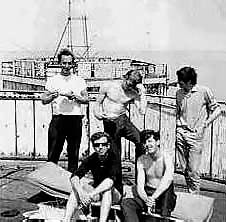
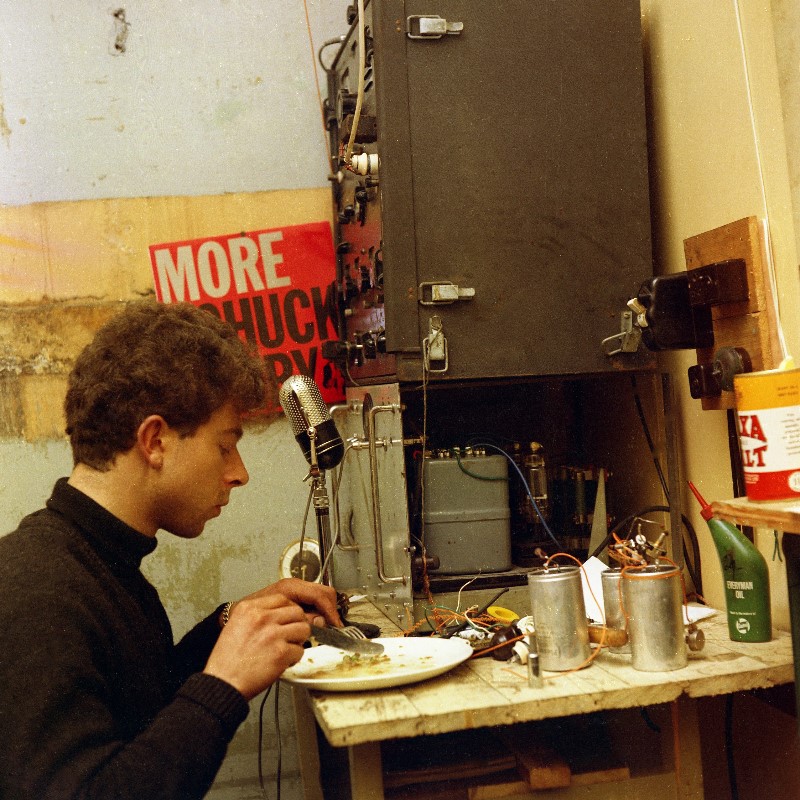 Dick Dickson / Dixon After spending his early years in London and Hampshire, Dick's family moved to Ramsgate in the early sixties and he remembers “that is when I heard
Reg Calvert advertising for a radio engineer and DJ on a very faint signal from Radio Sutch.” Dick got in touch with Calvert, Sutch's manager, and soon found himself working on
Shivering Sands, the old war-time fort that Sutch and Calvert had recently occupied. Everybody on the fort was expected to contribute on air so Dick Dickson was frequently heard presenting programmes on Radio Sutch.
This continued as Reg Calvert took over the station and renamed it Radio City. At the same time Dick altered the spelling of his surname. Radio Sutch's Dick Dickson became Radio City's Dick Dixon. During the summer
of 1965 Calvert began talks with Allan Crawford, boss of Caroline South. Caroline was losing listeners to Radio London and, as a result, advertising revenue had plummeted. Caroline needed to cut costs and Crawford was thinking
of buying Shivering Sands. He thought that a nice stable fort would be a cheaper base of operations than a ship. Calvert was keen to take his money but did not want to leave the radio business altogether so he dispatched
some of his men to investigate another Thames structure, Knock John, to see what the condition of the tower was and if it was feasible to use it for broadcasting. The initial survey looked encouraging and a couple of weeks
later, Dick was sent back with a small diesel generator and a Cossor transmitter, previously used for putting out night-time religious programmes on 188 metres. The plan was that they would launch “City 2” from Knock
John. Unfortunately someone else had other plans for the fort: Essex businessman Roy Bates. When Dick and his colleagues arrived, they found that Bates had claimed the tower and left two men to guard it. A certain amount of
disagreement followed. Despite press reports of fighting between the two groups, Dick says there was never any violence. However Roy Bates did order the City men off Knock John and proceeded to return them to Shivering Sands
in his boat. On the journey back, Bates mentioned to Dick that he was looking for a radio engineer and suggested he might like to join the team. At that time Dick wasn't interested. He already had a job. But when he got back to
City without the transmitter, Reg was furious and fired him. Dick was now suddenly free to take Bates up on the job offer. So he joined the guys setting up the new station on Knock John, Radio Essex. He says “Although I was
employed as a radio/audio engineer, I filled in as a DJ/presenter on The Big Band Sounds when David Sinclair was on shore but mainly I did the stint through the night from 2 to 8am. I used
to like working through the early hours and I still do.” Dick stayed with Radio Essex for about a year. He has now retired after working as a technician with the University of Kent for some years. In September 2014 he
organised a reunion in Whitstable to mark Radio City's 50th birthday. Dick also attended the Offshore 50 reunion in August 2017. (Many thanks to Dick for providing the
above information and to Martin Stevens for the photo.)
Dick Dickson / Dixon After spending his early years in London and Hampshire, Dick's family moved to Ramsgate in the early sixties and he remembers “that is when I heard
Reg Calvert advertising for a radio engineer and DJ on a very faint signal from Radio Sutch.” Dick got in touch with Calvert, Sutch's manager, and soon found himself working on
Shivering Sands, the old war-time fort that Sutch and Calvert had recently occupied. Everybody on the fort was expected to contribute on air so Dick Dickson was frequently heard presenting programmes on Radio Sutch.
This continued as Reg Calvert took over the station and renamed it Radio City. At the same time Dick altered the spelling of his surname. Radio Sutch's Dick Dickson became Radio City's Dick Dixon. During the summer
of 1965 Calvert began talks with Allan Crawford, boss of Caroline South. Caroline was losing listeners to Radio London and, as a result, advertising revenue had plummeted. Caroline needed to cut costs and Crawford was thinking
of buying Shivering Sands. He thought that a nice stable fort would be a cheaper base of operations than a ship. Calvert was keen to take his money but did not want to leave the radio business altogether so he dispatched
some of his men to investigate another Thames structure, Knock John, to see what the condition of the tower was and if it was feasible to use it for broadcasting. The initial survey looked encouraging and a couple of weeks
later, Dick was sent back with a small diesel generator and a Cossor transmitter, previously used for putting out night-time religious programmes on 188 metres. The plan was that they would launch “City 2” from Knock
John. Unfortunately someone else had other plans for the fort: Essex businessman Roy Bates. When Dick and his colleagues arrived, they found that Bates had claimed the tower and left two men to guard it. A certain amount of
disagreement followed. Despite press reports of fighting between the two groups, Dick says there was never any violence. However Roy Bates did order the City men off Knock John and proceeded to return them to Shivering Sands
in his boat. On the journey back, Bates mentioned to Dick that he was looking for a radio engineer and suggested he might like to join the team. At that time Dick wasn't interested. He already had a job. But when he got back to
City without the transmitter, Reg was furious and fired him. Dick was now suddenly free to take Bates up on the job offer. So he joined the guys setting up the new station on Knock John, Radio Essex. He says “Although I was
employed as a radio/audio engineer, I filled in as a DJ/presenter on The Big Band Sounds when David Sinclair was on shore but mainly I did the stint through the night from 2 to 8am. I used
to like working through the early hours and I still do.” Dick stayed with Radio Essex for about a year. He has now retired after working as a technician with the University of Kent for some years. In September 2014 he
organised a reunion in Whitstable to mark Radio City's 50th birthday. Dick also attended the Offshore 50 reunion in August 2017. (Many thanks to Dick for providing the
above information and to Martin Stevens for the photo.)
a very short clip of Dick Dickson, as he was then, on Radio Sutch in 1964. Recording kindly provided by Martyn Webster (duration 33 seconds)
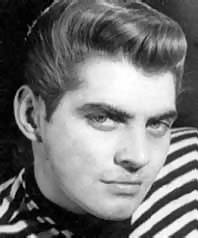 Peter Dolphin was an actor, originally from Birmingham. He was a regular on British television, including a 1961 appearance in the legendary Danger Man series (an
episode called ‘Sabotage’) and was in Dixon Of Dock Green a number of times. In 1966, in a gap between acting jobs, he briefly joined Radio City as a newsreader. Unfortunately it was not a good time to be on
the station. Only a few days into Peter's offshore career, the station was silenced by a raid on the fort. This dramatic event led to the death of station boss, Reg Calvert.
Radio City was kept off the air for a week and, by the time it returned, Peter had decided that there were safer ways to make a living. He left the fort and returned to acting. In the seventies he appeared in Gerry Anderson's
series U.F.O (an episode called ‘The Psychobombs’) and, in the eighties, he was in another science fiction series Tripods. He moved to France in 1992. A French website has reported that he died on 1st May 2009, aged 73. (Photo provided by Peter. Research into his acting career from
UFO - The Series and IMDB.)
Peter Dolphin was an actor, originally from Birmingham. He was a regular on British television, including a 1961 appearance in the legendary Danger Man series (an
episode called ‘Sabotage’) and was in Dixon Of Dock Green a number of times. In 1966, in a gap between acting jobs, he briefly joined Radio City as a newsreader. Unfortunately it was not a good time to be on
the station. Only a few days into Peter's offshore career, the station was silenced by a raid on the fort. This dramatic event led to the death of station boss, Reg Calvert.
Radio City was kept off the air for a week and, by the time it returned, Peter had decided that there were safer ways to make a living. He left the fort and returned to acting. In the seventies he appeared in Gerry Anderson's
series U.F.O (an episode called ‘The Psychobombs’) and, in the eighties, he was in another science fiction series Tripods. He moved to France in 1992. A French website has reported that he died on 1st May 2009, aged 73. (Photo provided by Peter. Research into his acting career from
UFO - The Series and IMDB.)
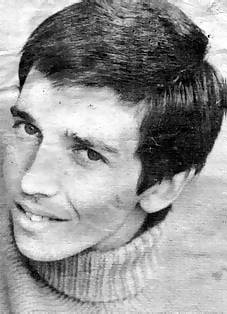 Pete Drummond was born in Bangor, Wales, on 29th July 1943. As a child he lived in Australia and France before attending Millfield public school where one of his fellow
pupils was Tony Blackburn. He trained as an actor and, while working in a play touring America, realised that British accents were in great demand on US radio. It was the time of “The British
Invasion” and every station wanted its own Beatles sound-alike. This same phenomenon also provided a training ground for Tommy Vance and John Peel among others.
He worked on stations in Wichita and Topeka but returned to the UK in August 1966. He joined Radio London the following month, staying with the station until its closure. Known as “Dum Dum,” his theme tune was
Marble Breaks, Iron Bends by Peter Fenton and he ended each show with this piece of advice: “Smile, it makes everyone else wonder what you've been up to.” Since his pirate days he has been heard on BBC Radio
One & the World Service and now works as a freelance commercial voice-over. (Photo from ‘Radio News’.)
Pete Drummond was born in Bangor, Wales, on 29th July 1943. As a child he lived in Australia and France before attending Millfield public school where one of his fellow
pupils was Tony Blackburn. He trained as an actor and, while working in a play touring America, realised that British accents were in great demand on US radio. It was the time of “The British
Invasion” and every station wanted its own Beatles sound-alike. This same phenomenon also provided a training ground for Tommy Vance and John Peel among others.
He worked on stations in Wichita and Topeka but returned to the UK in August 1966. He joined Radio London the following month, staying with the station until its closure. Known as “Dum Dum,” his theme tune was
Marble Breaks, Iron Bends by Peter Fenton and he ended each show with this piece of advice: “Smile, it makes everyone else wonder what you've been up to.” Since his pirate days he has been heard on BBC Radio
One & the World Service and now works as a freelance commercial voice-over. (Photo from ‘Radio News’.)
Pete Drummond on his final show for Radio London, the morning of Monday 14th August 1967. Tape kindly provided by Stuart Russell (duration 3 minutes 3 seconds)
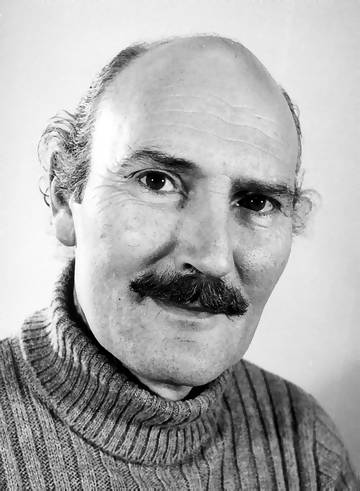 Peter Ducrow When Radio Caroline and Radio Atlanta merged in July 1964, some of the Atlanta DJs resigned rather than work on Caroline South (as
the station was now to be known). This was mainly because Caroline's shows were presented live from the ship whereas Atlanta's had been recorded on land. Some of the Atlanta guys didn't want to work at sea. Some new broadcasters
were needed to take their place and one of these was Peter Ducrow. Like many of the early offshore broadcasters, he was an actor and he appeared in a number of the seminal British TV series of the sixties, including Z Cars,
Doctor Who and Adam Adamant, in which he played the hero's arch-enemy, ‘The Face’ (see IMDB). Margaret Bailey contacted
The Pirate Radio Hall of Fame: “Peter Ducrow was my father-in-law. Ducrow was his stage name. His real name was Peter Bailey. He took the name Ducrow from his famous ancestor, Andrew
Ducrow an equestrian and circus manager. My husband Simon, Peter's son, used to go fishing off Walton Pier as a young lad and would listen to his dad doing a request programme. His dad tried to arrange for him to visit the ship
a couple of times but it was cancelled due to bad weather.” Peter left Caroline in August 1964 to continue his acting career. He didn't abandon radio altogether, appearing on BBC schools broadcasts for over 15 years, taking
part in over 4,000 programmes. Margaret continues “sad to say he died in 1976, aged 59, of a heart attack. He was a very talented character actor on TV, stage and screen - never a big star but always in work. We still miss
him.” (With grateful thanks to Margaret Bailey.)
Peter Ducrow When Radio Caroline and Radio Atlanta merged in July 1964, some of the Atlanta DJs resigned rather than work on Caroline South (as
the station was now to be known). This was mainly because Caroline's shows were presented live from the ship whereas Atlanta's had been recorded on land. Some of the Atlanta guys didn't want to work at sea. Some new broadcasters
were needed to take their place and one of these was Peter Ducrow. Like many of the early offshore broadcasters, he was an actor and he appeared in a number of the seminal British TV series of the sixties, including Z Cars,
Doctor Who and Adam Adamant, in which he played the hero's arch-enemy, ‘The Face’ (see IMDB). Margaret Bailey contacted
The Pirate Radio Hall of Fame: “Peter Ducrow was my father-in-law. Ducrow was his stage name. His real name was Peter Bailey. He took the name Ducrow from his famous ancestor, Andrew
Ducrow an equestrian and circus manager. My husband Simon, Peter's son, used to go fishing off Walton Pier as a young lad and would listen to his dad doing a request programme. His dad tried to arrange for him to visit the ship
a couple of times but it was cancelled due to bad weather.” Peter left Caroline in August 1964 to continue his acting career. He didn't abandon radio altogether, appearing on BBC schools broadcasts for over 15 years, taking
part in over 4,000 programmes. Margaret continues “sad to say he died in 1976, aged 59, of a heart attack. He was a very talented character actor on TV, stage and screen - never a big star but always in work. We still miss
him.” (With grateful thanks to Margaret Bailey.)
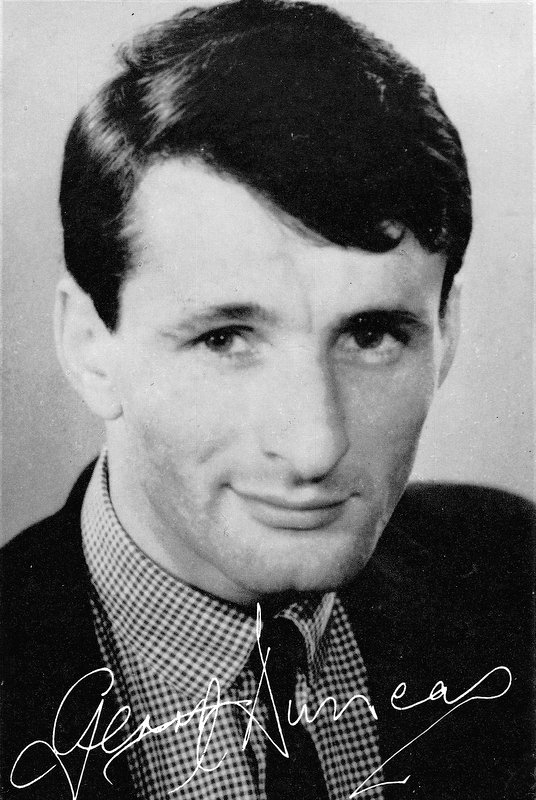 Gerry Duncan was heard occasionally on Radio Caroline during the early days of the station but was mainly employed behind the scenes as a producer, making taped programmes
on land and recording commercials. He was also responsible for Caroline's “sound of the nation” jingle package. Born in 1937 in London, he served in the RAF before finding work as assistant to film director Lewis Gilbert.
Gerry worked on a couple of major films, Light Up The Sky and Sink The Bismark before moving into television in 1960 as a cameraman with ATV. He joined Caroline four years later and stayed until January 1967. He died
during the seventies. (Photo issued by The Caroline Club.)
Gerry Duncan was heard occasionally on Radio Caroline during the early days of the station but was mainly employed behind the scenes as a producer, making taped programmes
on land and recording commercials. He was also responsible for Caroline's “sound of the nation” jingle package. Born in 1937 in London, he served in the RAF before finding work as assistant to film director Lewis Gilbert.
Gerry worked on a couple of major films, Light Up The Sky and Sink The Bismark before moving into television in 1960 as a cameraman with ATV. He joined Caroline four years later and stayed until January 1967. He died
during the seventies. (Photo issued by The Caroline Club.)
Gerry Duncan ending a late night jazz programme on Radio Caroline, 4th July 1964. This clip is taken from a recording made by Terje Isberg in Sweden, shared on www.azanorak.com by
Mike Barraclough. Our thanks to Terje, Mike and Ray Robinson (duration 58 seconds)