In April 1966 a press conference was held in London at which the imminent arrival of two new offshore stations was announced. These two, Radio England and Britain Radio, were to broadcast from the
same ship. “Swinging” Radio England would be a fast-moving Top 40 station; Britain Radio, your “hallmark of quality”, would play sweet music. Both would be staffed by experienced American broadcasting
professionals. Sure enough, the ship arrived, dropped anchor four and a half miles off Frinton, Essex, and on 3rd May test transmissions began.

|
|
|
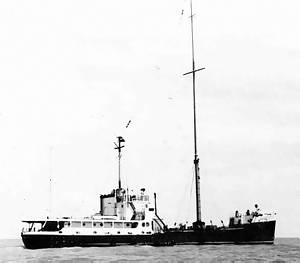
The mv Olga Patricia, also known as the Laissez-Faire.
|
|
|
|
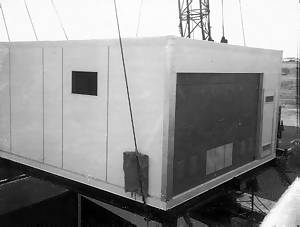
One of the containers, this one containing the transmitters, being loaded into the ship in Miami harbour. Photo from the Don Pierson collection, kindly provided by Grey Pierson.
|
The man behind these two stations was an American car dealer, the former mayor of Eastland Texas, Don Pierson. During 1964 he had launched Radio London but, by the time the station commenced
broadcasting, he had fallen out with some of his fellow directors. Disappointed by the direction Big L was taking, he started putting together a second offshore project, one where he would call the shots. Some
£1,450,000 was raised and work began converting a ship, the Olga Patricia. (Despite being referred to in publicity material as the mv Laissez-Faire, it is believed that the ship's name was not formally changed
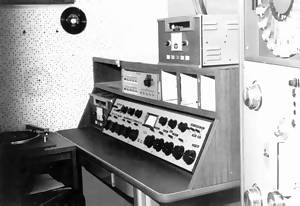
until September 1966. The DJs who worked on her in the early days tend to refer to her by the original name.) Two studios were installed in a prefabricated containerised section, like a Portakabin. The transmitting equipment
was put into another one and both were lowered into the ship's hold. Initially these were not secured so the whole studio would move around in bad weather. The work was carried out as quickly as possible and the ship
left for Europe before any disc-jockey sleeping accommodation could be built. Cabins were constructed later but during the early days the broadcasters had to make do with sleeping bags on the floor of the ship's
hold.
Although the accommodation was basic, the studios were well-equipped and even boasted an automated programme unit. This device could run a station on its own, complete with time-checks and commercials, without the
need for a human presenter. It played pre-recorded music on reels of tape with spoken links, commercials and jingles inserted from tape cartridges. Used mainly for overnights on Britain Radio (the programmes of
imaginary DJ “Derek Burroughs”), it was also useful during bad weather.
|
|
|
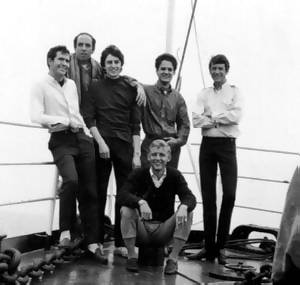
Some of the original DJ team. Left to right: Larry Dean, Brian Tylney, Roger Day, Ron O'Quinn and Graham Gill with Jerry Smithwick at the front.
|
A company called Peir Vick Ltd. was set up to run the two stations, headed by Managing Director Bill Vick. They took over luxurious offices at 32 Curzon Street, just over the road from Radio
London. Radio Vision Broadcasts International, part of the well established cinema advertising firm Pearl and Dean, was contracted to look after the selling of airtime. In early May test transmission began for
Britain Radio on 227 metres and “Swinging” Radio England on 355 metres.
 Larry Dean testing for Swinging Radio England in May 1966, playing MUCH MORE MUSIC! (duration 5 minutes 20 seconds)
Jerry Smithwick testing for Britain Radio, with the help of the automated playout system on 12th May 1966. Jerry's is the voice doing the station announcements, time checks, etc. The voice introducing the music
is on tape. These two recordings are courtesy of The Offshore Radio Archive (duration 2 minutes 29 seconds)
Each of the two stations used a 50 kilowatt Continental Electronics transmitter fed into the 160 ft. aerial mast. The publicity material claimed that they were “the world's most powerful
offshore radio station”. On 3rd June Peir Vick received a complaint that the Radio England programmes on 355 metres were causing interference to the Italian station Roma II. The two stations swapped wavelengths.
Britain Radio, now using the offending frequency, reduced its power at night to alleviate the interference.
|
|
|
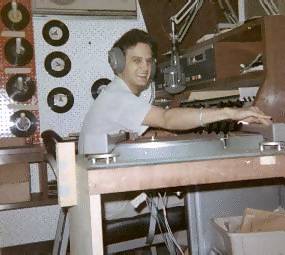
Ron on the radio. Photo kindly provided by Ron O'Quinn.
|
The first programme controller, Ron O'Quinn, remembers: “Both stations were operating over full power - in essence about 55,000 watts,
however the 355 that SRE was on at the time was causing interference with Roma ll so Joe Sanatone (not sure of the spelling of his surname), the Continental Electronics field engineer, said that we should probably
change frequency to 1322 kilocycles, or 227 meters, which would according to Joe be ‘a much better match for the antenna height’ and he also recommended that the night time power on 355 be lowered. We had
so much antenna current resistance that we rarely were able to run both stations at full power but this was kept secret. Our standing wave ratio was extremely high and we were losing effective radiated power in the
antenna. If the seas were fairly calm we could push both transmitters so that they were operating close to maximum. Radio England had the poorer frequency (after the switch) so it was always given the higher operating
power to attempt to make up the difference.”
Johnnie Walker making a rare appearance on Britain Radio during a test transmission on the new wavelength of 355 metres, 11th June 1966. Tape kindly donated by Hans Knot (duration 2 minutes 10 seconds)
|
|
|
From a sheet of Radio England notepaper, kindly donated by Colin Nicol. The words at the bottom proclaim it the “world's most powerful”.
|
Swinging Radio England and Britain Radio were launched in a blaze of publicity. A star-studded party was held at the Park Lane Hilton Hotel. This event very nearly developed into a riot when
hundreds of members of the public turned up. They had heard some ambiguously worded promotions on Radio England and thought they had been invited to the party too. There was also a dispute over the bill. It was not
settled until a court order was enforced some six years later.
Swinging Radio England was everything you would expect from an American Top 40 station, very fast, very slick with lots of jingles - quite unlike anything heard in Britain before. It utilised a format known as “Boss
Radio”. The original Boss Radio had been launched by Bill Drake at KHJ Los Angeles the previous year. However the Radio England version was different. Ron O'Quinn: “Boss Radio was a KHJ
first but the (Radio England) format was not a Drake-Chenault (KHJ's operators) format nor was it a KLIF format. (KLIF Dallas had been the model for Radio London). I had only heard KHJ a couple of times and KLIF only
once when I went to England. The format was a hybrid mixture of WFUN, WLCY, WPTR and my imagination. Would I do it differently now?..........OF COURSE!”
The initial team of disc-jockeys, or “boss jocks”, was made up of Americans Ron O'Quinn, Rick Randall, Jerry Smithwick and
Larry Dean, Australians Colin Nicol and Graham Gill and, from Britain, Johnnie Walker,
Roger Day and Brian Tylney. None of the British contingent had any previous broadcasting experience.
By contrast to the brash Radio England, Britain Radio was very relaxed. Also unique in the UK, this station offered personality presenters playing middle-of-the-road music. Both featured news bulletins. The news was
culled initially from a news agency teleprinter on the ship. Unfortunately, as Phil Martin recalls below, the stations' own high powered output caused interference to the teleprinter's reception.
To make Radio England sound more exciting, Ron O'Quinn fitted the reverb unit from a Hammond organ to add echo to the DJ's voices and played the records slightly faster than 45 rpm. Writing in Facebook in 2020 he said:
“we adapted the Hammond organ reverb unit to operate constantly in the background and also installed attenuator buttons on the board to activate MEDIUM - HEAVY -and SPOOKY reverb for emphasis.... I
speeded up the turntables a few rpm (47-48 rpm for singles) so that in a given period of time we actually did play ‘much more music’.... After we got on the air I adjusted the signal processor/compressor of Swinging
Radio England (not Britain Radio) to PUMP the audio up. This makes it mandatory that the board work be very tight! If there is any dead air the processor will also pump up any ambient signal noise. I adjusted the processor to
clip negative modulation at 100% and boosted positive modulation to 130%. This made the Radio England signal much louder than London and Caroline.”
The first DJ to be hired was Rick Randall:
|
|
|
One of the two virtually identical studios. A photo published by the Free Radio Association and kindly provided by George Morris.
|
“It was a unique opportunity for me to become the first DJ, or what I now understand in the UK is called a ‘presenter’, on Radio England and Britain
Radio. Don Pierson had hired me over the telephone while I was on the radio in Montana, asking me to join up with him in Miami, Florida - nearly 3 thousand miles away - which I did immediately. This occurred while
our ship, which was still called the Olga Patricia at the time, was being outfitted with transmitters and studios and being prepared for its voyage across the Atlantic. I spent 3 weeks there, where I also met Ron
O'Quinn when he also joined our staff. Ron hired the rest of the DJs, while I remained on the ship with Jerry Smithwick as we headed away from the Florida coastline on its historic journey. It would be my guess that
he and I may be the only two pirate DJs to actually cross an ocean on board such a vessel. I believe it has been well documented that we lost our antenna when we encountered rough seas, forcing us to take a detour
to Lisbon, Portugal for repairs. After a delay there, we finally headed north toward England where Ron and Larry Dean, a.k.a. Frank Laseter, joined up with us, along with the rest of the blokes who made up the
original staffs of the 2 stations.
|
|
|
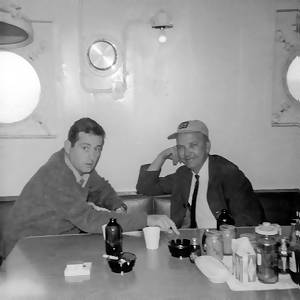
Captain Julio Alonzo (left) and Don Pierson on board the Olga Patricia. Photo from the Don Pierson collection, kindly provided by Grey Pierson.
|
One of my first memories in the North Sea, was the realization that pirates had no qualms about not only stealing the airwaves over populated countries, but also stealing
from each other as well. It was an enormous surprise to me, just days after we began broadcasting with our Swinging Radio England jingles, to hear the same jingles on Radio London with ‘Big L’ spliced over
our name. From then on I understood that there were no rules out there in the English Channel, though for the most part I believe such tactics were generally harmless, and indeed the source of quite a few jokes.
Besides the radio stations' crew, there was of course the ship's crew that maintained the vessel, kept us fed, and made sure we were safe at all times. Captain Julio Alonzo was a true gentleman of the high seas who
would invite guests into his cabin on rare special occasion to enjoy a sip of cognac. Don Pierson told me once that Captain Julio had originally come from Cuba where he had been a pilot in that country's air force
before Fidel Castro came to power. About the time of the Cuban Revolution, he defected to the United States by stealing what I believe Don said was a Cuban Air Force plane and flying to Florida. Seems he was somewhat
of a pirate himself and certainly a memorable friend to everyone on board.
One of the stories I have told before revolves around the original studios that Mr. Pierson had set up on board the ship, which were designed to operate from an automated tape system. I was fairly new in radio at that
time and was not quite sure how such an arrangement would work. When Ron O'Quinn came on board, he immediately did not like the idea of working in a studio set up in this manner and urged that we instead install
turntables and a manual operating console in a traditional studio design, which in fact is what we wound up doing. When the seas were rough however, this proved to be somewhat of a problem, which I would guess was also
true on some of the other pirate ships. We often had to weigh down the pick-up arms on the turntables, just to keep the needle from lifting out of the grooves of the records when the ship was rocking back and forth.
To do this, we often used some of those monstrously large English (old) pennies, sometimes stacking up two or three of them at a time. It didn't always work however and sometimes the needle would literally fly off the
records, which of course tended to mess up the songs that were playing at the time. Once when the water was especially rough, I remember being tossed around so much I was literally thrown out of the chair that we used
in the studio. In the years since those experiences, I have seen many radio stations employ the use of tape devices, instead of record (or ‘disc’) playing machines and have often wondered if perhaps we would
not have been better off using Don's original studio design, instead of re-wiring everything to suit our personal tastes.
|
|
|
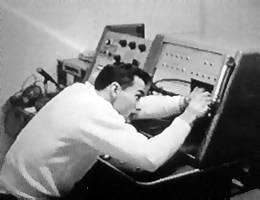
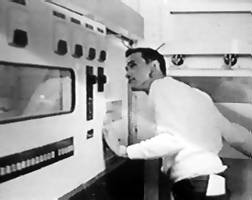
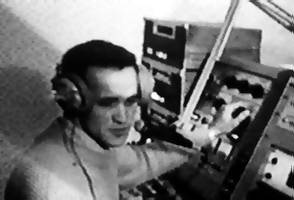
Three shots taken from a television report about Swinging Radio England. Left to right: Rick Randall wiring
up the studio, Rick in the transmitter room and possibly Rick on the air, although engineer Patrick Starling thinks this photo might be of him. Many thanks to Rick for providing these
screen-grabs.
|
While I was the first to join Radio England and our sister station, I was also the first to leave, returning to America toward the end of the summer of 1966 to make a fresh start
at completing my college education, something that had been interrupted in previous years by my military enlistment. In the years that followed, I worked in radio stations in a half dozen states, eventually settling
in Florida, where I am now involved in operations with a national broadcast, satellite and cable television network. I often wondered what ever had happened to our stations in England and how they had met their demise, as
well as all of the other pirates who were challenging the established radio programming of that era. It was quite astonishing only just a few years ago to learn, primarily through the internet, that the pirate tradition
has somehow managed to survive and remain a part of the history of broadcasting in the UK, as well as in Europe. As the original Radio England and Britain Radio presenters prepare for a reunion this year to remember our
brief invasion there 40 years ago, we share a vivid recollection of an experience like none other in our varied and diverse careers. There has never been anything like that episode in American broadcast history, and it
is a safe bet, there never will.”
Ron O'Quinn, comments: “Rick Randall states that I did not like the studio arrangement. He's right. It was totally unworkable. I did indeed tape one penny on each arm because it kept
the arm tracking better in really rough seas. The only time that I ever heard of a stylus jumping off the record was when the tender was along side and bumping into the ship.” Regarding the Carousel, he
says: “Don wanted SRE to be live and anyone who was ever around a Carousel machine knows that it is one hell of a loud mother and would make talking on live mic impossible. Also, where would
the current music for the tapes come from? All of the automated tapes with cue tones came from Bellingham, Washington, USA and their library did not encompass current records, much less current British records.”
As Rick mentioned, within days of going on air, Radio England's jingle package had been ‘pirated’ by Radio London (and Radio Caroline). So a second package was commissioned, based on the cult TV programme
Batman. The lyrics actually said “that man” to avoid any copyright difficulties:
A selection of Swinging Radio England's “that man” jingles kindly provided by Frank George (duration 2 minutes 4 seconds)
|
|
|
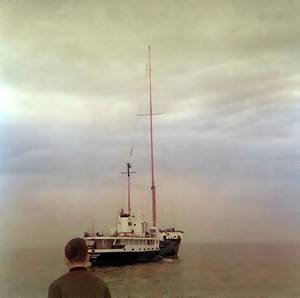
The Olga Patricia at sea in 1966. Photo from the Don Pierson collection, kindly provided by Grey Pierson.
|
Next up to reminisce, it is the turn of Britain Radio's Phil Martin. He joined the ship during the test broadcasts and was there when the station officially opened for
business on 19th June 1966:
“I was going to give it just three weeks. In the end I think I stayed on and off the Olga Patricia (Laissez-Faire) longer than any of the other DJ originals. I can't be precise, as I kept
no diary, but all in all I think it was about a year. An amazing year of sounds, memories, colour and fun. For me it started quite by chance at the flat I shared with two guys called Ray Williams and Simon Hayes in
Bruton Place, in a remarkably pleasant corner of Mayfair just of Berkeley Square in London's West End. I was working at Lintas, the advertising agency owned by Unilever, as a go-fer. It was my first job after university.
Simon ran a pop PR agency called Ace Public Relations and he and his business (it seemed to me then) were at the absolute epicentre of the Swinging Sixties scene in London at the time. Giants of the pop scene were
forever calling in to Bruton Place. I could scarcely believe the whole thing and my luck at being there. One day, as I returned from a dull session at Unilever, Simon said to me: ‘Come and meet Ron O'Quinn
(* see below). He's over from the States to start a pirate station that'll be even better than Big L.’ ‘You've got a pleasant voice’ Ron said to me in his deep toffee drawl. ‘How would you like to
be a disc jockey?’ ‘Never thought about it’ I replied ‘ but why not?’
|
|
|
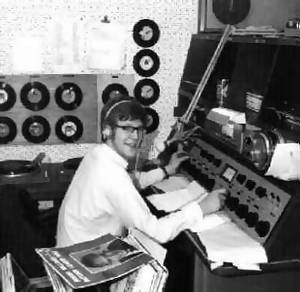
Phil Martin on the air. Photo courtesy of Look Boden.
|
I put in for some holiday leave and never went back to the world of soap flakes and Vesta Instant Curry. (Not until after the Marine Offences Act when Unilever had inexplicably
lost interest in me.) From the start it was a giant laugh. My responsibility, for a while anyway, was Britain Radio, a strange mixture of requests and Ray Conniff and Kay Starr and Procol Harum. No playlist, little
experience ... but masses of enthusiasm. And somehow it seemed to strike a chord with a fair few listeners, but sadly not enough A-list advertisers. We were new, we had a pretty good frequency (355 metres) and signal. But,
looking back on it, honestly we were a bit of a mess. The Hallmark of Quality? Erm, I think not. We did have one ‘plus’ over our competitors along side us, Radio Caroline and Radio London. We had a teleprinter
which was supposed to bring us the news from the wire services. Sadly, affected by our transmitters, it generated only gobbledygook most of time. So it was back to the old tried and tested method of nicking the news from the
Beeb. However, in those days of the Home Service and the Light Programme, there were hours of no news. Only Workers Playtime and A Story, A Hymn And A Prayer and similar fodder. So one Sunday, I am ashamed
to admit, I decided to liven things up a little and slipped into the 3pm bulletin: ‘We are getting reports of a jail break in Texas with many dangerous criminals on the loose. More details when we get them’.
Later I heard the same story on the news from one of our competitors. I wonder where they got it from!
Forty years on, it all seems a bit of a dream. An extraordinary mix of laughter and boredom. Of sea sickness (on the tender journeys from Felixstowe) and elation. Of doing something new and exciting. Listening to some of
those old tapes today, I feel ashamed at how grim (and foolishly posh) I sounded. At how amateur we all were. But I learned so much in that year of '66. Made many friends and met many fine people. I am glad I was asked
to become a pirate. I regret not a day of it.”
* Phil originally wrote that it was Rick Randall who asked him to become a DJ. Over forty years one's memory can sometimes fail and he now thinks it was Ron O'Quinn, not Rick, who made the initial offer. He has asked
us to amend the above.
|
