|
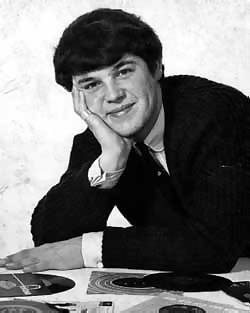 Allen Ives was part of Radio 270's original DJ team but, unfortunately, he never got to present a single show on the station. Back in 1966, aged 18, he
was working on a newspaper by day while DJ-ing at night in a London discotheque, Tiffanys in Shaftesbury Avenue. He was signed to an agency called Commentators Limited. The company was approached by Don
Robinson, the man behind Radio 270, and Roger Gale, the station's first Programme Controller. They were looking for potential broadcasters. Allen was auditioned and soon found
himself on board the Oceaan 7, waiting for the big day. The station intended to commence broadcasting on 1st April 1966 but this was delayed, first by the non-arrival of some technical equipment from the
USA, and then, rather more seriously, by the collapse of the aerial mast in a gale. The ship returned to harbour and Allen went home to Romford, Essex, with his colleague Bob Dewing. Radio 270 eventually
made it onto the air, two months later, but without Allen. He says: “Radio 270 cured me of broadcasting. Afterwards I did all sorts of things and ended up running a typesetting and graphic design
company.” (Many thanks to Allen for getting in touch and sharing his story, and for the photo.)
Allen Ives was part of Radio 270's original DJ team but, unfortunately, he never got to present a single show on the station. Back in 1966, aged 18, he
was working on a newspaper by day while DJ-ing at night in a London discotheque, Tiffanys in Shaftesbury Avenue. He was signed to an agency called Commentators Limited. The company was approached by Don
Robinson, the man behind Radio 270, and Roger Gale, the station's first Programme Controller. They were looking for potential broadcasters. Allen was auditioned and soon found
himself on board the Oceaan 7, waiting for the big day. The station intended to commence broadcasting on 1st April 1966 but this was delayed, first by the non-arrival of some technical equipment from the
USA, and then, rather more seriously, by the collapse of the aerial mast in a gale. The ship returned to harbour and Allen went home to Romford, Essex, with his colleague Bob Dewing. Radio 270 eventually
made it onto the air, two months later, but without Allen. He says: “Radio 270 cured me of broadcasting. Afterwards I did all sorts of things and ended up running a typesetting and graphic design
company.” (Many thanks to Allen for getting in touch and sharing his story, and for the photo.)
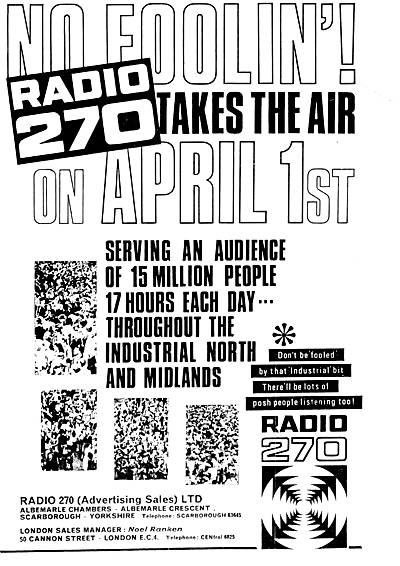
Thanks to Hans Knot for this press advert for the launch of Radio 270.
Unfortunately, due to the reasons mentioned above, the station did not start broadcasting until some weeks after the announced 1st April 1966.
Colin J In the early days of Radio City life on the fort was fairly basic and resources were limited so, when a tender arrived from land bringing fresh
supplies, everybody was needed to pitch in and help unload - including the on-air DJ. To fill the air-time while the presenter was away from the studio, the station would play out ‘tender tapes’.
These were short pre-recorded programmes, made on land by enthusiastic amateurs. Colin J was one of them. He provided three or four of these ‘tender tapes’ at the end of 1964/beginning of 1965. He
tells us that they were well received and he was offered a full-time job with the station but he turned it down as he didn't want to give up an apprenticeship.
 Clips from two off-air recordings, made by Colin's friend Richard Norman at his home in Peckham, south London. There is the end of Colin's first show on air, from 1st December 1964, followed by Radio City
DJ Chris Cross introducing another one from the following month. Thanks to Colin and Richard for the recordings (duration 2 minutes)
Clips from two off-air recordings, made by Colin's friend Richard Norman at his home in Peckham, south London. There is the end of Colin's first show on air, from 1st December 1964, followed by Radio City
DJ Chris Cross introducing another one from the following month. Thanks to Colin and Richard for the recordings (duration 2 minutes)
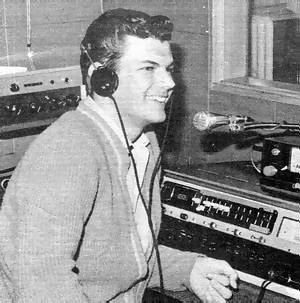
 Johnny Jackson and Bob Scott When Radio Atlanta launched in May 1964 most of its programmes were pre-recorded in studios
on land but somebody had to sit on the ship and play out the tapes. That job was shared by this Texan father and son team (real names Johnny and John Thompson). As well as keeping the pre-recorded shows running,
they also presented some live programmes themselves. Bob's theme tune was Little Brown Jug by Bobby Summers. The father, Bob Scott, in particular, had a taste for corny maritime-related slogans like:
“Radio Atlanta - where our only cargo is music,” “the ship that rocks the ocean” and “the music queen of the seven seas.” They were both good professional broadcasters and,
being live, often sounded more spontaneous than their colleagues on the pre-recorded shows. Unfortunately their southern American accents were thought unsuitable and they only stayed on the ship for the first
month. We asked if anyone could provide more information about them. In December 2006 The Pirate Radio Hall of Fame heard from Johnny Jackson himself. He wrote: “My
mother is from England and all of my family on her side are still there. In '64 we were in England to see my granddad as he was very ill. In fact he passed away while we were there. We had noticed a story in one of
the papers about the pirate ships, called out of curiosity and, believe it or not, (Managing Director) Allan Crawford answered the phone and invited us to London to discuss his ventures. We went up on a Saturday
afternoon and were the only people in the office in Soho. The Texas connection didn't hurt as Gordon McLendon (of KLIF, Dallas) had sent over one of his engineers to help get Atlanta on the air. His name was Milan
Leggett (I think that is the correct spelling). As it turned out Allan offered us jobs. The frequency crystal for the transmitter was being flown over about that time. We met Allan Crawford at a little English
village on the coast, where the liaison ship would leave from to service the Mi Amigo, one night for dinner. He was worried about getting the frequency crystal through customs. He handed it to me and asked if I had any
ideas. Jokingly I said I could just pop it down my pants. As it turned out that's the way we got the crystal on board. No one bothered to check as we told the Customs officials we were going on board as advisors, which
is why different names were used on the air. I was 17 and probably had the shakiest voice on radio. We did the test transmissions with only a handful of records on board. Most were cover versions of current hits that
Allan had from his record company. We didn't think anyone would be listening as we were only on the air a few hours a night. It was an exciting time and, you're right, my Dad did have some corny slogans. As it
turned out millions were listening. I always felt Atlanta should have been the radio leader of all the pirate stations as it had a beautiful signal but it was programmed along the lines of the BBC with block programming.
I said to Allan it should be a ‘Top 40 or Straight-up Rock and Roll 24 Hour Powerhouse’ but he probably felt the advertisers wouldn't go for it at that time. I believe Allan had the intention of me doing an
‘American Hits on Atlanta’ show. He was a very forward thinking gentleman and in the back of his mind was probably thinking of being able to offer cover versions of the American hits from his record company,
although he never mentioned that part.” Bob Scott died in 1997. Our thanks to Johnny for getting in touch. (The photos of Johnny, left, and Bob, right, are from press cuttings kindly supplied by Johnny.
You can find them here. Our grateful thanks to him, Colin Nicol and Mary Payne, and to Paul Graham for the theme tune information.)
Johnny Jackson and Bob Scott When Radio Atlanta launched in May 1964 most of its programmes were pre-recorded in studios
on land but somebody had to sit on the ship and play out the tapes. That job was shared by this Texan father and son team (real names Johnny and John Thompson). As well as keeping the pre-recorded shows running,
they also presented some live programmes themselves. Bob's theme tune was Little Brown Jug by Bobby Summers. The father, Bob Scott, in particular, had a taste for corny maritime-related slogans like:
“Radio Atlanta - where our only cargo is music,” “the ship that rocks the ocean” and “the music queen of the seven seas.” They were both good professional broadcasters and,
being live, often sounded more spontaneous than their colleagues on the pre-recorded shows. Unfortunately their southern American accents were thought unsuitable and they only stayed on the ship for the first
month. We asked if anyone could provide more information about them. In December 2006 The Pirate Radio Hall of Fame heard from Johnny Jackson himself. He wrote: “My
mother is from England and all of my family on her side are still there. In '64 we were in England to see my granddad as he was very ill. In fact he passed away while we were there. We had noticed a story in one of
the papers about the pirate ships, called out of curiosity and, believe it or not, (Managing Director) Allan Crawford answered the phone and invited us to London to discuss his ventures. We went up on a Saturday
afternoon and were the only people in the office in Soho. The Texas connection didn't hurt as Gordon McLendon (of KLIF, Dallas) had sent over one of his engineers to help get Atlanta on the air. His name was Milan
Leggett (I think that is the correct spelling). As it turned out Allan offered us jobs. The frequency crystal for the transmitter was being flown over about that time. We met Allan Crawford at a little English
village on the coast, where the liaison ship would leave from to service the Mi Amigo, one night for dinner. He was worried about getting the frequency crystal through customs. He handed it to me and asked if I had any
ideas. Jokingly I said I could just pop it down my pants. As it turned out that's the way we got the crystal on board. No one bothered to check as we told the Customs officials we were going on board as advisors, which
is why different names were used on the air. I was 17 and probably had the shakiest voice on radio. We did the test transmissions with only a handful of records on board. Most were cover versions of current hits that
Allan had from his record company. We didn't think anyone would be listening as we were only on the air a few hours a night. It was an exciting time and, you're right, my Dad did have some corny slogans. As it
turned out millions were listening. I always felt Atlanta should have been the radio leader of all the pirate stations as it had a beautiful signal but it was programmed along the lines of the BBC with block programming.
I said to Allan it should be a ‘Top 40 or Straight-up Rock and Roll 24 Hour Powerhouse’ but he probably felt the advertisers wouldn't go for it at that time. I believe Allan had the intention of me doing an
‘American Hits on Atlanta’ show. He was a very forward thinking gentleman and in the back of his mind was probably thinking of being able to offer cover versions of the American hits from his record company,
although he never mentioned that part.” Bob Scott died in 1997. Our thanks to Johnny for getting in touch. (The photos of Johnny, left, and Bob, right, are from press cuttings kindly supplied by Johnny.
You can find them here. Our grateful thanks to him, Colin Nicol and Mary Payne, and to Paul Graham for the theme tune information.)
Johnny Jackson on Radio Atlanta from 18th May 1964 (duration 2 minutes 51 seconds)
“Mrs.Scott's little fat boy Bob” on Radio Atlanta from the evening of 18th May 1964. Both recordings shared by Hans Hendriks on The Offshore Radio Club
Forum. Our thanks to him (duration 4 minutes 25 seconds)
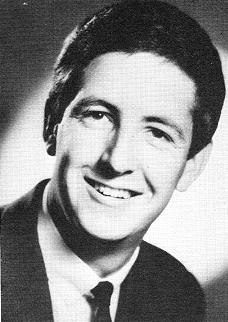 Peter James Born on 18th November 1941 in Masterton, New Zealand, he was educated at St.Paul's College in Auckland. Peter's first job was as a trainee announcer on Radio 2ZC,
Hawkes Bay. After working for the New Zealand Broadcasting Corporation for four years, he set sail for the UK. Within weeks of arriving, in January 1965, he was back at sea on Radio Caroline South where his theme tune was
Hawaiian War Chant by Charles Blackwell & his Orchestra (see video). His stay with Caroline was short but in September 1965 he returned to the air as an integral
part of Radio 390's first team of announcers. He was soon appointed Senior Presenter and, when he became Programme Controller the following year, he left the fort to work for the station on land. When 390 closed down, he worked briefly
as an announcer for Rediffusion Television before joining the BBC as a producer. He was with London's Capital Radio from its start in 1973 and, for a time, presented a classical music show. He was also Head Of Music. From Capital, he
returned to the BBC as Head of the Transcription Service, making programmes to sell overseas. In 1993 he moved to Australia to run ABC Classic FM. He left in 2000 following ill health and The Pirate Radio Hall
of Fame wishes him a long and happy retirement. There is another picture of Peter in Colin Nicol's photo album, a couple here and a short video of Peter on Radio 390
here. There is also an interview with him here. (Photo from ‘Who's Who In Pop Radio’, published by The New English Library. Many thanks to Peter for his help with
the above.)
Peter James Born on 18th November 1941 in Masterton, New Zealand, he was educated at St.Paul's College in Auckland. Peter's first job was as a trainee announcer on Radio 2ZC,
Hawkes Bay. After working for the New Zealand Broadcasting Corporation for four years, he set sail for the UK. Within weeks of arriving, in January 1965, he was back at sea on Radio Caroline South where his theme tune was
Hawaiian War Chant by Charles Blackwell & his Orchestra (see video). His stay with Caroline was short but in September 1965 he returned to the air as an integral
part of Radio 390's first team of announcers. He was soon appointed Senior Presenter and, when he became Programme Controller the following year, he left the fort to work for the station on land. When 390 closed down, he worked briefly
as an announcer for Rediffusion Television before joining the BBC as a producer. He was with London's Capital Radio from its start in 1973 and, for a time, presented a classical music show. He was also Head Of Music. From Capital, he
returned to the BBC as Head of the Transcription Service, making programmes to sell overseas. In 1993 he moved to Australia to run ABC Classic FM. He left in 2000 following ill health and The Pirate Radio Hall
of Fame wishes him a long and happy retirement. There is another picture of Peter in Colin Nicol's photo album, a couple here and a short video of Peter on Radio 390
here. There is also an interview with him here. (Photo from ‘Who's Who In Pop Radio’, published by The New English Library. Many thanks to Peter for his help with
the above.)
A short clip of Peter James on Radio Caroline South in early 1965. The voice at the start is Keith Skues. Many thanks to Harm Koenders of The Offshore Radio Archive for this recording
(duration 1 minute 16 seconds)
Peter James on Radio 390's request show, From Me To You, from March 1966. Recording kindly provided by Jonathan Shirley (duration 3 minutes 38 seconds)

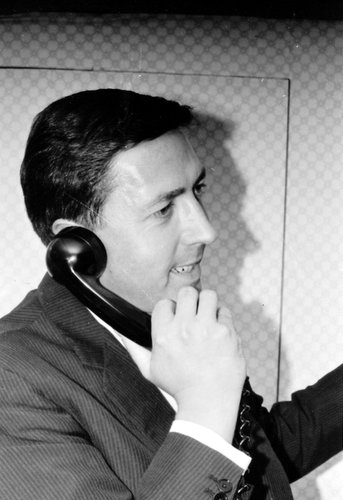 Peter Jameson was the Managing Director of RaCity Sales, the company responsible for selling Radio City's airtime, but as well as flogging advertising for the station
he also found time to present the weekly Basildon Request Show. This was sponsored by the Essex town's newspaper, the Basildon Recorder, in partnership with various other local businesses who each paid for individual
segments of the show. Radio City attempted a number of other localised request programmes focussing on Southend, Ashford, St.Albans and south-east London but the Basildon show was the only one to be successful and last any
length of time. Bob LeRoi's website (archived here) reveals that Go-Go-Po-Go by Percy Faith & his Orchestra was the programme's theme tune. Following the end of his time with Radio City, Peter continued to be a disc jockey but also worked in advertising, wrote
novels, ran a restaurant and, for a time, a castle in Scotland. He died in January 2015. His son Philip has kindly passed on a few items of memorabilia from his father's offshore career which can be found
here. (We are grateful to Philip for his help. This photo was issued by Radio City for promotional purposes and kindly provided by Mike Lewis. More of Mike's collection
here.)
Peter Jameson was the Managing Director of RaCity Sales, the company responsible for selling Radio City's airtime, but as well as flogging advertising for the station
he also found time to present the weekly Basildon Request Show. This was sponsored by the Essex town's newspaper, the Basildon Recorder, in partnership with various other local businesses who each paid for individual
segments of the show. Radio City attempted a number of other localised request programmes focussing on Southend, Ashford, St.Albans and south-east London but the Basildon show was the only one to be successful and last any
length of time. Bob LeRoi's website (archived here) reveals that Go-Go-Po-Go by Percy Faith & his Orchestra was the programme's theme tune. Following the end of his time with Radio City, Peter continued to be a disc jockey but also worked in advertising, wrote
novels, ran a restaurant and, for a time, a castle in Scotland. He died in January 2015. His son Philip has kindly passed on a few items of memorabilia from his father's offshore career which can be found
here. (We are grateful to Philip for his help. This photo was issued by Radio City for promotional purposes and kindly provided by Mike Lewis. More of Mike's collection
here.)
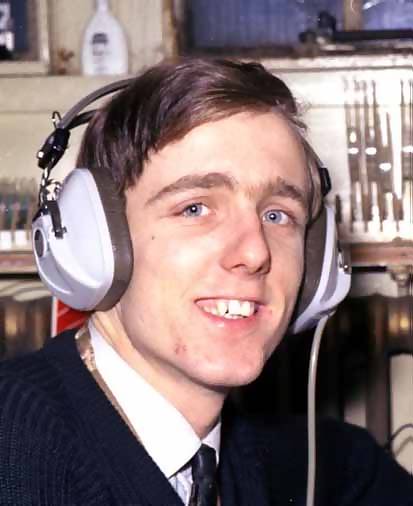 Eric Jay Real name Eric Johnson, he was born in 1946. As a teenager, living in Gravesend, he was a regular listener to Radio City. He remembers: “There
were often reference in programmes to the record shop in Whitstable High Street. I decided to visit it one day and got into conversation with the man there. I cannot remember his name. (Web-master's note: it was
Eric K Martin). Somehow it was agreed for me to go out on Radio City. This I did via the supply boat one night.” Eric, who was 19 at the time, made just two trips out to the Shivering Sands Fort. He cannot
remember exactly but thinks he worked for the station for around a month. Eric continues: My job, before and after, was in photographic processing and printing. This explains why I happened, luckily, to have a
decent camera with me.” Some of Eric's fantastic colour pictures are in the DJs' photo album. After his time at sea Eric returned to photography then turned his attention to radio
and television sales and service. He says “Nowadays I prefer to play around with computers and keep my two boys interested in all things computerwise.” (Many thanks to Eric for all his help and for
letting us publish his amazing photo collection.)
Eric Jay Real name Eric Johnson, he was born in 1946. As a teenager, living in Gravesend, he was a regular listener to Radio City. He remembers: “There
were often reference in programmes to the record shop in Whitstable High Street. I decided to visit it one day and got into conversation with the man there. I cannot remember his name. (Web-master's note: it was
Eric K Martin). Somehow it was agreed for me to go out on Radio City. This I did via the supply boat one night.” Eric, who was 19 at the time, made just two trips out to the Shivering Sands Fort. He cannot
remember exactly but thinks he worked for the station for around a month. Eric continues: My job, before and after, was in photographic processing and printing. This explains why I happened, luckily, to have a
decent camera with me.” Some of Eric's fantastic colour pictures are in the DJs' photo album. After his time at sea Eric returned to photography then turned his attention to radio
and television sales and service. He says “Nowadays I prefer to play around with computers and keep my two boys interested in all things computerwise.” (Many thanks to Eric for all his help and for
letting us publish his amazing photo collection.)
 Phil Jay Like a number of pirate disc-jockeys, Phil got his training in the art of broadcasting courtesy of H.M.Government, while serving a three year short service
commission in the RAF. Stationed on the island of Cyprus, Phil got his break on the British Forces station there and Cyprus TV. He was also personal assistant to the legendary music business manager Larry Parnes and,
for a while, looked after Billy Fury on the road, as well as several of the other stars in his stable (Dickie Pride, Duffy Power, Vince Eager, etc.) He also worked as a compère on rock'n'roll package tours and
did a summer season at Great Yarmouth. After that he says: “I worked for a man called Bill Channell who used to run a huge number of weekly discos around the country - Swindon, Walthamstow, Dunstable, Orpington
etc. Bearing in mind my (broadcasting) experiences in the RAF, Bill said ‘why don't we try for a spot on Radio City?’ At City's suggestion I recorded a live programme at Orpington and it was accepted.”
Phil joined Radio City in April 1965. This station had a rapid turn-over of staff but he became one of the permanent fixtures. Like Ed Moreno, he recorded his show on land. He says:
“I worked as a sound balancer and sometime voice at Granville TV in Fulham (the old Granville Theatre) and the chief sound engineer put two decks in the control room for me.” Phil recorded his Discamania
shows there and, although the programme's transmission times varied, it remained a regular part of the schedule until Radio City closed down in early 1967. He told us: “I did visit the fort only once. I think most
of the guys thought I was making a fortune out of my Radio City show but alas no! (After the closedown) I did work for Radio Luxembourg, CBS Radio, World Service etc. During the launch of Radio One I was in hospital with a
virus that took six months to clear. I then joined One doing the Saturday afternoon show, Roundtable and millions of Radio One Clubs. I also became very involved with World Service and used to alternate
on Listener's Choice with a man named Terry Wogan. I also presented the Morning Show, a mix of heavy interviews and pop music. I got a bit fed up with just playing music on Radio One and eventually left. I
worked for Thames TV as an announcer, did many voice-overs and joined LBC from day 1 minus ten. I was the first person, quite by chance, to host a British commercial radio phone-in. In 1978 I started sending regular weekly
shows to the Arabian Gulf. Over 30 years and I have made more than 5,000 programmes. I still enjoy doing the shows just as much as ever and, of course, going off around the country doing interviews for them. I now have
a partner, Pam. I've taught her to interview and she now provides a weekly slot on my In All Directions show. London Line is just me. Pam and I also sing. We go around the country performing our act, songs
from the war years and old time music hall.” There is a newspaper article about Phil here. (Many thanks to
Phil for his assistance. Photo from ‘Who's Who In Pop Radio’, published by The New English Library. There is a more recent photo of Phil, taken at the August 2002 DJ reunion, on the
Radio London website.)
Phil Jay Like a number of pirate disc-jockeys, Phil got his training in the art of broadcasting courtesy of H.M.Government, while serving a three year short service
commission in the RAF. Stationed on the island of Cyprus, Phil got his break on the British Forces station there and Cyprus TV. He was also personal assistant to the legendary music business manager Larry Parnes and,
for a while, looked after Billy Fury on the road, as well as several of the other stars in his stable (Dickie Pride, Duffy Power, Vince Eager, etc.) He also worked as a compère on rock'n'roll package tours and
did a summer season at Great Yarmouth. After that he says: “I worked for a man called Bill Channell who used to run a huge number of weekly discos around the country - Swindon, Walthamstow, Dunstable, Orpington
etc. Bearing in mind my (broadcasting) experiences in the RAF, Bill said ‘why don't we try for a spot on Radio City?’ At City's suggestion I recorded a live programme at Orpington and it was accepted.”
Phil joined Radio City in April 1965. This station had a rapid turn-over of staff but he became one of the permanent fixtures. Like Ed Moreno, he recorded his show on land. He says:
“I worked as a sound balancer and sometime voice at Granville TV in Fulham (the old Granville Theatre) and the chief sound engineer put two decks in the control room for me.” Phil recorded his Discamania
shows there and, although the programme's transmission times varied, it remained a regular part of the schedule until Radio City closed down in early 1967. He told us: “I did visit the fort only once. I think most
of the guys thought I was making a fortune out of my Radio City show but alas no! (After the closedown) I did work for Radio Luxembourg, CBS Radio, World Service etc. During the launch of Radio One I was in hospital with a
virus that took six months to clear. I then joined One doing the Saturday afternoon show, Roundtable and millions of Radio One Clubs. I also became very involved with World Service and used to alternate
on Listener's Choice with a man named Terry Wogan. I also presented the Morning Show, a mix of heavy interviews and pop music. I got a bit fed up with just playing music on Radio One and eventually left. I
worked for Thames TV as an announcer, did many voice-overs and joined LBC from day 1 minus ten. I was the first person, quite by chance, to host a British commercial radio phone-in. In 1978 I started sending regular weekly
shows to the Arabian Gulf. Over 30 years and I have made more than 5,000 programmes. I still enjoy doing the shows just as much as ever and, of course, going off around the country doing interviews for them. I now have
a partner, Pam. I've taught her to interview and she now provides a weekly slot on my In All Directions show. London Line is just me. Pam and I also sing. We go around the country performing our act, songs
from the war years and old time music hall.” There is a newspaper article about Phil here. (Many thanks to
Phil for his assistance. Photo from ‘Who's Who In Pop Radio’, published by The New English Library. There is a more recent photo of Phil, taken at the August 2002 DJ reunion, on the
Radio London website.)
“Your DJ, Phil Jay” on his Discamania show from Saturday lunchtime 13th August 1966. The clip is taken from a tape issued by GJB Sales and used with kind permission. Donated by Lynne Sims, it is from the
Martin Lynch collection (duration 2 minutes 56 seconds)
Eddie Jerold (sometimes spelt Jerrold) was one of the presenters on the early offshore station, Radio Invicta, which launched in 1964 from Red Sands fort in the Thames estuary.
In common with the other Invicta presenters, he used more than one name on the air. This was done to make the station sound like a bigger operation than it really was. Eddie was also known as Frank Smith.
Welsh by birth, he grew up in Canada after his family emigrated there. He returned to the UK in 1940, complete with a Canadian accent. An engineer by trade, he was hired to work on Radio Invicta after someone overheard him talking to
an engineering client in a west London café. “I was just listening to your voice,” said the man who leaned across from the neighbouring café booth, “have you ever thought about working in radio?”
We are told Eddie had an adventurous spirit and a lifelong love of ships and boats so his decision to head out to sea wasn't surprising. In 1965 Invicta closed down to be replaced by King Radio. Eddie stayed with the new set-up and
was senior DJ. In later years he spoke often, and warmly, about his time on Red Sands and about helping to build the transmitters on the fort - including Radio 390's huge setup. He was involved in preparation for this later station,
but wasn't heard on-air there. After he left pirate radio he pursued a multitude of careers from engineering and building supplies management, removals firms, owning and running shops and B&Bs to becoming a coach driver later
in life. However he never lost his love of radio and joined hospital station BHBS in Bristol in the 1970s and then Rookwood Sound in Cardiff in the late 1980s. A correspondent, Chris Napier, knew him when he was in Bristol. He
wrote: “I used to work with Eddie in the seventies at hospital radio in Bristol. He used to live in a huge house and, after being made redundant from an engineering company, bought a corner shop in the Redland area of the city.
He moved to South Wales, in the eighties. I attended a hospital radio reunion recently and was told that sadly Eddie died a few years ago.” Dave Roake met him at Hospital Radio Bristol too, where he was the technical operator
on his Friday programme. Dave told us he thought Eddie was Canadian (we had previously said we thought he was American, now corrected). Another correspondent, Charlie Brown, the Deputy Chief Executive of Rookwood Sound Hospital
Radio in Cardiff, told us that “Eddie finished his broadcasting career with Rookwood Sound presenting the Reverie programme between 8 and 10 every Sunday night, until just prior to his death. His full-time employment was
with Edwards Coach firm in Church Village.” Chris Napier: “He had a great radio voice. He always finished off his show with a Nat ‘King’ Cole track as he crushed his cigarette out in the ash tray!” Chris
also remembered: “During his pirate days, he used to sign off as Eddie Jerold ‘and my producer Frank Smith’. I put it to him that his name was Frank Eddie Gerald Smith and this was a crafty way of getting two pay
cheques. He never denied or confirmed this - just walked away with a satisfied grin on his face!” Sadly, Eddie passed away in 1998. Many thanks to all the correspondents for their assistance. (We don't have a photograph of
Eddie but are told that he is the man wearing glasses in this Getty copyright
image.)
a very short clip of Eddie on Radio Invicta's Mail Call programme kindly provided by Harm Koenders of The Offshore Radio Archive (duration 32 seconds)
Radio Invicta had a daily Information Desk feature at 12.55pm, bringing the listeners up to date with what was going on. This recording is of Eddie Jerold from 25th December 1964, soon after the death of station
owner Tom Pepper, DJ Simon Ashley and engineer Martin Shaw. Eddie introduces a DJ called “Bob Gray”. Did he mean Bob
Graham, a colleague who had only just joined the station? This recording was made by the late Buster Pearson and has been kindly provided by Keith King (duration 4 minutes 2 seconds)
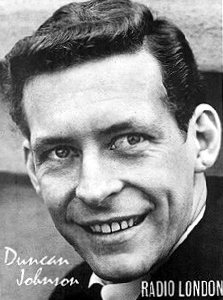 Duncan Johnson was born in Toronto, Canada, on 17th August 1938. The Radio London press office always used to imply that he had been a lumberjack before turning
to radio but it is probably more accurate to say he had worked for a logging company. He only ever saw two trees come down. After a number of brief but varied jobs Duncan joined a small radio station in Swift Current,
Saskatchewan, where he learned the basics of broadcasting. From there he moved to CJOC in Lethbridge, Alberta. He sent a tape of one of his shows to a former colleague who had moved to a station in Bermuda, which resulted
in Duncan being offered a job there and eighteen months in the sun. Two of his mates in Bermuda, Mike Lennox and Willy Walker, also later turned up on Radio
London. In August 1963 he came to the UK to visit some relatives and ended up staying. He compèred some gigs, including an early Rolling Stones tour, and did voice-over work until he saw a newspaper article about
the impending arrival of a new radio station. Duncan tracked it down and joined Radio London on 1st February 1965, a few weeks after its launch. He mainly covered for whichever presenter was on shore-leave but, when the
broadcasting hours were extended to 2am, he presented a late night show London After Midnight. When asked about his theme tune, Duncan could not remember the title: “I used something by Sounds Orchestral featuring
a jazz piano. It may have been the B-side of (the hit) Cast Your Fate To The Wind but I don't think so.” Correspondent Alan Field has provided the title after listening to an off-air recording from August 1966. The Sounds
Orchestral track was Image. However this record was not released until June 1966 so it is possible that something else was used previously. Jim Parkes' Encyclopedia
of Offshore Broadcasting lists Night Rider by the John Schroeder Orchestra. We are not sure if that was a theme for one of Duncan's daytime shows, an incorrect identification of the track we now know to have been
Image (Schroeder was one of the people behind Sounds Orchestral) or possibly an earlier theme used on London after Midnight before Duncan started using Image. Can anyone provide more information? Duncan
left Radio London in 1966 and presented a series called Newly Pressed for the BBC Light Programme, joining Radio One the following year. In 1968 he made a record, “The Big Architect”, which was not a hit but
did have the distinction of being voted one of the “World's Worst Records” by listeners to Kenny Everett's Capital Radio programme. He later worked for EMI Records, Radio Northsea
International (see The Pirate Radio Hall of Fame ‘Seventies Supplement’), Radio Luxembourg, BBC Radio London, Capital and Invicta Radio but spent
the last years of his career as financial controller for an advertising agency. Duncan retired at the end of June 2004 and spent the last years of his life in Brinsworth House, a retirement home for people who have worked in
show business. He suffered from the debilitating Parkinson's Disease and passed away on 11th October 2018, aged 80. Our tribute to him is here. We have some post-pirate photos of Duncan, taken during
the Pirate BBC Essex broadcasts, the August 2007 Radio Academy Celebration of Offshore Radio, and his 70th and 75th
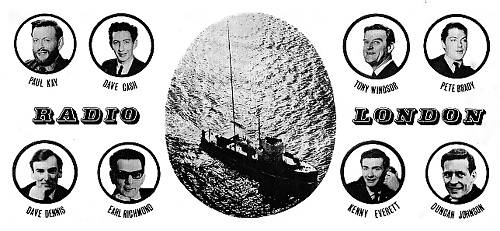
birthday parties. (Duncan was a good friend to this website and provided the copy of the 1965 Radio London promotional postcard, above, and a fantastic page of previously unseen Radio London photos.
He also provided copies of the original plans of the mv.Galaxy, the Radio London ship. We will miss him greatly.)
Duncan Johnson was born in Toronto, Canada, on 17th August 1938. The Radio London press office always used to imply that he had been a lumberjack before turning
to radio but it is probably more accurate to say he had worked for a logging company. He only ever saw two trees come down. After a number of brief but varied jobs Duncan joined a small radio station in Swift Current,
Saskatchewan, where he learned the basics of broadcasting. From there he moved to CJOC in Lethbridge, Alberta. He sent a tape of one of his shows to a former colleague who had moved to a station in Bermuda, which resulted
in Duncan being offered a job there and eighteen months in the sun. Two of his mates in Bermuda, Mike Lennox and Willy Walker, also later turned up on Radio
London. In August 1963 he came to the UK to visit some relatives and ended up staying. He compèred some gigs, including an early Rolling Stones tour, and did voice-over work until he saw a newspaper article about
the impending arrival of a new radio station. Duncan tracked it down and joined Radio London on 1st February 1965, a few weeks after its launch. He mainly covered for whichever presenter was on shore-leave but, when the
broadcasting hours were extended to 2am, he presented a late night show London After Midnight. When asked about his theme tune, Duncan could not remember the title: “I used something by Sounds Orchestral featuring
a jazz piano. It may have been the B-side of (the hit) Cast Your Fate To The Wind but I don't think so.” Correspondent Alan Field has provided the title after listening to an off-air recording from August 1966. The Sounds
Orchestral track was Image. However this record was not released until June 1966 so it is possible that something else was used previously. Jim Parkes' Encyclopedia
of Offshore Broadcasting lists Night Rider by the John Schroeder Orchestra. We are not sure if that was a theme for one of Duncan's daytime shows, an incorrect identification of the track we now know to have been
Image (Schroeder was one of the people behind Sounds Orchestral) or possibly an earlier theme used on London after Midnight before Duncan started using Image. Can anyone provide more information? Duncan
left Radio London in 1966 and presented a series called Newly Pressed for the BBC Light Programme, joining Radio One the following year. In 1968 he made a record, “The Big Architect”, which was not a hit but
did have the distinction of being voted one of the “World's Worst Records” by listeners to Kenny Everett's Capital Radio programme. He later worked for EMI Records, Radio Northsea
International (see The Pirate Radio Hall of Fame ‘Seventies Supplement’), Radio Luxembourg, BBC Radio London, Capital and Invicta Radio but spent
the last years of his career as financial controller for an advertising agency. Duncan retired at the end of June 2004 and spent the last years of his life in Brinsworth House, a retirement home for people who have worked in
show business. He suffered from the debilitating Parkinson's Disease and passed away on 11th October 2018, aged 80. Our tribute to him is here. We have some post-pirate photos of Duncan, taken during
the Pirate BBC Essex broadcasts, the August 2007 Radio Academy Celebration of Offshore Radio, and his 70th and 75th
birthday parties. (Duncan was a good friend to this website and provided the copy of the 1965 Radio London promotional postcard, above, and a fantastic page of previously unseen Radio London photos.
He also provided copies of the original plans of the mv.Galaxy, the Radio London ship. We will miss him greatly.)
Duncan Johnson, sitting in for Dave Dennis on the lunchtime show, Easter Sunday 18th April 1965. Audio courtesy of the Offshore Radio Archive (duration 2 minutes 50 seconds)
Duncan Johnson ending the Radio London Brides Show and beginning the Fab 40 on Sunday 29th August 1965. Tape courtesy of Ray Andrews (duration 1 minute 57 seconds)
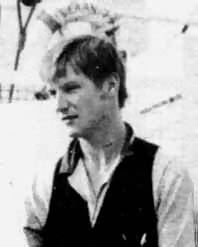 Jeff Jones was born in Darlington and studied chemistry at Aberdeen University. After graduating in 1967 he phoned Wilf Proudfoot, Managing Director of Radio 270, to
ask for a job. Jeff says he put on his best English accent in an effort to impress the boss but the reaction was: “‘Ee lad, are you from Durham’ I replied ‘Aye lad, that I am’. He said ‘You
start on Tuesday.’” Jeff recalls: “My main job at the start was reading the news, which I did very badly, and I was given the odd chance to be a ‘boy wonder’ (as our jingles said) as time
proceeded .... When we were all thrown on to the dole (by the legislation closing Radio 270 down) I went back to Scotland and started up the then new concept of the mobile discotheque. After that it was hospital radio, BBC
Radio Aberdeen and Moray Firth Radio when it opened in 1982.” Jeff was with MFR for many years and, when not on the radio, was also a chemistry teacher. Jeff attended the Offshore 50 reunion
in August 2017 but sadly passed away on 19th February 2019. See his obituary in The Scotsman. (This photo, issued by the Free Radio Association, is courtesy of George Morris.)
Jeff Jones was born in Darlington and studied chemistry at Aberdeen University. After graduating in 1967 he phoned Wilf Proudfoot, Managing Director of Radio 270, to
ask for a job. Jeff says he put on his best English accent in an effort to impress the boss but the reaction was: “‘Ee lad, are you from Durham’ I replied ‘Aye lad, that I am’. He said ‘You
start on Tuesday.’” Jeff recalls: “My main job at the start was reading the news, which I did very badly, and I was given the odd chance to be a ‘boy wonder’ (as our jingles said) as time
proceeded .... When we were all thrown on to the dole (by the legislation closing Radio 270 down) I went back to Scotland and started up the then new concept of the mobile discotheque. After that it was hospital radio, BBC
Radio Aberdeen and Moray Firth Radio when it opened in 1982.” Jeff was with MFR for many years and, when not on the radio, was also a chemistry teacher. Jeff attended the Offshore 50 reunion
in August 2017 but sadly passed away on 19th February 2019. See his obituary in The Scotsman. (This photo, issued by the Free Radio Association, is courtesy of George Morris.)
Jeff Jones reading the 10am news on Radio 270, 6th July 1967. Tape kindly donated by Karl Jones (duration 2 minutes 6 seconds)
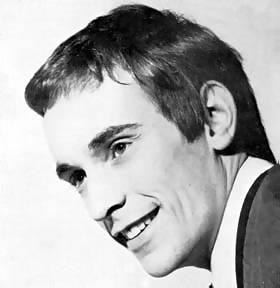 Ric Jonns Born Richard John Turton on 26th January 1943 in Thorpe, Norfolk, Ric was working as a ten-pin bowling instructor in Oldham in the early sixties when he met
Tony Prince. Tony was then a club disc-jockey and, through him, Ric began playing records at the Oldham Astoria. He also took care of the lighting at the Manchester Plaza. It was there
that he met a group called Herman and the Hermits. Ric became their road manager. They later found fame with the shorter name of Herman's Hermits. Ric joined Radio Caroline in late 1964 and, after a short stint on the
south ship where, according to correspondent André de Raaij, he was known as Chris Jonns, he switched to the north. The exact dates are long forgotten but his sister Sue thinks he stayed with
Caroline for about a year but left to work on American radio - a job he found with the help of Peter Noone (“Herman”). Andy Walmsley of the Random Radio
Jottings blog has shared a Radio Luxembourg schedule from September 1965 on Facebook. This shows a Ric Jonns hosting a sponsored EMI programme. We don't know if it is the same person but maybe Ric presented these shows on
Luxembourg before moving to the States. According to his sister he was one of the first, possibly the very first, English disc-jockey to work on American radio, presenting on WAIR in Winston-Salem, North Carolina. After about three
years on US radio and television, he returned to the UK. He was involved in band management among other things. One of his ventures involved teaching skate-boarding but he was too early. The craze did not catch on for a few more
years and this was not as big a success as he had hoped. In the late seventies he returned to the States and was earning a living teaching soccer when tragically he died in a car accident in 1985. He was just 42. There is an
interview with Ric and more photographs here and a newspaper profile here. (With many thanks to Ric's sister Sue Field for providing much of the above information and the
photograph, and to Alex Field for putting us in touch.)
Ric Jonns Born Richard John Turton on 26th January 1943 in Thorpe, Norfolk, Ric was working as a ten-pin bowling instructor in Oldham in the early sixties when he met
Tony Prince. Tony was then a club disc-jockey and, through him, Ric began playing records at the Oldham Astoria. He also took care of the lighting at the Manchester Plaza. It was there
that he met a group called Herman and the Hermits. Ric became their road manager. They later found fame with the shorter name of Herman's Hermits. Ric joined Radio Caroline in late 1964 and, after a short stint on the
south ship where, according to correspondent André de Raaij, he was known as Chris Jonns, he switched to the north. The exact dates are long forgotten but his sister Sue thinks he stayed with
Caroline for about a year but left to work on American radio - a job he found with the help of Peter Noone (“Herman”). Andy Walmsley of the Random Radio
Jottings blog has shared a Radio Luxembourg schedule from September 1965 on Facebook. This shows a Ric Jonns hosting a sponsored EMI programme. We don't know if it is the same person but maybe Ric presented these shows on
Luxembourg before moving to the States. According to his sister he was one of the first, possibly the very first, English disc-jockey to work on American radio, presenting on WAIR in Winston-Salem, North Carolina. After about three
years on US radio and television, he returned to the UK. He was involved in band management among other things. One of his ventures involved teaching skate-boarding but he was too early. The craze did not catch on for a few more
years and this was not as big a success as he had hoped. In the late seventies he returned to the States and was earning a living teaching soccer when tragically he died in a car accident in 1985. He was just 42. There is an
interview with Ric and more photographs here and a newspaper profile here. (With many thanks to Ric's sister Sue Field for providing much of the above information and the
photograph, and to Alex Field for putting us in touch.)
a very short clip of “your DJ, RJ” on Radio Caroline North (duration 35 seconds)
Ric Jonns interviewing his old mates Herman's Hermits during their time in the pantomime Dick Whittington and His Cat at the Royalty Theatre Chester in January 1965. Apologies for the noise on the recording. Tape kindly
provided by Karl Jones (duration 4 minutes 53 seconds)
The Pirate Radio Hall of Fame needs your

The site is updated regularly and we are always on the look-out for new material to add. If you have any information, photographs, recordings or contact details for any of the disc-jockeys we haven't been able to
trace, please get in touch.
|
John Junkin Born 29th January 1930 in Ealing, west London, John was one of the very earliest disc-jockeys on Radio Caroline although he never actually visited the
ship. He presented some pre-recorded shows, taped in studios in London. His time as a DJ was short-lived but he went on to a long and successful career as an actor, comedian and script-writer. He appeared in numerous
films and television programmes including The Beatles' A Hard Days Night, How I Won The War with John Lennon, Coronation Street, where he played a character called Bill Fielding, Inspector Morse,
various Marty Feldman comedy shows, Mr. Bean, The Sweeney and many, many more. See the Internet Movie Database for full details. He died in
the early hours of 7th March 2006 in Stoke Mandeville Hospital in Buckinghamshire. He had been suffering from lung cancer, emphysema and asthma. There are obituaries on the BBC and Guardian web sites.
John Junkin on Radio Caroline with a programme from 9th April 1964, just weeks into the station's life. Because his shows had been pre-recorded on land and stockpiled in advance of Caroline's launch, it was not possible
for John to include any topical references. With many thanks to Steve Kirby for the recording (duration 1 minute 17 seconds)
Another John Junkin programme from the early days of Radio Caroline, precise date unknown. These pre-recorded shows were made without any timechecks. The live DJs on the ship would fade the taped music down every so often and give the
time. The voice doing this over the last song is Simon Dee. This recording is from the collection of Leon Tipler, kindly provided by Steve England (duration 4 minute 30 seconds)
|


