Part Seven: The Mi Amigo returns.
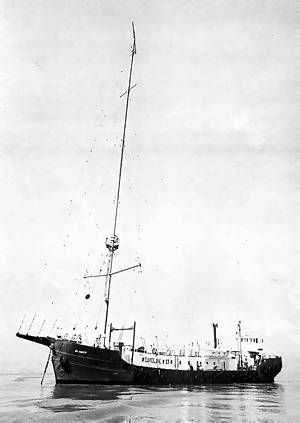
Following the grounding of the mv Mi Amigo in January 1966, the ship was taken to Zaandam in Holland for repairs. In the meantime, Radio Caroline South programmes continued
from a borrowed ship, the mv Cheeta II. While the Mi Amigo was in Holland, a brand new fifty kilowatt Continental Electronics transmitter was installed, the studios were renovated, the aerial
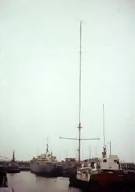
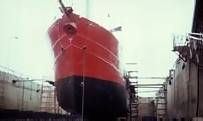
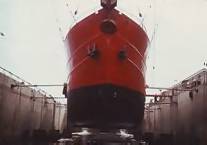
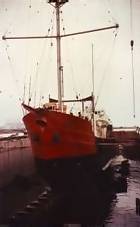
mast extended and a new generator fitted. DJ Colin Nicol has kindly provided these pictures of the ship under repair:
There are more photos of the ship in Zaandam here. At the beginning of April 1966 the newly refurbished ship was back in position, not far from the Cheeta II.
With two ships at anchor, the disc-jockey team was split between them. On the 17th April, while normal programmes continued from the Cheeta II, a test broadcast went out from the Mi Amigo on 1169 kHz,
257 metres (a frequency later to be used by Caroline North). The test only lasted a few hours as the aerial short-circuited, putting the station off the air. The disc-jockeys sat around waiting for the fault to be fixed,
keen to get back on the air.
|
|
|
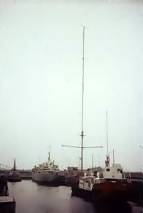
The newly refurbished Mi Amigo. Photograph from ‘Radio Caroline Picture Souvenir Book’ published by MRP.
|
Speaking some years later to interviewer Ray Clark, Tony Prince remembers: “There was something right at the top of the mast that had come askew and it was stopping
us from broadcasting. (There was) a force 12 and we wouldn't get the tender out with the engineer on. So we were all sitting on the ship playing cards, bored like crazy, thinking what can we do. Norman
St.John said ‘let's get up this bloody mast and get back on air’ and we agreed like the cavalry, ‘we can do this thing captain’ so Norman with the mouth went up first - and did about 10 rungs
and came back down. It was very cold. So God bless Tony Blackburn, he had a go. He went about half way and he came back, hands freezing, so then I had a go. You put this safety harness on
with a clip and I went up and I realised why Tony had come down at that point. You got to a point on the mast where the new section has been welded on. The rungs from that point were thicker and the little clip on the
safety belt wouldn't clip over the rungs. So the worst part of the journey up, was the most dangerous, because you wouldn't have your safety harness. So I went a few rungs and I was like jelly, looking down at the sea
and swaying from side to side, hands were freezing and I was going to drop off there any minute. I thought no, I'm not going to be a hero today and I came back down. By that time Blackburn had got his courage up again
and he decided to have another go. He went all the way. I'll never know how he got the courage to do it. We often talk about it, Tony and I, but it was a very heroic thing from an anorak DJ to want the ship back on air
passionately enough to do that. He climbed right to the top and got the rogue wire, let it come down. It didn't come down all the way, he was too tired to get it when he got it halfway down. Then I went back up and got
the rogue wire from the point where it had got stuck again and just at that point (station boss) Ronan O'Rahilly and the engineer had come out in the tender and there was all kinds of yelling going on, telling
the tender not to come along side in case it banged the ship and knocked the ‘Royal Ruler’ (me) off the mast.” (Reprinted from Offshore Echos, issue 142. Thank to Ray for permission to reprint this extract.)
|
|
|
The Mi Amigo in harbour. Photo courtesy of Colin Nicol.
|
In his autobiography, Tony Blackburn - The Living Legend, Tony Blackburn remembers the occasion,
but modestly plays down just how dangerous it was. He writes: “Once when the ship ran aground Ronan offered £50 to anyone who would climb to the top of the radio mast and untangle some cabling which was fouled
up. The crew wouldn't go because they said it was too dangerous and so I volunteered. Half-way up with the mast swaying and the ship looking the size of a pedalo beneath me, I told myself what a silly bastard I was. Ronan
never did give me the £50 but I didn't mind his meanness because even then I had an eye for publicity and this exploit on high was recorded in the press (see cutting), which encouraged
more listeners to tune into my show.” (Published by Comet.)
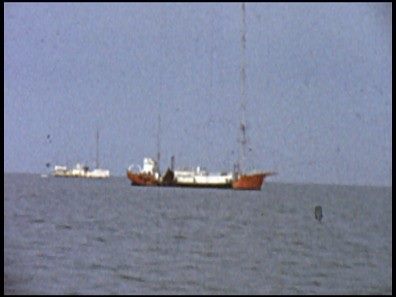
From 25th April there were two Caroline Souths on the air: the Cheeta II broadcasting on the familiar 199 metres wavelength and the Mi Amigo on a new spot on the dial - 1187 kHz, 253 metres.
 Tony Prince on the Caroline Club Request Show from April 1966, a programme being broadcast on both ships. This recording kindly donated by Bob Le Roi (duration 1 minute 32 seconds)
Dave Lee Travis testing from the mv Mi Amigo on 253 metres. Recording kindly provided by Nigel Fell (duration 2 minutes 6 seconds)
Dave Lee Travis testing 253 from the Mi Amigo links up with Graham Webb, still broadcasting on 199 from the Cheeta II. Recording courtesy of Nigel Fell (duration 2 minutes 46 seconds)
|
|
|
The two ships together. Still taken from a home movie posted on Facebook. Our thanks to Charles Wright and Brian Nichols.
|
Once the tests were completed and everyone was satisfied with the signal, the audience had to be persuaded to retune their radios from the familiar 199 spot on the dial to Caroline's new home, now
being described on air as “259”. This was not strictly correct, any more than “199” was.
Dave Lee Travis and Tony Prince trying to persuade their listeners to retune to 259. Tapes courtesy of Robin Rushton and Lynne Sims, from Martin Lynch's collection (duration 40 seconds)
During the hand-over period there was a certain amount of fun to be had with conversations between presenters on the two ships.
Clips of the two stations linking up on air. Graham Webb and Dave Lee Travis are on the Cheeta II, Norman St.John and Tony Blackburn on the Mi Amigo. It is not great quality but it does capture a unique moment in the
history of offshore radio. Many thanks to Martyn Webster for the tape (duration 7 minutes 15 seconds)
|
|
|
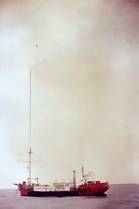
The Mi Amigo after the refit and back at sea. Photo courtesy of Colin Nicol.
|
With most of the DJs and records transferred to the Mi Amigo, the newest presenter, Robbie Dale, was left on the Cheeta II with the unenviable job of continually encouraging
his listeners to re-tune to the other wavelength. You can read his memories of that period here. Then the Mi Amigo took over completely. The Cheeta II continued to relay her programmes until 1st
May and then 199 was switched of. The improved Caroline South now had new jingles, a new slogan “The Sound of the Nation” and a brilliantly clear signal on 259. The team of excellent presenters assembled around
the nucleus of Tom Lodge and Mike Ahern, both of whom had moved from Caroline North, got stuck into winning the audience back from Radio London. This was the
beginning of a golden era for Caroline South.
Some of the jingles from Radio Caroline's new ‘Sound Of The Nation’ jingle package (duration 3 minutes 46 seconds)
Emperor Rosko presenting the Caroline Countdown of Sound on Saturday 30th April 1966. The full Top 50 chart can be found on
The Stonewashed Collection. It is very strange to hear Rosko referring to Caroline as
“boss radio”. It wasn't the station's normal slogan. Had he heard that “Swinging” Radio England, due to launch in just a few days, was planning to use that same strap-line? Tape courtesy
of Nigel Fell (duration 3 minutes 47 seconds)
Part eight of ‘Caroline in the Sixties’ over the page.
Back to the previous page.
|