Part Six: Caroline rides the Cheeta.
Following the grounding of the mv Mi Amigo in January 1966, Radio Caroline South was silent. Fortunately no one had been hurt in the incident but the ship needed a thorough
overhaul. She was taken to Holland for this very necessary work. It looked as if the station was going to be off the air for quite some time, when, out of the blue, came the offer of a replacement ship. This unexpected
gesture came from Mrs. Britt Wadner, owner of the Swedish Radio Syd. Her ship was currently off the air because of pack ice in the sea around the station's normal anchorage. The ship was languishing, silent, off the Dutch
coast. Not surprisingly, the Radio Caroline directors jumped at the offer. At the time, for some reason, it was reported that the vessel was being lent free of charge. In fact rent of around £700 a week was
paid. Radio Syd's ship, the Cheeta II, set sail for England and took up the Mi Amigo's position off the coast. Radio Syd normally broadcast to Sweden on VHF-FM. This waveband was not widely used in Britain at the
time so one of the Mi Amigo's 10 kilowatt medium wave transmitters was brought back from Holland on a tender and installed by the engineering staff. They also rigged a temporary aerial for the AM signal. DJ
Colin Nicol was sent out to the ship to help get the studio set up in the way that the Caroline jocks were used to. On 12th February 1966, after a break of less than a month, Caroline
South was back on the air, although at a lower power than usual. Engineer George Saunders worked on board the Cheeta II with Colin and both share their memories here. George first:
|
|
|
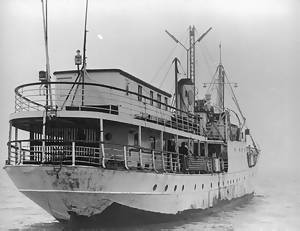
The Cheeta II. Photograph kindly provided by Colin Nicol.
|
“Our temporary replacement ship, Radio Syd's Cheeta II, had been forced from the Baltic by severe icing. A bit of the ship's history: She had been build in 1924 in Norway. Previously known
as the Mosken, she had been used as an inter-island ferry for the Norwegian fjords and islands. In 1960 she had been bought by the company operating the Danish station, Radio Mercur. She replaced the station's original
vessel, the Cheeta, and was therefore renamed the Cheeta II. The original Cheeta was bought by Mrs. Britt Wadner who started a Swedish station called Radio Syd.
The Scandinavian governments acted against their offshore stations and passed legislation to outlaw them. The new law came into force on 31st July 1962. Radio Mercur and the Swedish Radio Nord closed down but Radio Syd
continued. Mrs Wadner later bought the Cheeta II to replace her original ship.
Working outside the law proved difficult and a number of advertisers were prosecuted. Mrs. Wadner even spent some time in prison. The Cheeta II broadcast until January 1966 from off the coast of Sweden. She made history
in December 1965 by being the first ship-borne television station. She had a ship-built UHF TV transmitter, using Channel 41 and a clever aerial system. I saw all the kit when I was on her. The official reason for her
closure was because of the severe Baltic weather. It was thought that the thick ice would damage her thin plates so she had to move to warmer waters. But another aspect was that the Swedish government had tightened up
its already tight legislation against maritime broadcasting.
The ship's interior was quite nice but very old-fashioned. A long mahogany-lined passageway was below deck, with brass fittings and bevelled-glass panels in doors leading into her public rooms.
The TV studio was in her hold. They had all the gear, including lighting etc. This was where we established the temporary Radio Caroline South. Most of our kit was spread out on boxes (tea chests, etc.) with connecting
leads in between. The transmitter was all in pieces, all opened up with no protection (EET 7,000 volts!) because it had suffered water damage on the Mi Amigo. We made use of their studios but a lot of modification was
needed because their style of programming was totally different. They had no Spotmaster cartridge machines and didn't use the one man self-op DJ style at all. It was just like the BBC - the presenter was on one side
of a double-glazed window and the control room staff were on the other!
The Cheeta's generators weren't powerful enough to run our gear so we transferred our General Motors 75 kV diesel alternator across from the Mi Amigo to her.”
And Colin's memories:
|
|
|
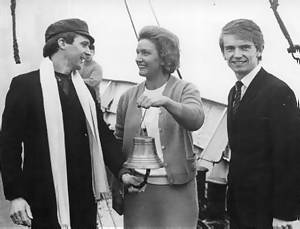
Colin Nicol, Britt Wadner and Caroline's founder Ronan O'Rahilly on the deck of the Cheeta II. Photograph courtesy of Colin.
|
“My overall memory of my tour of duty aboard Cheeta II was of happy times. They are good memories, so much so that when my job of helping convert the ship to Radio Caroline South was finished
and the rest of the DJs coming aboard became a reality, I decided I was finished with pirate radio as well. My quote from that moment was along the lines that I felt it was not just last days for me but for pirate radio
itself.
The other strong recollection is of the factor coincidence brought to play in having the Swedish pirate ship available just after Mi Amigo went aground. That the Radio Syd ship was available at the right moment was due
to the fact of the bad winter freezing the Baltic coupled with renewed pressure against the ‘Swedish Pirate Queen’ Britt Wadner by her government. After hacking off ice from their ship, the decision
was made to head south to set up afresh off Gambia on Africa's west coast, which meant Cheeta II was moving toward the English Channel at the time Ronan O'Rahilly made contact and did the deal that gave Caroline South
an emergency home until Mi Amigo was repaired in Holland. I was sent aboard with the technicians to make sure the adaptation of the equipment was to our requirements. No doubt I was meant to be a presence and to represent
the programming side as well.
The ship was cosy and friendly. Especially so since apart from the Caroline techs and myself, it had only its basic crew, along with Britt's son Kalle. He and I became friends and I still remember him with sadness
because of his tragic end. Of all luxuries, I had a neat little single-berth cabin to myself. The Swedes were good company, the food better than I had been used to on Caroline and there was not a lot for me to
do during my long stay aboard. My recollection is that it was about nine weeks and I believe it was, but that does seem a long period.
|
|
|
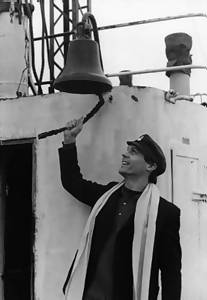
Colin Nicol with the Caroline bell. Photograph provided by Colin.
|
However there was much to be done on the technical side: shipping the transmitter over from Mi Amigo at Scheveningen along with other equipment and getting it all aboard. I remember how tricky
that was and can still picture the moment as we lowered away and cautiously eased the valuable and delicate bulk into the hold. One slip and it could have been all over for Caroline South. We were on the high seas after
all. Then the complicated and highly technical puzzle of how to design and install an antenna that would radiate sufficiently effectively.
Radio Syd had been an FM station and had not required a very high or complicated transmitting mast. There was no tall tower as Caroline had required for AM broadcasting over any worthwhile area of coverage. The Caroline
South folded dipole system was not applicable to this temporary set-up. All that could be done was to adapt what was there and that meant rigging copper cables between the ship's masts fore and aft and tuning the transmitter
to that array. It worked, as history attests, thanks to the brilliance of our technicians.
(Web-master's note: Although the Caroline technicians were undoubtedly brilliant, the low masts on the Cheeta II meant that the aerial array could only be, in George's words, ‘a lash-up’. Apparently sparks
flew if any sort of high power was attempted. As a result Caroline was only able to broadcast from the temporary home on reduced power. Night-time reception was impossible so transmission hours were shortened. But Caroline
was back on the air and, even at low power, this was considerably better than nothing.)
The more I look back on the history of pirate radio the more I realise how much Radio Atlanta and consequently Radio Caroline owed to the creators of Radio Syd and its predecessor Radio Mercur. Many of their original plans
sprang from what had been introduced by the Swedish. That other great innovator of shipboard broadcasting, the Dutch Radio Veronica, must also not be forgotten as central to the innovations that resulted in the advent of
British offshore radio. More than a generation later, they are all still well remembered, and missed.”
Colin describes the Cheeta II as cosy and friendly. George has rather different memories:
|
|
|
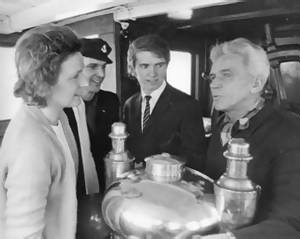
Britt Wadner, Colin Nicol, Ronan O'Rahilly and the ship's Captain Holger Jensen. Photograph provided by Colin.
|
“The Cheeta II was a technical nightmare. Everything that could go wrong did so. We were cold, power failed frequently, water supply was irregular, and breakdowns in our gear - which had seriously
suffered in its transfer - were very frequent. I did not enjoy life on the Cheeta II. It really was most unpleasant. I've never, in the whole of my professional life before or since known so many breakdowns. Even basic
ship services like water and electric lighting failed for quite long periods. I've often quietly wondered whether it was deliberate or simply because everything was worn out! Apparently everything had worked perfectly
when she was off Sweden earlier in January 1965. Very strange!
Our relations with the Swedish crew were interesting and totally different from those with the Dutch crew on the Mi Amigo. The Dutch were generally extrovert and we had conversations with them at meal times. The Swedish
crew were almost silent with no conversation at all even among themselves. I don't now if they resented out presence on board or being off England or what.
One bitterly cold night we sat (or huddled) in an ornate mahogany and brass Victorian-style lounge with only a 1 kilowatt electric fire element suspended by its wires from the ceiling for both heat and light!”
After helping to set up the studio on the Cheeta II, Colin left the station. Disc-jockeys Tom Lodge, Norman St.John,
Tim Yale and Tony Blackburn arrived, later joined by others such as Tony Prince, Tommy Vance and
Emperor Rosko. Test transmissions started on the afternoon of 12th February 1966 with regular programmes the following day.
Tony Blackburn shares George's memories of the Cheeta II being a miserable place to work. In his autobiography, Tony Blackburn - The Living Legend (published by Comet) he wrote:
|
|
|
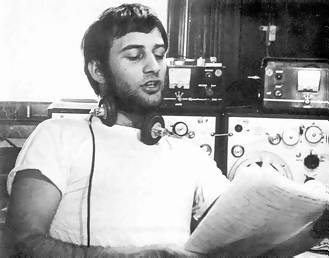
Emperor Rosko in the Cheeta II studio. Photograph from ‘Emperor Rosko's DJ Book’, published by Everest Books, and kindly provided by Martyn Webster. The Spotmaster cartridge machines, in the background,
had been brought from the Mi Amigo.
|
“We had to broadcast from a borrowed ship called the Cheetah II which never did work properly and most of the time we were off the air. We had no water or heating on the Cheetah II. It
was the middle of winter and I was totally fed up. I was on board with Tommy Vance, as the other DJs were on shore recuperating from the shock of almost being drowned. I suggested to Tommy that he should go to
London and tell our management at Caroline House how dreadful conditions were on the Cheetah II. The moment Tommy left, of course, turned out to be the one time the transmitter worked properly and I was on air
non-stop for about eight hours. I fell asleep while one record was on and had to be woken up just before it ended so I could continue the show. At that time I made the classic broadcaster's mistake. I thought
the ship was off air and in desperation I opened my microphone and said ‘This is Radio Bullshit’. We received a lot of letters from listeners afterwards saying how much they'd enjoyed it.”
Tony was not the only one to inadvertently broadcast a swear word during this problematic period. Norman St.John: “We had many transmitter problems and, whilst in the company of Graham
Webb, I believed that we had gone OFF the air again, for about the sixth time in as many minutes. At this time I said ‘Oh F***’ but it appears we were ON the air! I had many letters but all were in good
spirit as things at that particular time were very difficult for Radio Caroline. I also remember distilling our own spirits by boiling Heineken Beer. I can't say we drank much of it as even though times were tough we all,
to my knowledge, never broadcast whilst under the influence.”
 Graham Webb broadcasting from the Cheeta II in February 1966 - and demonstrating the problems they were facing: off the air yesterday and no news today. Tape kindly provided by Nigel Fell (duration 1 minute 47 seconds)
Tony Blackburn on a Caroline South Breakfast Show from late March/early April 1966. This recording kindly donated by Harm Koenders of The Offshore Radio Archive (duration 2 minutes 50 seconds)
The Mi Amigo returned from her refitting in April 1966.
The story continues in part seven of ‘Caroline in the Sixties’ over the page.
Back to the previous page.
Many thanks to George, Colin and Norman for sharing their memories and to Colin for the photos.
For more on the Cheeta II, see the Offshore Radio Nostalgia site.
|

