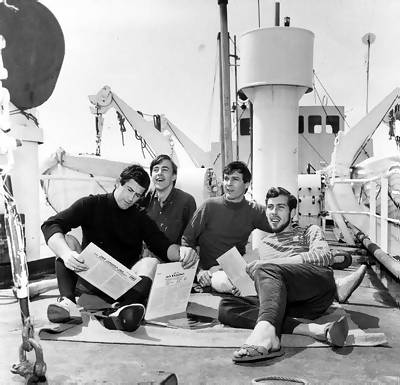
The two stations merged. Radio Atlanta was now known as Caroline South and the two management teams had to learn to work together. This was not easy. They came from different backgrounds, had
different philosophies and different ways of operating. It was not a happy marriage:
|
|
|
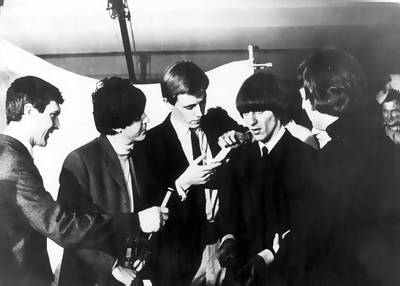
Disc-jockey Simon Dee presents The Beatles with their Caroline Bell Award, one of four given at Easter 1965 to mark Caroline's first birthday. Also in the picture Colin Nicol,
left, and Beatles manager Brian Epstein, far right. Thanks to Colin for the photo.
|
Allan Crawford: Ronan did no work, Ronan just influenced. He was a politician through and through - he didn't do any work. I ran the company, as much as I was allowed to
do with Ronan's interference from the next door office. He had a gang of fellers there that were presumably being paid by his side because we didn't pay them. I called them ‘the Irish mafia’. I found
them quite intimidating. It never came to bruises and blows but I was afraid to be in the building sometimes. I got sick of it eventually but what can you do?
(Web-master's note: the next section is confusing. Allan refers to putting men on the Thames forts before Screaming Lord Sutch, which means prior to May 1964, and then seems to imply that they were still there
when Roy Bates took over Knock John, more than a year later. Is he possibly talking about two separate incidents?)
Colin Nicol: We were talking about the Verweij brothers and setting up a transmitter on a fort. We got as far as ..
AC: The day I came back with a sort of tacit “yes, we are interested, let's get into detail”, there was this huge announcement by the Labour Postmaster General or whoever it was, it
might have been Callaghan who I think was Home Office, that this was absolutely not on, so we had to forget it. I was going to do a special programme of good music in the evening together with financial news for
the City all day. We hadn't approached the Financial Times at the time, but I was going to go to them for the news.
CN: Which was the fort?
AC: Well, that was the one that Lord Sutch, Screaming Lord Sutch ..
CN: Later took over. Shivering Sands.
AC: Because I was looking for money from people and his manager (who was later shot to death by my Chairman, Oliver Smedley) became friendly and, because of my investigations, they became aware
that this was a possibility. What happened originally was that I put two or three men on each of the viable forts and this, naturally, got into the newspapers although I tried to keep it low profile. And Captain -
what's his name, the one who's now got Sealand, Captain someone .... Bates, Bates.
CN: Yes, Roy Bates. Former Major Paddy Roy Bates.
AC: He got half a dozen men to go on and of course bully our two or three fellers off and I waited until he couldn't afford to have six men on and I sent a half a dozen and turfed him off! This
was all without any publicity, but it got to be too expensive just holding the empty forts and the board of directors didn't like the cost. I had to stop it so Bates got on again, you see, and eventually started a
tiddling little radio station. In the meantime, I went back to the one, Shivering Sands, that was occupied by Reg Calvert. I said “now look, you've got a rotten transmitter. Supposing we put up a really decent
one and work together?” He was interested because he was short of money. And so I flew out a second-hand transmitter from America via Holland and put it on the station.
CN: It fell off in the process of trying to get it up there ..
AC: No, no only the generator fell off. I couldn't blame anyone because they must have been operating from a fairly small ship with a heavy object with make-do cranes and what-not but we overcame
that. We were eventually going to hire a pretty good Rolls Royce generator from somewhere but we never got that far because our company decided not to continue because, with this roller-coasting of the income, the
see-saw aspect, it was getting to be too heavy. We did get a further loan from (investor) Jarvis Astaire who, when we reached this point, recalled the loan which, of course, put us out of business. I felt that he was
too pally with Ronan. I couldn't watch Ronan all the time and Ronan had all the time in the world to go around and meet these people, put ideas in their heads and disrupt. He was a marvellous third party. Two parties
aren't going to argue unless there's a secret third party giving them ideas. I call that a third party influence. Ronan was marvellous at setting up this third party disruptive influence and I'm sure - I can't prove
it - he got hold of Jarvis and put ideas in his head and so Jarvis pulled the plug at the wrong moment. In a way I can't blame him. He had a priority on collecting money and so on, and so we were never able to go
ahead. I must say this: at one stage when I decided not to go ahead, Mr. Smedley rang me and said “I want to have a meeting with your Trinity House boys in your office” and I said “OK”. At
this he said “look, we're going to get a gang of people and capture the fort that has our property on it - that is the transmitter - Reg Calvert's place, and then we'll be in control of it”. I said “no,
I won't be in that. You can't keep that a secret. It'll get out. It'll make us look real pirates instead of just humourous pirates and I won't have anything to do with it”. And then, the next day, he rang and
said “you're right. We won't do anything about it” and at that point I knew damn well that he was going to do something about it but it wasn't my affair. So one morning the big news broke that he had
chartered a little ship and put some big dockers on it and that they had crept up the ladder and captured the fort from Reg Calvert's people because it was off the air that morning. You can't keep a thing like this
secret. I told them that you couldn't avoid unfavourable publicity, but they'd done it. And then Calvert rang up on the Monday morning, because I'd introduced him to my Chairman in the first place, and he said
“you know that fellow - where does he live - I want to go and visit him” and I wouldn't give him the address. He lived out in the country somewhere, don't ask me where. And he also wanted (investor) Kitty
Black's address because Kitty had been in on the meetings.
CN: She was on the boarding party.
AC: Was she? Well Kitty's marvellous with her sense of adventure and so on. She's a great partner to have. She backs you up. So they had the fort and they didn't know what to do with it or how to
handle it. And Calvert's muttering all kinds of curses and threats, and I wouldn't give him Kitty's address, although he could have got it out of the phone book if he'd looked, and nor would I give him the country
address of the Chairman. And that was on a Monday and he rang me - and I know Wimbledon was on at the time because I love Wimbledon and I used to get home and watch the last hours of it in the evening. And I'm looking
at TV when Calvert rings me, wanting the address. This was on a Monday night. And he uttered some blood-curdling threats like he could get people to drop poison gas, believe it or not, on the fort, to discourage them.
I mean, you know, ridiculous, I mean the breezes are so strong out there on the Estuary, no poison gas would have lasted more than a couple of seconds. Anyway, I figured that he was only uttering threats so that I
would ring up and frighten the others, so I didn't do it. And the next night, he rang me again and said “you won't give me those addresses?” No, I wouldn't. I said you meet them in business hours if you
can arrange appointments and so on. I might be wrong about the dates, it might have been on the Monday afternoon that Smedley rang me and said “I'm taking your name in vain, Allan. I've fixed a meeting in your
studio without your permission. Is it alright?” He was getting all the parties involved, including Radio London, with a man that I liked very much ..
|
|
|
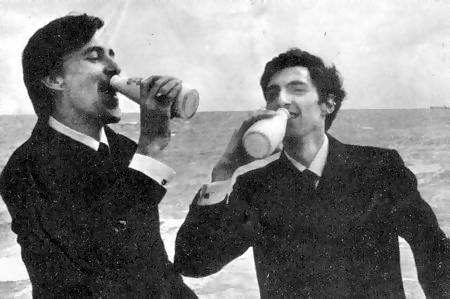
Caroline South ‘Good Guys’ Bryan Vaughan and Keith Skues “drinka pinta milk a day”. Thanks to Hans Knot for the press cutting.
|
CN: Philip Birch?
AC: Birch. A very sensible, sane man and I liked him. They were all meeting to talk about this problem - about the publicity and what not and how to get out of the adverse publicity - and I said
yes, you can have a meeting but I won't be there. I've got an appointment - and I made sure that I was not there. In fact, before I went out the internal phone rang and Smedley said “we're having problems
Allan, and we need you” and I said “I'm sorry. I've got my appointment. I'm going” and I went and I left the building. Coming back, I met Kitty coming from the meeting and she said that they hadn't
been able to reach any agreement on what to do. Well, the next evening, Calvert rang me again, and I didn't know that he'd had lunch with someone during the day and got the address of my Chairman at that lunch - he
still asked me for that address that evening - to kid me he didn't have it, I suppose, so that I wouldn't warn anyone. And he went that night with a tough henchman to attack Smedley. Smedley happened to have the
daughter of his best girlfriend there. She was in love with him - he'd been divorced you see - which made it even worse because they broke in the front door, hammered on the front door, Smedley realised who it was,
went to the neighbour next door and borrowed a shot gun, loaded it, came back in, and when they were busy attacking the girl in the head with a statuette they'd picked up in the hall - I got this from what Kitty said
later, she was actually a witness in the court case, in the murder trial - he killed Calvert with the shot gun and was arrested for murder. So when Kitty came to me the next day, she was in hiding. I'd debated for
some time whether I would mention the threats that had been made to me by telephone by Calvert a day or two before because I didn't like Smedley very much as he'd been so bloody unhelpful the whole time and he hated
Ronan and Ronan hated him, and he had made the situations that we had worse. I wanted to leave him to stew in his own juice but then I decided I couldn't. I had to tell Scotland Yard what I knew. So they sent an
Inspector Brown round to see me on the Wednesday or Thursday. While he was there, Kitty rang me and she was in hiding. So I had to take the call in the next office. I couldn't say anything at my end. Eventually of
course, she came into the open and, I believe, what she said was enough to get Smedley off because, after all, he was being attacked in his own home.
CN: Now, about Government departments.
AC: One thing I can remember about the Government departments was my astonishment at discovering that they were not, as an outsider would first imagine, an entity. For instance, the Home Office
could be baying against us all the time, but the Customs and Excise wouldn't give a damn. They'd quite happily let the boys pass through, whereas you'd think that if one Government department was hostile to our
operations, another one would combine and mesh in and stop us - but they never did. It was lovely to see this disruption and you can just imagine how chaotic behind the scenes any Government must be.
|
|
|
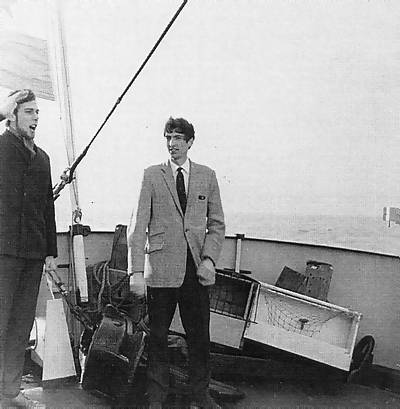
Paul Noble salutes Keith Skues. Photo by Carl Thomson, supplied by Colin Nicol.
|
CN: And, you think if they had pulled together ..
AC: Oh, they could have stopped us I think, effectively, because they could have made various difficulties for us to send the boys out from England. If they had, we'd have to have sent them via
Holland at far greater expense and far more difficulty.
CN: Do you think that was an intentional?
AC: Oh no that was just an accidental by-product of the way Governments are put together. Since that time, of course, I've had years to ponder over Governments and I've now created an entirely
new philosophy on how to run your life without Governments at all - but that's another story and it will be an even bigger one, I hope!
CN: But you don't think they were just trying to soft-pedal in order not to strike too soon?
AC: No, no, no, no. There was literally an antagonism within different parts of the Government. For instance “this is my bailiwick, how dare you cross my fence. This is my responsibility,
I'm doing this and don't you damn well interfere” which is ridiculous!
CN: And, as a result, Government departments never pulled together.
AC: That's right. They did in the case of war, of course. They had to because everybody sees that you've got to beat Hitler. But, otherwise, you aren't going to get any willing cooperation.
CN: On another tangent all together, we just looked at a photograph of the Caroline bell. Do you know how that idea came into existence?
AC: No. Tell me.
CN: I don't either.
AC: All I know is that I have in my possession the Mi Amigo Bell which was presented to me, and it's on a stand held by welded links of a chain, and it still works. I've still got it, I forget where,
but it's somewhere under a chair!
CN: Was that THE bell?
AC: Yes, it was the bell.
|