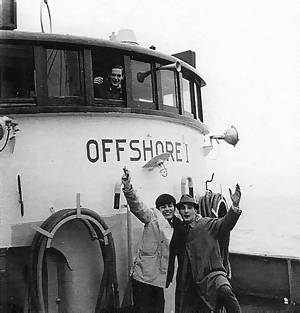
Eventually the partnership fell apart and, at the end of 1965, Ronan O'Rahilly's company, Planet Productions, took full control of Radio Caroline:
Colin Nicol: What happened with the parting of the ways. How did that occur?
Allan Crawford: Well with the parting of the ways. We'd had such a see-sawing of income - at some stages it had been sixty thousand a month, which was pretty good for a business in those days,
but it would go down to a few thousand a month, and really we had to have much more predictability to have a business going. There's a point at which you either say ‘stop’ or rearrange things and keep
going. Of course, we had rearranged it already once or twice, and the directors just felt that the interruptions we were getting from the Postmaster General of the day in Parliament were disrupting our advertisers'
confidence so much that we simply called it a day and sold out to our partners at, really, for what we owed. In other words, to turn out honourably. But in fact we did end up with quite a bit of cash in hand which
was really too small, we felt, to return to the shareholders. It was a derisory dividend of a return of capital, so we started to invest in the Stock Exchange in futures and what not, and we were doing pretty well
for a while. I don't know what it was that finally brought it to a halt. It might have been the coffee crisis which cost Cadbury an awful lot of money. I had nothing to do with the investments on the Stock Exchange.
I knew nothing about it, although I was still on the board. I only took a director's interest. I would call in at the meetings now and again and say “well done chaps!”. The reason that, eventually, the
company itself was wound up was because the principle shareholder had become Oliver Smedley who had been buying shares from everyone else for pennies, and had therefore, bought control. And, he went broke, and
because he was the principal shareholder, the company had to be wound up. So eventually, from my few thousand shares, I think I got fourteen pounds as a final breaking up fee.
CN: So you worked for all that and did all that for fourteen pounds?
AC: Well, for a lot less than that because I lost so heavily. I lost my music catalogues too because I had to pay off other debts that I'd shouldered in the period and I ended up selling my
catalogue to Dick James merely to pay off debts, and I was still left heavily saddled with debts. So I wasn't very pleased about the situation, but there was nothing I could do about it. I was more sorry for the
people who'd been with me who'd lost.
CN: So, on the Project Atlanta side, it could be said it was a risk venture and the risk didn't pay off.
AC: Yes, that's right. There's every reason, looking back, to believe that it should have paid off. The original prognostications were good ones, but the chaos that can be presented to you by
Government acting in the way that Governments do act - which is for political ..
CN: Expediency.
AC: Expediency.
CN: What about the Radio Caroline - Planet Productions, which was their operating company side of things. Do you think very many of that side made money out of Radio Caroline?
AC: Oh, no. I'm pretty sure they didn't. I should have become a shareholder because, with the money that was owed to me when we sold to our partners - to make life easier for the deal - instead
of demanding two thousand cash for part of what was owed to me, I agreed, reluctantly, to take it in shares instead. But, of course, I was never issued the shares, and no matter what I did to persuade someone to
do it, I was stalled and I just didn't have the time or the interest to be bothered. And, eventually, of course - whatever happened to those shareholders, I didn't even suffer that fate because I never got the shares
issued. I was literally diddled out of a couple of thousand shares. I do know that (director) Philip Solomon rang me once to offer me a shilling a share, to take over the shares - in which case I suspect they would
have been issued then re-issued to him. But I refused that offer and never got the shares anyway.
CN: These would have been shares in Planet Productions?
AC: Yes, yes. So I don't know what happened to those shareholders. There was one important little episode here that I've just remembered and it concerns the programming, because, as a music
publisher, one of the basic reasons that I'd started Atlanta was to get more honesty into broadcasting. To get more competition, and this wasn't being supplied by the BBC otherwise there'd have been no point in
starting a commercial station. And one of the ways that I could see that we could get more cooperation out of EMI and Decca, who didn't want us to have these ships, was to start broadcasting copies of the hits which
would have made the public start asking for those artists instead. It would push EMI and Decca into becoming fairer about what they agreed to give and what not to give.
CN: So you produced a cover version industry.
AC: Well, I did this independently - it was my own business - but I produced a series of records which, ultimately, when budget records came on to the market as LPs, became a very powerful sales
tool. What I was doing was predicting what the hit would be in a few weeks time, get an arranger to take that arrangement off that record, get a singer that sounded like that singer and record them again myself. And
do them as well as the originals, if I could. And so my first record, which contained Love Me Do, the Beatles first
hit, had six numbers on it as an extended EP. Six numbers, three a side and selling for the price of one single. Very good value. This happened simultaneously with us opening the ships anyway, and it was a marvellous tool
to use to get cooperation out of EMI and Decca.
|
|
|
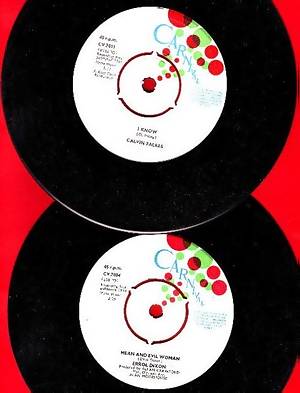
A couple of releases on Allan Crawford's Carnival Records label. Thanks to Colin Nicol for the scan.
|
CN: You were able to play their songs but not their versions of them.
AC: Well, we had permission to play my versions, because I was giving it. Had we continued this policy of playing my copies, which were good enough to play, because they weren't crappy, compared
to the originals, the public demand would have been for my versions. That would have forced EMI and Decca into a much more cooperative frame of mind. And, what happened? I heard that the records I was sending out to
the ship were being taken out to the rail and being thrown into the ocean so that the originals could be played. Ronan didn't have the guts to believe the theory of it. Later on, every time an LP of my records in this
fashion were made, it went to number one on the hit parade. Every time. And the major companies eventually had to invent new rules to stop them being listed in the best-selling LPs, because they were budget and copies
and they didn't want them being listed, but Pickwick Records would shoot up to the number one, Top of the Pops, every time they were issued which proved I was right. They were very high quality. The public loved them
and they were selling millions of these things. I think in picking about a thousand titles for these over a period of years, I only picked one wrong one that wasn't a hit.
CN: Well, here we are twenty years later. Would you do it all again and, if you did, what would you do differently?
AC: Yes. I would do it differently. I would have never have had a partnership with anybody and I would have gone for more money and stuck it out. We'd still either be operating in the same place
with a huge business going or we'd have agreed to stop operations in return for say, a London license. Or something like that.
CN: Is that what you originally had in mind?
AC: No, no ..
CN: How long did you think Radio Atlanta would operate?
AC: Well, I thought that it would go for three years and that, during that time, we'd amortise the investment and have a profit for the shareholders, and then decide either keep going, sell out
to someone else, or stop operation having made our profit, whatever.
CN: Did you ever expect that you might have been offered a land-based franchise?
AC: Yes. I felt that inevitably, once the public demand was proven for the product, that there'd be no way that the politicians could resist the demand for the alternative, because I was satisfied
that the BBC couldn't supply it - even when we taught them a new way of programming. As it happened, they changed to Radio One and everything - and took many of our DJs and did exactly what we'd taught them to do.
Not terribly well - I'm not very proud of the Radio One format but, certainly, we won the war because the Government - the politicians - were forced to bow down to public demand.
© Colin Nicol.
Web-master's note. This interview took place in 1984, twenty years or so after the events described. It is apparent from the full transcript that Allan Crawford had forgotten some details and was
confused about others. Some of his memories may not be totally correct but, even if they aren't, we feel the interview provides a fascinating insight into the early days of offshore radio. It is patently obvious that
Crawford did not trust his partner, Ronan O'Rahilly. As it turned out Crawford lost control of his station so he may have been wise not to do so. But, at the same time, it must be said that Caroline South under Crawford's
management was failing. When O'Rahilly's Planet Productions took over, at the end of 1965, the station's fortunes improved vastly and it became a very successful and popular operation. The people who worked for Allan
Crawford speak very highly of him. He was obviously a man of tremendous vision who commanded great respect. Without his efforts, commercial radio may never have come to Britain but, as Winston Churchill once remarked,
history is written by the victors. O'Rahilly won - and it his place in Caroline's history that is remembered.
With many thanks to Colin Nicol for allowing us to publish this interview. Colin has also interviewed Richard Harris and Ken Evans who both also worked for Radio Atlanta.
Johnny Jackson's Radio Atlanta memorabilia is here.
Colin's Radio Atlanta advertising rate card is here.
|