Colin Nicol was one of the first DJs to be signed up for Radio Atlanta. Despite a successful career in legitimate radio, both before and after, he remained fascinated
by the offshore radio story and, on 5th February 1984, recorded a long interview in London with his old boss, Atlanta's founder, Allan Crawford. The former Managing Director of Southern Music in Sydney and
London, proprietor of Merit Music and owner of a number of record labels specialising in cover versions of contemporary hits, Crawford was the instigator of offshore radio in Britain, having begun working on the project
as early as 1960. At the time of the interview he was quite elderly and has since died (in December 1999). He was at times hesitant or unclear, and frequently wandered off the subject. He told stories as they occurred
to him, often out of chronological order. We have edited the text in an attempt to make it clearer but, as a result, this is not a precise transcript. It is, however, a fascinating insight into what was going on behind
the scenes in the early days of offshore radio.
As is related here, Radios Atlanta and Caroline merged after only a few months on air. The partnership was not one of equals and, it is apparent from this interview, that Allan Crawford did
not like or trust Ronan O'Rahilly, his fellow joint Managing Director. Speaking twenty years after the events, there is still resentment about the way things turned out. Maybe this is not surprising. O'Rahilly
is now remembered as the founder of UK offshore radio while Crawford, who had the idea and began setting it up first, has not received the recognition he undoubtedly thought he was due.
The interview is copyright Colin Nicol. We are grateful to him for allowing The Pirate Radio Hall of Fame to publish it.
|
|
|
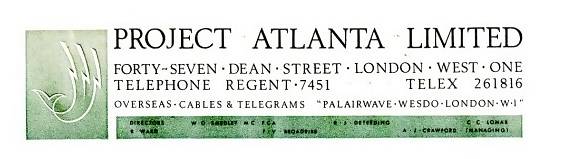
Project Atlanta letter heading, kindly provided by Colin Nicol.
|
We start with Allan's memories of how Project Atlanta began:
Colin Nicol: So - to begin at the beginning, because it's usually a good place to begin - how did you first hear about pirate radio?
Allan Crawford: What happened was that I was a music publisher for a long time. I was Managing Director of Southern Music both in Australia and in London, but had resigned from the London company
after fourteen years to become independent. As an independent it hit me that having three hundred publishers in London striving to get into any half hour radio programme was idiocy. There was no way to win as an
independent, especially under that situation.
|
|
|
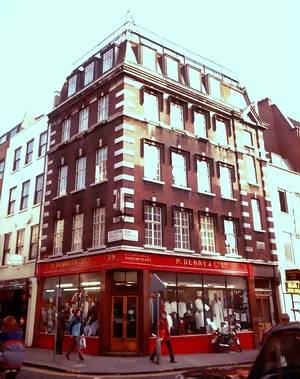
The offices of Merit Music and Radio Atlanta at the corner of Dean Street and Old Compton Street in London's Soho. Atlanta's studios were on the top floor. Photo kindly provided by Colin Nicol.
|
CN: Getting your works played on air was restricted?
AC: Yes, that's right. There was a bottleneck and the BBC didn't give a damn about any particular publisher.
CN: And they were, anyway, restricted as to the number of gramophone records they could play.
AC: And restricted in their ideas too, and the publishers that were getting success were the well established, wealthy publishers who could wine and dine people.
CN: But, of course, you were always a bit of a maverick.
AC: Oh, I was ..
CN: Competing with people like (publishers) Boosey and Hawkes and Chappells who'd been established for a hundred years.
AC: I was Managing Director for Southern Music which was a very big company. In fact the biggest popular publishing company in the world in the sense that it was in every country, not just a few.
More than any other single publisher and they had almost a monopoly in Latin American music and in hillbilly music for many years. So, as an independent, having left Southern Music, it was a darned sight harder for me
to compete. I could have had the best numbers in the world but it doesn't bloody well matter if you can't get them broadcast. You don't even start getting any income. So I decided that something should be done about it.
An article came out, I think, in the New Musical Express, announcing that Radio Luxembourg had made an arrangement with Campbell Connelly, one of the big publishers, to form a joint publishing company between them. Well
I was angry at that because I could see that it would result in favouritism. You couldn't blame Campbell Connelly, it was one way to get Radio Luxembourg to play their numbers, but I was annoyed so I wrote a sarcastic
letter to the BBC and said “following the announcement in the paper”, and I didn't name the article or what it said - I went around the bush and said “following this, I now make the following suggestion
to the BBC. That the BBC and my company, Merit Music, form a sub-publishing company, so that by careful programming, we could do away with such worthy institutions as the Performing Rights Society, the Publishers
Association and Phonographic Performance Limited, so that all the numbers being broadcast being mine, Merit Music, and the BBC's.” It was sarcastic. Such a thing could never happen but, you know, they had a fellow
ring up a few days later and say “Mr. Crawford, we have your letter. What does it mean?” I've forgotten the name of the man who rang but he and his brother were quite famous names at the time with the BBC. I
was invited to lunch with the secretary of the BBC, Mr. Farquarson. Well Farquarson was there in the boardroom - there was a butler serving a beautiful luncheon on silver platters, and we were sitting at a boardroom table
a mile long - there were only three of us there - and the other man was a Michael Standing or Standring - Standing I think, and he was in charge of BBC programmes. This wasn't TV, this was radio. He obviously was reluctant
and a little bit huffy at having been made to come until he listened to what I was saying. Then he warmed up and he leaned forward and said “we don't meet many publishers like you, Mr. Crawford!” He liked what
I was saying. I was saying how Luxembourg worked. It worked this way: The main advertisers on Luxembourg for the principal hours in the evening were EMI and Decca so, naturally, it was their numbers that were being
played. Naturally, they weren't going to distribute for any other company so American companies couldn't break into the British market unless they let them issue their records. It was a very restrictive set-up. Mr.
Farquarson listened and he wrote out in his hand-writing - I don't know if I've still got this, I probably have amongst my volumes of stuff - the address of a committee that was meeting to take evidence about radio - the
future of radio.
CN: That would have been the Pilkington Committee ..
AC: It was probably the Pilkington. In fact I'm certain it was.
CN: They were set up in 1960.
AC: That's right, and he described how they were going to have housewives and what not on this committee and I thought “my God, we're going to get some sense out of this, aren't we!” And
I took it from him and he said “would you please repeat to them, what you said to me” and I said “I'll think about it”. I left and stood outside in Portland Place, looking up at the BBC building
where I'd just been, and I said to myself, “I'll be dammed if I'll do this. I'm not going to play your game to make Radio Luxembourg look bad so there'll never be commercial radio in England. I will do it myself.”
And that was that day that pirate radio was born.
CN: When you said that you'd do it yourself, did you know how you were going to do it?
AC: Not quite. I started to look into how it could be done.
Allan finds his ship:
|
|
|
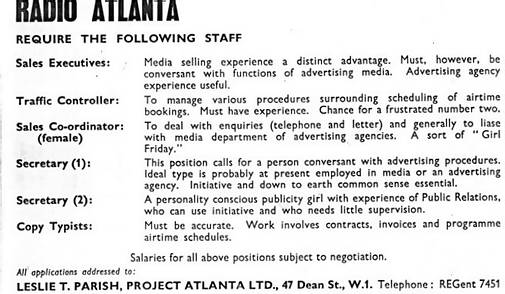
Radio Atlanta advertises for staff. Cutting kindly provided by Hans Knot. Click to magnify.
|
AC: My attention was drawn to the fact that there was a Radio Nord operating in the Baltic off Stockholm. So I called the people up, found out who they were and went and paid them
a visit.
CN: How did you find out about them?
AC: Well, you ask people questions. I'm very good at research. I forget how I did it in detail but I ended up meeting the owners who were Americans, Texans, and very nice people, and eventually had
them visit me in London. Anyway, they were having some difficulty here and there, and eventually the ship came up for sale because they were closing down (in June 1962). I suppose because of suppressive Government acts,
I forget now. I could see that this was an opportunity. I tried to persuade them that they could remain owners and I could operate the ship off England but they didn't like that idea and, while I was busy formulating the
proposal under how we could operate successfully off England, they got scared, as money men often do. They took the ship back to Texas. So, in the meantime, I was having great difficulty in getting people, even lawyers,
to talk to me about it. I know that we went through twelve sets of lawyers to find out how to do this, and many of them wouldn't even talk to us. And my Texan friend who, himself, had seven radio stations in America and
was considered one of the bright executives of America, he rang me and said “we've got it from the horse's mouth that you'll never be able to get away with opening a ship there”. I was broken hearted, because
you know I depended on getting that damned ship, the Mi Amigo, for us. It was already equipped with radio. Eventually, the brightest lawyer that I've ever met, Alan someone, he was able to see what we'd done. By that
time, I'd already got the legal opinion through another lawyer, a leading QC in the copyright forum. We worked out this formula that the ship would be owned by a Panamanian company, that it would be run by a company in
Liechtenstein which would enter into agreements for us to sell advertising time in England, which legally we could do. In other words, we had a company in England that didn't own the ship but did have a contract with the
owner of the ship so that it could sell advertising time and give it so much of the revenue. From that revenue the crew would be paid from Liechtenstein, through Holland, and everything was legal.
CN: What was the name of the company that was selling in London? Was it Hengown?
AC: No, Hengown Limited was the company that employed the disc jockeys.
CN: Hengown paid me ..
AC: Yes, and it got so much every month from Liechtenstein, from the company there, and the company selling the advertising was Project Atlanta Limited, PAL, and it was that formula that was used by
both sets of companies, for Caroline North and Caroline South. But I had this formula worked out so that my lawyers could go to the Treasury, which they did do, for permission for the money to go overseas, and the Treasury
people said, “Yes, this is absolutely above board. It conforms with all English law. You can do it.” From that moment, we knew that we could go and get money legitimately from people to invest.
CN: And then you set about doing just that.
|