|
|
|
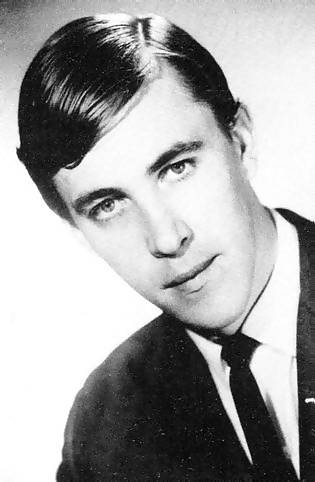
Bryan Vaughan. Radio Caroline promotional photo.
|
Ray Clark has interviewed numerous people involved with Radio Caroline for documentaries and for his book, Radio Caroline: The True Story Of The Boat That Rocked (reviewed here).
One of his interviews was with Bryan Vaughan. Bryan was one of the first to be taken on by Radio Atlanta when it launched, stayed as the station merged with Radio Caroline and, after a period with
Radio Luxembourg, joined Radio Scotland.
The interview was carried out in September 2023 over a Zoom call between Ray in England and Bryan at his home in Australia.
The conversation was long and wide-ranging. We have edited it for publication.
We are grateful to Ray for sharing this recording with us.
RAY CLARK: Thank you ever so much for your time. Let's dive in here. When did you first meet (Radio Atlanta founder) Allan Crawford?
BRYAN VAUGHAN: I met him about October, November 1963 through a mutual friend of ours. I used to work in radio in Sydney and a friend of mine... He was the programme director of a station in Sydney and he went overseas before me.
He was called Ken Evans and I met him in London. He said “oh, you won't believe this, but an Australian friend of mine is going to start a radio station.” And he told me all the story about it
being on a boat and so forth and I thought it was all a bit fanciful. You know what I mean? You think it's pretty unlikely. I went over there to try and get an apprenticeship at the BBC. And I went for an interview at the BBC, an
interview board, and there were lots of people sitting in front of me and in the end, they said, “well, you have to prove that you're going to stay here for a period of time before we allow you to join us or get an
apprenticeship”. So I had to sit around for 18 months doing all sorts of things, like backpackers do, working in pubs and I worked in cigarette packing, W.D. & H.O. Wills in Holborn, packing cigarettes and sending them out
to tobacconists and so forth. And eventually, eventually, almost at exactly the time I was offered a job at the BBC, it was in Northern Ireland, it was to be in Belfast to start there, this guy Ken Evans met me and he said, “look,
you should meet Crawford because he's starting a radio station.” And I thought, oh, well, I'll go along. I didn't know Allan Crawford. I knew he was a music publisher. He'd been in charge of Southern Music in Australia and he went
and became the main man in London - Southern Music is a British publisher. And so I met him. They were in Dean Street in London and it was 49 Dean Street, I think.[1] Next door was a brothel! Right next
door. It had the same entrance, if you understand what I mean (laughs). You went to the side for that purpose and you went upstairs for Allan. And that's where the publishing company was. And right on the on the top floor, he was
building a studio because his idea was to record the programmes and then play them on what turned out to be Radio Atlanta, as you know. And there would have been live announcements but most of the programmes would have been recorded.
I had a background in doing radio, but also had a background in producing record programmes, so I helped build the studio, not that I'm that technical, but I sort of follow instructions, you know what I mean? And then I panelled
(operated the studio recording desk) for all these people who came in, like Tony Withers - he later became Tony Windsor of course - and he was my hero in Sydney. I always wanted to be like Tony Withers.
I had wanted to panel for him when I was a kid.
RC: Because he'd been a huge, huge name back home, hadn't he?
BV: He was a star. He was an absolute star in Australia. Anyway, Crawford got in touch with him. So he was going to be one of the major people on Atlanta. And then there was a guy called Dave Dennis,
who ended up being called Neil Spence. No, the other way around. And then (later) who should turn up but a young boy from Bournemouth, very young, fresh faced boy who turned out to be Tony Blackburn.
He came for an audition. I auditioned him. I auditioned all these people. And so that's how I got involved in it anyway. I didn't know that there was another pirate boat but subsequently, in the beginning of 64, we learned that
Ronan (O'Rahilly) had the Caroline boat, you know, the big one ...
RC: Yes.
BV: In Greenore in Ireland, just on the border of Ireland, Northern Ireland. I've been there subsequently. And he was preventing the Mi Amigo, which was the Atlanta boat, from getting into port. That's where they were both going to
be fitted out. But of course, Ronan - his father owned Greenore ...
RC: It's a handy position to be in, isn't it?
BV: It was very handy. Yeah, yeah. That's why he got the start on Crawford. It's a very long and involved story, really. But essentially, that's what happened.
RC: Had you met Ronan before you knew he'd got a ship? I mean, had he been sniffing around Allan's office?
BV: No, not ever. Not ever.
RC: It's interesting, isn't it? There's different stories about Allan going to him for money, and then him going over to Texas in '63 for Allan. And it's just fascinating. I find the whole thing
fascinating.
BV: So do I, but I don't really know what the right story is. Because when you're in it, you didn't know all those details. All you were worried about was producing a programme or something. You didn't worry about who was paying
Allan.
RC: And you're young and you're a long way from home and you're just doing radio. And that's all that matters, isn't it?
BV: Yeah, exactly. And I mean, to this very day, I really do not know why I decided to join Radio Atlanta instead of getting the job at the BBC which I'd waited for for 18 months. It was just crazy. It's one of those things. But it
fascinated me, I think, really. And Tony Withers was involved in it. And he was, as I said, he'd been my hero.
RC: Yeah, that's going to help, isn't it?
BV: I ended up panelling for him. I thought, look, just give it a go.
|
|
|
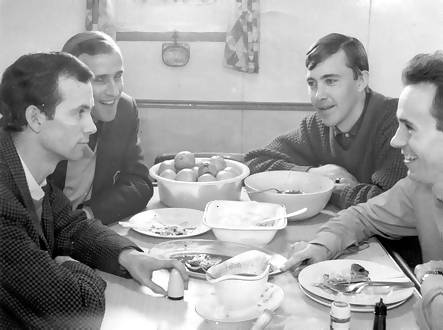
Bryan, second right, enjoying a meal on the mv Mi Amigo. Keith Martin is sitting next to him. Arthur Pelteret, who looked after commercial traffic, is on the far left. Photo kindly provided by Keith Martin.
|
RC: Yeah, yeah. So you were doing the programmes for Atlanta. Simon Dee, rightly or wrongly, has said that they, the Caroline guys, started recording their programmes in Dean Street as
well. Do you remember that? Were you involved with that?
BV: Not really. I had met Simon, but I can't remember them all coming into Dean Street. I really can't remember that. So that's a story that I don't know. And I thought I would have known, seeing as I went to Dean Street every day.
RC: Yeah, you'd have been there.
BV: We (Radio Atlanta) had a lot of programmes, we had a lot in the can. From memory, there were two-hour programmes, but I don't think there would have been three-hour programmes. I just don't really remember that.
RC: Well, in those days, it wasn't done really, was it - three hour, four hour shows?
BV: It doesn't matter anyway. The idea was that we took these programmes out to the ship. I went out. The first time I ever went on Mi Amigo was on a barge from Brightlingsea, which I'd never been to, of course. We stayed in a little
pub right near the wharf and then the barge came. It was one of those barges that goes around the coast and moves cargo from one place to another. And so we got on this barge, and there was no real accommodation on it. You just had
to hang on to the side of it really. And then there was the Mi Amigo. You couldn't miss it because, obviously, a great big mast was there. So we went aboard, and we started broadcasting. I went aboard, I never went off. I did the sort
of continuity, if you like, introduce the programmes. And then, of course, there were always gaps, weren't there? You didn't have 18 hours of broadcast a day[2]. So I took my opportunity (to present shows).
RC: That's right. You've got to.
BV: So the first show I ever did was at 11 o'clock in the morning. I don't know why I remember that, but it must have been a fill-in between 11 and 12 or something. And then, of course, Caroline had already started, and then they came
together and discussed whether what would happen with these two ships (merging).
RC: Had you heard the rumour on the ship that the two groups were talking?
BV: They were talking, I think, on land. We weren't talking to them. They were sort of our rivals, obviously. Anyway it was decided that mv Caroline would go up to the Isle of Man and become Caroline North, and Mi Amigo became Caroline
South. So Simon (Dee) came on board the Mi Amigo then. I might have met him before, but that's really when I met him, and very soon after we started doing programmes live. There were still probably some recorded programmes - Tony
Withers never came out to the Mi Amigo. He only ever recorded his programmes. It was left to myself and there was another guy called Colin Nicol (to play out the tapes).
RC: How did it all end? You had a good year, didn't you? A good year plus with Caroline. You were the boss man, weren't you, after a while?
BV: Yeah, I was all through '64 and the whole of '65. I mostly did the breakfast programme almost the entire time, six to nine. Not always, but the majority of the time, certainly. And also that meant when I say as a boss, I was in
charge of scheduling the various commercials and the jingles and who was on the air at what time and so forth but we had fairly set shifts. So, for instance, I did breakfast and Keith Skues did the morning.
He followed me. One of the funniest things ever was because we were on for so long, so many were on the same shift. So we came on board the same time and went off the same time. You know how very English Keith is? Very English accent.
People thought that I was the Englishman and he was the Australian. He was absolutely bloody horrified by that! He was a lovely guy. He was the best man at my wedding. So you can imagine he was a good friend of mine. When I finished at
Caroline on the end of 1965, I went back to Australia because my sister was getting married and I was giving her away and so forth. When I came back, everything had changed and somebody else had taken over and there was no job for me.
You know, this is radio, isn't it?
RC: Yes. Yeah, it happens.
BV: So I was offered a job on Radio Luxembourg. They were all sponsored programmes in those days, which were recorded in London. You didn't really go to Luxembourg. I did go to Luxembourg occasionally, but mainly it was recorded in
London. I worked for Polydor Records, which (distributed) Atlantic Records as well so it had Aretha Franklin and Otis Redding and all those sort of people.
RC: Brilliant. And Ken was there at that time, was he? Ken Evans had moved over to Luxembourg?
BV: Yes, he was. He was Programme Director or Music Director or whatever. And so I worked for Polydor. As it turned out, ironically, when I came back to Australia, I ended up working for Polygram, which is Polydor. But I wasn't to
know that. Then that was a whole year. And then 1967, I was offered a job on Radio Scotland, which at that point, was off Glasgow, on the west coast. The ship had to be moved. It was a terribly long story about how we got to the other
side but it the most amazing experience of my life, you know, like a Force 10 gale - serious - in a little bloody lightship![3]
RC: No engine ...
BV: It was built to not sink. They're not meant to sink, lightships, because that's why they build them but it was uncomfortable and it had no engine. So they towed it everywhere. We were towed right around the top
of Scotland, right around the top, meant to take three days, took 10 days. The tow rope broke. John Kerr was on board with me, and a guy called Mel Howard. Three disc jockeys
on board. I was already married by then. I had a daughter as well, young baby daughter. And I went off for my two weeks (stint) and came back about four weeks later! It was ridiculous, but it was fun. And you think “why did you
do that?”
RC: Yeah, but what a story all these years later. I'll tell you what, it's worth investigating and I will send you a link to something because what I didn't realise until a couple of years ago,
I've always been a bit of a fan of the RNLI and when the Mi Amigo sank, a chum of mine was on the ship so, you know, it deserves to be supported. But they send out a magazine and the (Radio Scotland) ship, the Comet, when it was a
lightship, was the subject of a heroic rescue off the Irish coast, years and years and years before Radio Scotland came along. I'll try and dig that out for you and send it off to you because it's fascinating to read. And it's the
very same ship.
BV: I would be interested to read that because I've never heard that story.
RC: Yeah, yeah. I'll get that to you. I'm getting a message now saying time is running out (on the Zoom call).
BV: Well, we'll just keep talking. Eventually it'll run out.
RC: One more question.
BV: Yes ask me anyway.
|
|
|
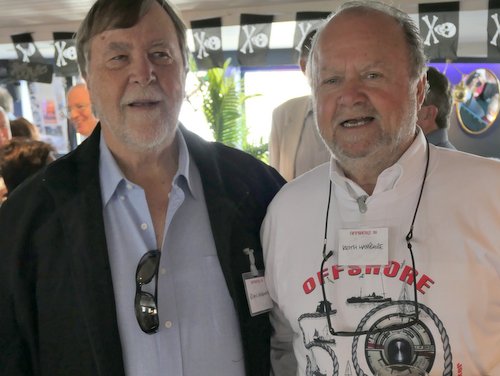
Bryan, left, with Keith Hampshire at the ‘Offshore 50’ reunion in 2017. Photo kindly provided by Martin van der Ven.
|
RC: Ronan, what did you make of him? When did you meet him? How many times? Did you have much to do with him?
BV: Eventually, over a period of time, I met him quite a few times and certainly at all the reunions as well that we had. (thinking) He was a bit of an Irish blarney guy, wasn't he?
RC: (laughing) Yes, that's got it in one.
BV: I don't know. I think he conned Allan. Definitely, you know, without question he did. But Allan was a much more sort of honourable person who was unaware of these conmen.
RC: Yeah, yeah. I think that's fair to say.
BV: Charming with it, of course. He's a charming guy.
RC: Yeah, the most charming man you could have imagined. I mean, when I went out to the ship, I went out in the 80s and I met him again afterwards and he said “hey, Ray, are you going out again?”
I said, “I can't, Ronan. I've got a house. I can't pay a mortgage on the possibility of maybe getting some money from your left sock under the table. I can't do that.” And he said “oh, you don't need money. You could
be the next Johnnie Walker!”
BV: Yeah, right.
RC: When you think that next year (2024), it will be 60 years of Caroline. It's Britain's second longest established radio broadcaster. I mean, that's just crazy, isn't it?
BV: Crazy, isn't it? Yeah. And it all started for me in 1963 in a little studio up the top of Dean Street.
RC: You were there. Something to be proud of.
BV: Well, my grandkids are fascinated by the fact. I've got a few photos, you know, in this room. There's one with Skuesy and Don Allen. He was on our shift as well. They said (about offshore radio)
“Granddad, that's a very weird thing to do....”
NOTES
|
|
It was 47 Dean Street.
|
|
|
Atlanta didn't broadcast 18 hours a day. It was 6am - 8pm, 14 hours.
|
|
|
More on that journey here.
|
Back to Ray's conversation with George Saunders.
|