|

|
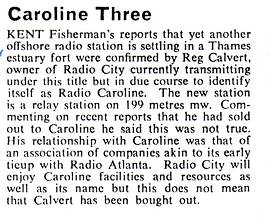
| Trade paper TV Mail reports the tie-up between Caroline and City. Cutting courtesy of Hans Knot. |
In September 1965 merger talks began between Radio City and Radio Caroline South. The
ship-borne station was losing both listeners and revenue to the bigger, more powerful, more professional Radio
London. As the fort was considerably cheaper to operate, it was proposed that Shivering Sands should become the base for
Caroline South. Project Atlanta, which owned and operated the Caroline South ship, sent a transmitter out to the fort
for use by the new station. This piece of equipment was later to be the cause of a dispute which resulted in a raid on the fort and the
death of Reg Calvert. For more on this sad chapter in the history of offshore radio see this page.
As these negotiations were getting underway, Radio City took over the Knock John fort off Southend. (See
Cliff Cuttelle's photo album.) The official reason for this occupation was that Knock
John was to be used as a test-bed for new equipment but, obviously, if Shivering Sands was now to be used by
Caroline, Reg Calvert was looking around for a new home for his station. However, it was not going to be here.
Southend businessman Roy Bates had plans to start his own station, Radio Essex, on the same fort and a feud developed between
the two groups of pirates. Knock John repeatedly changed hands, with each side kidnapping the other's men, and,
although it never actually got violent, some threatening incidents took place out at sea. Fortunately, before it went too
far, an agreement was reached between the two groups. Radio City got back its equipment and Roy Bates got to keep the fort.
Radio Essex started broadcasting from there in October. (See press cutting).

|
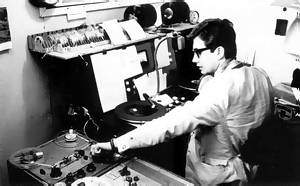
| Tom Edwards in the Radio City studio. Photo published by the Free Radio Association, kindly donated by George Morris. |
Tom Edwards remembers his time on Radio City with great affection:
Reg Calvert hired me some time in 1965 and at once took a
shine to me, as did the whole of his family - Mrs. Calvert plus Candy and Susan the
daughters.
When I first arrived at the towers I was amazed at the size of them, then being hoisted up 90 feet above sea level!
I hated getting on and off the blasted things in all my time there. Chris Cross was senior
DJ at the time, plus Alex Dee. Paul Kramer came along later as
did Adrian Love, Ian MacRae and Alan
Clark, Dennis Straney aka Dennis the Menace (which he was!) and
RWB.
I was a young man of 22 and it was an exciting time. I also made friends on shore in Whitstable and eventually
set up home with Phil Perkins who was a City engineer. A lovely place right on the seafront
with Peter Cushing the actor as a neighbour.
I recall a few members of the City staff wanting to form some kind of company and when Reg heard of this he went into one
of his terrifying rages. He sacked almost everyone on the spot and appointed me as Chief DJ and Programme Director there
and then. Later of course I firmly believe it was Reg's temper that caused his death.

|
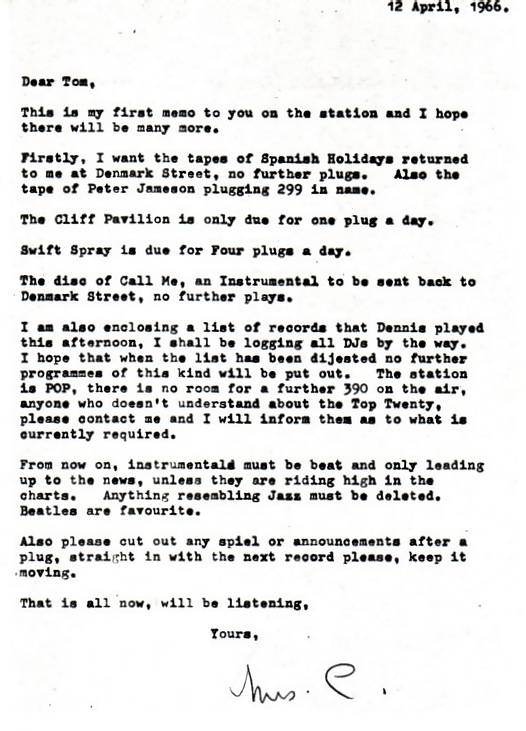
| The first of many memos about station programming sent to Tom Edwards by Mrs. Calvert. Click to magnify.
Kindly donated by Hans Knot. |
I wanted to upgrade the sound of Radio City and thought we must have a news service, which we did -
gathering stories from the BBC Light programme and World Service. I rejigged the stories and thought no one would ever
suss what we were up too.
Ian and Alan formed The Auntie Mabel Hour which was way way ahead of its time ...very very funny and inventive.
We also had The Five by Four Show each weekday with nothing but the Beatles and Rolling Stones music. Hundreds of
requests poured in with every visit from (the tender) Harvester II, always ably supplied by Freddie Downs the
skipper.
I also got Reg to fork out for a proper studio clock and we did have the most accurate timechecks of all the pirates.
I would set the second hand to the BBC's pips.
Reg wanted his groups, The Fortunes and Pinkertons Assorted Colours, played on a regular basis - and why not -
it was his station after all.
What actually paid our wages, and the running of Radio City really, was the American religious programmes such as The
Voice of Prophecy and the unforgettable A.A Allen Revival Hour. The way Allen shouted used to overload the
compressor and sometimes take us off the air. Oh what fun!
With the music, I would sit and sift through all the many singles sent out. I got well known names to say
they listened to City. I knew by instinct that Sinatra's Strangers in the Night would be a number one. All
the guys thought I was nuts. Well I wasn't. And also Frank's daughter Nancy I knew would have a hit with
These Boots Are Made For Walkin'. My favourite, which still makes me think of those far off days, is Fontella
Bass and Rescue Me. Still played a lot but never made it to number one. A turntable hit in other words.
Tom Edwards on the air from August 1966. Recording kindly provided by Stuart Russell (duration 2 minutes 34 seconds)
Ian MacRae on the air from August 1966. Recording kindly provided by Stuart Russell (duration 3 minutes 12 seconds)
Ian MacRae and Alan Clark on the unique Auntie Mabel Hour on Radio City. Recording
kindly provided by Nick Widdows (duration 2 minutes 49 seconds)
The merger talks with Radio Caroline South collapsed and Reg Calvert carried on the operation of
Radio City on his own. At the same time he began talks with Caroline's great rival, Radio London. The fascinating
book Starmakers And
Svengalis has a chapter devoted to Reg Calvert. In it author Johnny Rogan suggests that Calvert had realised
by this stage that offshore radio from a fort could not last forever and wanted to sell up while his station was at the
peak of its success. Rogan also reveals that the ever-inventive Calvert had a plan to use the money raised by
selling Radio City to launch a pirate television station from a submarine!

|

| Radio City promotional postcard. DJs pictured, clockwise from bottom left: Ian MacRae,
Eric Martin (not the same man mentioned by Johnny Flux), Alan Clark, Tom Edwards,
Paul Kramer, Phil Jay and Ed Moreno. These last two recorded
their shows on land and did not work on the fort. |
After long discussions between Reg Calvert and the Radio London organisation, an agreement was
reached to launch a sweet music station from the fort to be called U.K.G.M (United Kingdom Good Music). But,
before this could happen, in the early hours of 20th June 1966 the fort was boarded by a group of unemployed dock workers
led by Oliver Smedley and Kitty Black, two investors in Project Atlanta, the owners of the transmitter that had been
delivered to the fort the previous year. (There is a press cutting relating to this incident here
with more on successive pages.)
The dispute is chronicled in greater detail here. It resulted in Radio City being silenced for
a week and, tragically, Reg Calvert being shot dead by Oliver Smedley.
Paul Elvey was on the fort at the time:
Unfortunately everything started to go wrong with the business side. Reg had serious problems
with a partner, lost his temper and threatened him. The other guy, apparently in self defence, fired a fatal shot. That
basically was the end of Radio City. There was also the occasion when we were invaded by some guys who were paid to seize
the station. I awoke one morning to find a guy standing by my bed pointing a gun at me. I just told him to take whatever
he wanted. I was just worried about my colleague Ian West who was in an adjacent bed to me. I knew he had an air rifle
under his bed. I thought my God if he instinctively reaches for his rifle it could be awful. I quickly
explained this in whispered tones to the gang leader. He was OK with it. He realised we were definitely not going to pose
a threat.
At the end of the week, the boarding party departed. The shell-shocked Dorothy Calvert, Reg's widow, announced
that she would keep Radio City going. She already looked after the programming side of the station but now she had to deal
with the business side as well. She discovered that City's finances were not in good shape, with numerous debts
dating back to the unsuccessful partnership with Caroline South. She immediately cut staffing, clamped down on expenditure
and, despite various religious advertisers deserting the station after the incident, she managed to get things under
control.
It is back to business as usual for Ian MacRae on 27th June 1966, the days after the raiders left the fort. This clip is
part of a longer recording available to members from The Offshore Radio Archive (duration 3 minutes 38 seconds)
In late 1966 both of the other fort-based stations, Radio Essex and Radio 390, were prosecuted under the Wireless
Telegraphy Act for broadcasting inside territorial waters. It was only a matter of time before the same happened to
Radio City. However, although the future looked uncertain, City appeared confident on the air. Recorded shows by American
disc-jockeys Gary Stevens and Ralph Cooper were
imported and broadcasting hours were increased from 13 to 18 a day.
| Radio City Programme Schedule, January 1967. |
| Monday - Friday |
Weekends |
6.00am Early Bird show
7.30 Voice Of Prophecy (repeat)
8.00 Breakfast Break
8.30 Allen Revival Hour
8.45 Up And About
10.00 Just Go (incl. 10.45-11.00 Coffee Break and mon, wed, fri 11.00-11.15 Radio Doctor)
12.00pm Gary Stevens
1.00 Breakaway
5.00 Five by Four
5.30 Sixty Minute Special
6.30 Voice of Prophecy
7.00 Ralph Cooper
7.30 City by Night
(Friday 8-9pm The Auntie Mabel Hour, repeat)
11.00 Late Date
12.00am closedown
News: On the hour 8.00am-8.00pm
|
SATURDAY
6.00am as Mon-Fri
4.30pm Discamania
5.00 as Mon-Fri
12.00am closedown
SUNDAY
6.00am Early Bird show
7.30 Voice Of Prophecy (repeat)
8.00 Breakfast Break
9.30 Basildon Request Show
11.00 Just Go
12.00pm A La Carte
2.00 The Auntie Mabel Hour
3.00 Breakaway
4.30 Discamania
5.00 Cobweb Corner
5.30 Release Date
6.30 Voice of Prophecy
7.00 City Top 20
8.00 City By Night
11.00 Late Date
12.00am closedown
|
| Information from Offshore Radio by Gerry Bishop, published by Iceni Enterprises. |

|
| Press advert for Radio City, mentioning the 500th Five By Four Show. There is an extract from
the 200th edition on the second page of this feature. Cutting kindly provided by Hans Knot. |
Ralph Cooper getting funky on Radio City, 12th January 1967 (duration 4 minutes 45 seconds)
The Auntie Mabel Hour was normally presented by Ian MacRae and Alan Clark but both were on shore leave when
this programme was broadcast on 18th December 1966. Adrian Love and Paul Kramer deputise. Both clips are part of longer
recordings available to members from The
Offshore Radio Archive (duration 2 minutes 51 seconds)
In January 1967 the station moved into bigger offices, just off Bond Street in London's West End. But it did not
have much time to use them. Within a month Radio City, like the stations based on the neighbouring forts, was prosecuted
under the Wireless Telegraphy Act. Six months earlier the police had told Mrs. Calvert that her fort was outside the
territorial limit and they could not help her get the raiders off the fort. Now, apparently, it was inside UK waters
after all.
On Wednesday 8th February 1967 a Southend court found Dorothy Calvert guilty of broadcasting without a license. She was
fined £100. That night, at midnight, Radio City closed down.
Tom Edwards, Ian MacRae and Alan Clark get a bit political during the final hour of Radio City (duration 2 minutes
33 seconds)
Tom Edwards and his colleagues close Radio City down for the final time. Both recordings kindly provided by James
Pringle (duration 1 minute 53 seconds)
Tom Edwards again:
I decided that, for the final hour, all of us should be in the studio to talk about what
our dreams were for the future. An emotional sixty minutes and I chose Shirley Bassey singing The Party's Over
as our last record. Which it was. The rest as they say is history.
We all went our separate ways. Some of the lads are no longer with us. Those of us who are left are much older now. I'm
told that to look back and live off the memories of life is maybe wrong. I don't think so. What fun we all had - but
also touched by tragedy. I'm so glad I sent that seven minute tape to Reg all those decades ago. Little did I
realise what fate had in store. And you know what? I wouldn't have missed it for anything!
I got the nickname of Mother on Shivering Sands.........and it sticks to this very day! I used to fuss
and cluck about. Old habits die hard.
That final show was a sad farewell but the station was professional to the end. When it was all over, the City DJ team
split up. Alan Clark joined Radio 390, where he became known as Christopher Clark; Adrian Love and
RWB worked on London 67, a syndicated radio show they hoped to sell round the world; and three City men went
to Radio Caroline: Paul Kramer to the North ship, Tom Edwards and Ian MacRae to the South. Eric Martin left broadcasting
altogether.
Radio City claimed an unconfirmed audience of three million. It was never one of the big boys but there was something
special about it. The technical quality may have been a bit dubious, the high turnover of DJs may have meant that occasionally
the on-air polish slipped, but it had an enthusiasm and excitement all its own. Many Radio City presenters went
on to enjoy long careers in broadcasting. It was a first rate training ground, had some genuinely innovative programming
and was well loved by its listeners. It would be greatly missed.
|