|
|
|
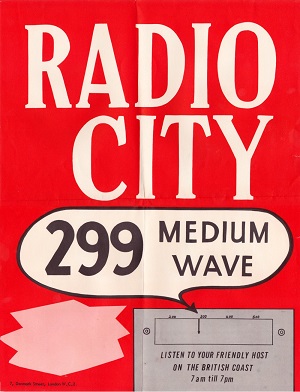
A poster advertising Radio City, kindly provided by Mike Lewis. More of his City memorabilia can be found here.
|
Radio City was never a big operation. The equipment was basic in the extreme and the living conditions were pretty unpleasant. (See the Eric Jay photo album for some fantastic
colour pictures of the station as it was in 1965.) The occupants of the fort mainly survived on a diet of tinned meat pies, beans on toast, crackers and condensed milk.
Towards the end of Radio Sutch, as the Screaming Lord and his band-mates lost interest, it was the long hours put in by generator engineer and part-time DJ, Paul Elvey, that kept the station
on the air. Transmitter engineer Dick Dickson was also heard and, in the dying days of Radio Sutch, they were joined by a new DJ, Chris Cross. Over the next few
months, as the station became established under its new name, and on its new wavelength of 299 metres, he seemed to be on the fort almost permanently, working alongside a steady stream of young hopefuls, sent out by
Reg Calvert as “trial DJs”. These trial DJs were unpaid, apart from their board and lodging. Gradually a strong team began to develop. Alexander Dee
and Dennis The Menace were firm favourites, joined later in 1965 by Johnny Flux and Tom Edwards. Both these two and Paul Elvey
have been kind enough to share their memories with The Pirate Radio Hall of Fame.
 Chris Cross plugs the bizarre ‘Anti-City Show’ which welcomed complaints about the station, followed by two extracts from the programme. All clips from 1965, the first is courtesy of
Offshore Echo's, the second from Colin Taylor, the third from Hans Knot (duration 3 minutes 32 seconds)
Chris Cross plugs the bizarre ‘Anti-City Show’ which welcomed complaints about the station, followed by two extracts from the programme. All clips from 1965, the first is courtesy of
Offshore Echo's, the second from Colin Taylor, the third from Hans Knot (duration 3 minutes 32 seconds)
Chris Cross, with interjections from Alexander Dee, on the 200th edition of the daily ‘Five By Four Show’, November 1965. ‘Five By Four’ played nothing but Beatles and Stones tracks and proved very
popular. Recording kindly provided by Stuart Russell (duration 3 minutes 51 seconds)
The station operated on a shoe-string, but it did begin to make money. Religious organisations booked time for their evangelical programmes and many local advertisers took advantage of its low rates.
For a time the station broadcast on two wavelengths, 299 and 188 metres, with the religious shows concentrated on the latter. It was a good plan but it did not go down well with the advertisers who wanted their shows
on the frequency that people actually listened to! The second outlet did not last long.
Just a few of the many sponsored religious shows that featured on Radio City and helped keep the station solvent. ‘Radio Bible Class’, ‘J.J Staff’, ‘I Have Found The Answer’ and
‘Voice Of Prophecy’. All clips kindly provided by Nick Widdows (duration 2 minutes 2 seconds)
Initially the station suffered from poor reception but this improved dramatically when a new aerial mast was built in June 1965. Standing 240 foot high on top of a 117 foot tower, the new antenna put
out a good signal which was audible throughout most of south-east England even if it still did not penetrate too well into the heavily built-up capital. The new antenna also gave the station a slogan. It was “the tower of
power”.
The station's jingles were recorded by various bands managed by Reg Calvert. They might have lacked the professionalism of the PAMS jingle packages heard on other offshore stations but they did the job.
As an engineer, Paul Elvey remembers the technical challenges of operating from a fort on a limited budget:
|
|
|
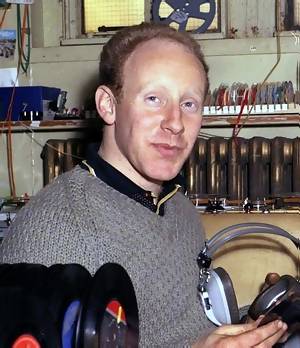
Paul Elvey in the Radio City studio. Photo courtesy of Eric Jay.
|
“I was very pleased to land the job as engineer for Radio City. It meant that I was no longer having to work in the Far East or Africa which entailed many months away
from home. At last I would be home quite regularly. Also the money wasn't too bad. There were very few of us who were on salary; most guys were doing it for the thrill and in the hope of becoming a famous DJ.
For me it was just another project. My previous project was working on the installation of generation equipment for a tin mine in central Africa so for me this project was heaven. Working for Reg Calvert was great.
He really did not understand much about engineering problems but he generally did listen and take advice. Of course he was a great show biz agent so he was no fool. This was a particularly challenging time for me as
an engineer. As soon as I arrived at the Shivering Sands forts I was hit by the sheer scale of the problems that confronted us. Most importantly I was appalled at the tiny transmitter and the small power source which
was an ex-army 24 volt generator and a bunch of batteries. This clearly was not the way for a sensible approach to running a commercial radio station. The most urgent requirement was to dramatically upgrade the
electrical power available for two reasons. One, for domestic and general use we naturally needed lights, cooking, pumps etc. But mainly we needed considerable electrical power to drive a large transmitter. I discussed
this with Reg and explained that the only way you can radiate a strong signal that would reach London is by having a transmitter of suitable RF output, but that would require a large diesel generator to power it. He
immediately took this on board and arranged for the generator and transmitter to be delivered.
Another essential requirement was a decent aerial. Unfortunately Reg had his own ideas on this. He sent out a boat load of scaffold poles and clips. I had grave misgivings about this. However we all set to the task of
building a mast but, of course, the first strong wind was the end of the mast. Reg conceded and a company was brought in to erect a proper aerial.
I felt fortunate in as much as there was a group of us who were all very enthusiastic and good at their own jobs but equally willing to help out with anything else. We had a good radio engineer in Phil
Perkins. Very few people understood much about transmitting equipment, especially on the general public broadcast bands. Short wave was not a problem, many guys could handle that, but a big AM rig was not the kind of
thing that many people knew anything about. The only people that had that kind of knowledge were with the BBC, British Telecom and the Army. And those guys were under strict orders not to help.
|
|
|
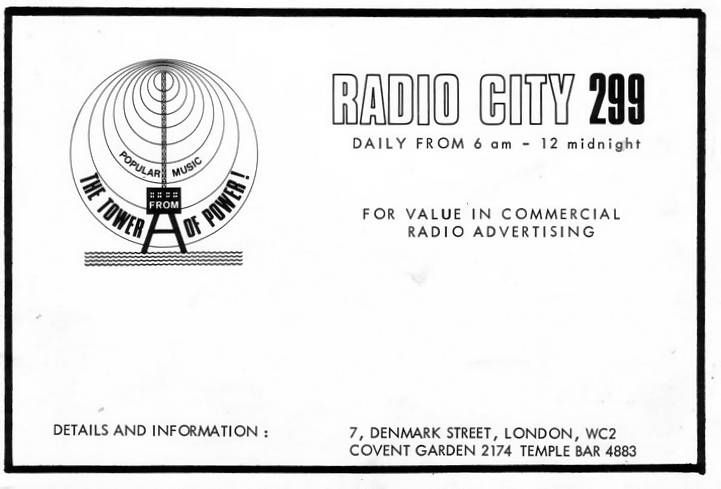
Radio City compliments slip, courtesy of Hans Knot. Click to enlarge.
|
One of the other things that were so vital to the operation was a good reliable shore base. We had some brilliant people in the team at Whitstable. They would do whatever
was required to keep us supplied. Sometimes the weather prevented our wonderful supplies skipper, Fred, from coming out in his fishing boat, so we would just had to rough it for a few days. I well remember feasting on
toasted stale bread and condensed milk sandwich. But the whole crew was in the same situation so morale was never too low. We just all mucked in and made the best of it.
Personal hygiene took some effort. We had to haul a few buckets of sea water up to the station and try to wash with that. I found that the best stuff to use to get some lather at all was Stergene. It worked and we were
able to strip wash using that. Guess it was all good character building stuff!
I also used to DJ most days, generally early in the morning or when the DJ was doing his cooking stint. I really got quite used to it and found it was good fun. It was quite funny to watch people come on board to DJ after
submitting a very good tape to be considered as a station DJ. Some of them would completely freeze when confronted with a live mike. Guess it's one thing talking into a mike connected to a tape recorder at home but when
you know the mike is going out to a huge audience its quite another thing. Some of the best DJs we had came from Australia, because they had had some real experience of radio work. I well remember Ian
MacRae and Dennis ‘The Menace’ Straney, both excellent.”
|