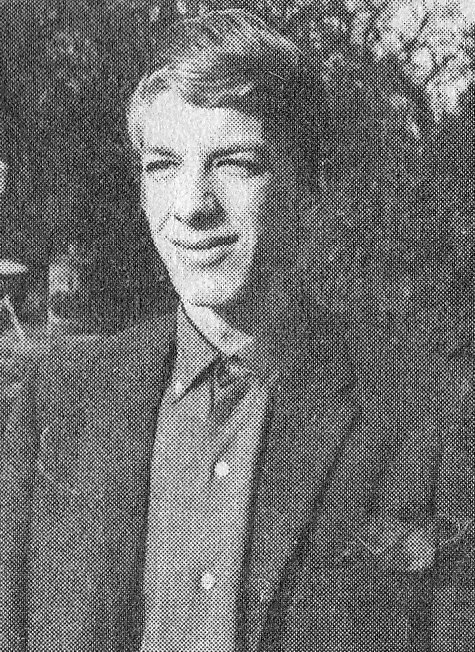
Radio 270 employed many experienced broadcasters who had learnt their craft on forces broadcasting, Australian commercial radio or on other offshore stations. However it also took on some local
lads with no previous experience. One of these was blues fan Robin Best. He tells us how he got the job in the DJ biography section of The Pirate Radio Hall of
Fame. Here he remembers his time on the Oceaan 7:
 |
|
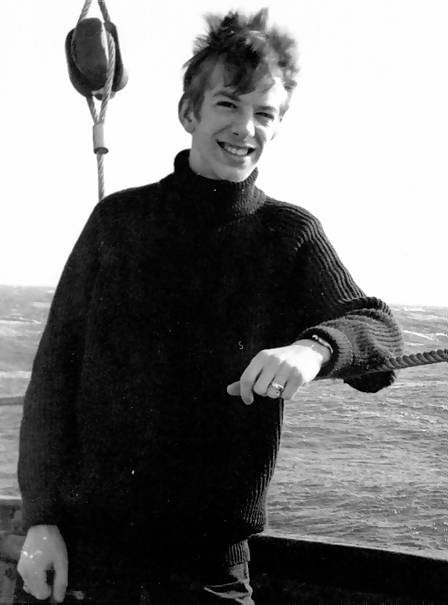
Robin Best on the deck of the mv Oceaan 7. Thanks to Robin for the photo.
|
“At the time I joined, October 1966, the Oceaan 7 was anchored 4 miles off the coast of Scarborough. I was informed that I should work a week on board as a DJ, with a
week off, working for Wilf Proudfoot on his special projects. I was to be paid the princely sum of £25 per week. I later found out that this was exactly the same as all other DJs except that they had to sell
advertising during their week off. This fact immediately marked me out as ‘different’. I was introduced to Vince ‘Rusty’ Allen and told that he would act as my
mentor. There was only sleeping room for a shift of 4 DJs in the central mess (four bunks taken from caravans) so a kind member of the crew walked me to their quarters deep in the prow of the boat. This was the best
thing that could have happened. Firstly, the crew recognised me as ‘one of them’ i.e. a local lad with a local accent, so there was always someone friendly on hand to offer advice with the inevitable
seasickness. Also I was sleeping in a purpose built bed that was part of the fabric of the boat. When it got really, really rough (often) I stayed within the confines of my bunk. The mess-sleeping DJs were thrown
out of their wooden bunks onto the floor and all over the place!
The station broadcast between 6.30am to 1am and was covered by four DJs. My week's shift consisted of:
6.30am to 9.00am: Paul Burnett
9.00am to 12 noon: Vince ‘Rusty’ Allen
12 noon to 2.00pm: Roger Scott, later Guy Hamilton
2.00pm to 4.00pm: Brendan Power
4.00pm to 6.30pm: Roger Scott, later Guy Hamilton
6.30pm to 7.00pm: American evangelist Garner Ted Armstrong with The World Tomorrow
7.00pm to 9.00pm: Paul Burnett
9.00pm to 12 midnight: Brendan Power
12 midnight to 1.00am: Vince ‘Rusty’ Allen
News and weather were broadcast by an off-air DJ every half-hour between 6.30am and 9.00am, and every hour between 9.00am and 1.00am.
We used a Top 80 playlist format. (* see below.) We played them in the following order:
a single from between 1 and 20 in the chart
a single from between 41 and 60 in the chart
an LP track (free choice)
a single from between 21 and 40 in the chart
a single from between 61 and 80 in the chart
a new release ‘power play’, etc.
This system was to be strictly adhered to on pain of death! A chart listing the eighty discs was pinned up in the studio. Each time a disc was chosen you had to place a tick next to its name. The shift's Programme
Controller would check the chart daily to ensure all eighty discs were being aired equally. As we all used different coloured pencils to mark up the chart, he would speak to anyone that favoured a particular artist
or record. My colour was purple by the way. The top 40 chart show took place on a Sunday between 4.30pm & 6.00 pm. A committee in Wilf Proudfoot's office decided on the top 40 chart positions, and what the new
release power plays were to be. All the aforementioned were brought out in boxes at shift change on a Thursday. On Sunday at 4.25 it was all hands to the wheel to get the numbered boxes of discs and the charts
swapped over! Usually the DJ leading up to 4.30 would play a pre-taped segment from 4 pm onwards to facilitate a smooth change.
For weeks one and two of my life on the ocean wave, I sat in with Rusty on his morning show learning the use of the technology and joining in with his cheery banter. I also started to take part in the news/weather
reading shifts. Then my apprenticeship really got under way when they allowed me to broadcast exactly what music I wanted between the hours of 1 and 2am when they were normally closed down. The blues formed a major
segment of my show, liberally mixed with records on the Tamla Motown, Chess and Stax labels.
 |
|
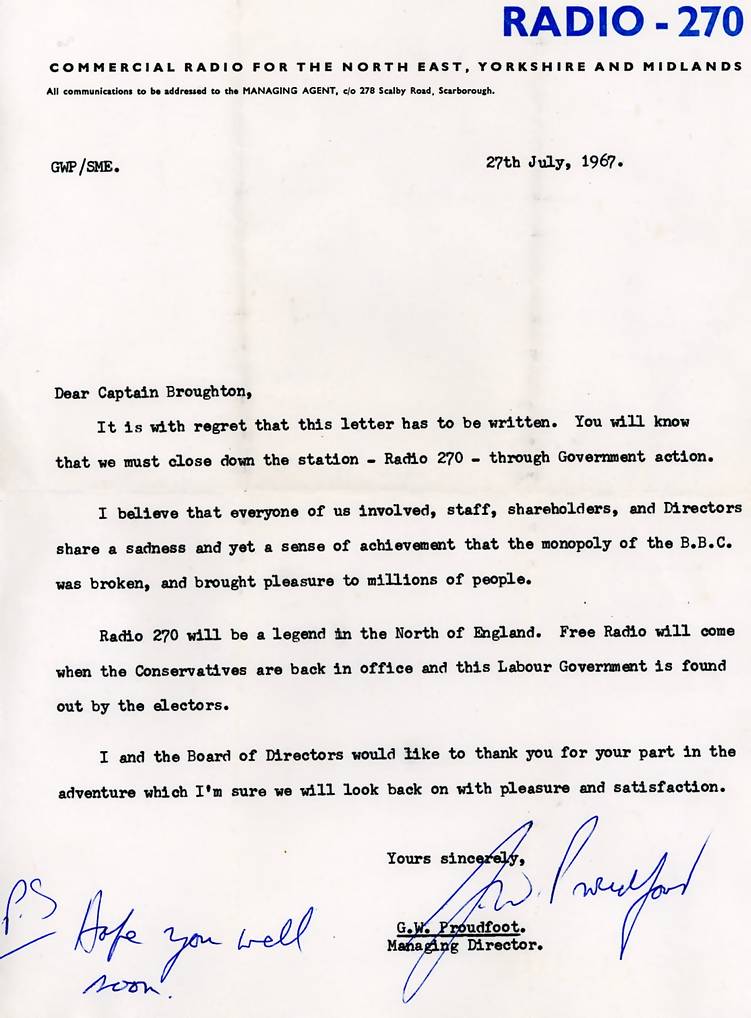
Letter from Managing Director Wilf Proudfoot to one of the Captains of the mv Oceaan 7, Charles Broughton, at the time of the station's closure in August 1967. Click to enlarge. Letter kindly provided by
Colin Narramore.
|
The next major event was the ship moving from off Scarborough to the relative calm of Bridlington Bay. Despite what you may have heard/read since, this move had nothing to do
with pressure re. the stormy seas from the DJs. The decision was all about money! Scarborough was a Corporation-run harbour so they charged for everything, including the vast amounts of drinking water we used to take
onboard when we put in. Bridlington, on the other hand, was designated a ‘port of convenience’ so there were no berthing fees etc.
I can't remember exactly when I got a normal daytime show, but I do remember that Brendan Power left to take up another job, in the heartland of the USA I think. I didn't get his afternoon show (I wasn't considered
good enough yet) but I did get the evening show (9 until midnight) which was where I really wanted to be. The drawback now was that I had to conform to the playlist format - a trade off I suppose allowing me to play
old style R&B in my LP slots. A lot later I did a bit of horse-trading with Rusty. I bargained for his midnight to 1am slot to add to my own 3 hour programme. In return I took over some of his news reading duties
so that he could concentrate on his admin.
And that's that… The sum total of my broadcast life was eventually a 4-hour programme that I broadcast until I permanently returned ashore in late, late spring of 1967. Why did I leave before the bitter end?
Well, lots of little reasons really. We all knew legislation was bringing the end after the General Election of 1966
a) so change was a daily event with most of the old hands leaving to seek out broadcasting jobs all over the world (Hal Yorke was reputed to have got a job broadcasting in English for 1 hour a day in Lourenço
Marques, Mozambique) and
b) nearer to the actual end inevitably wages started to go missing/be late. I tackled Wilf Proudfoot re. the latter and he said ‘don’t worry, stick with me, I've got big plans’. This did not endear
me further to the remaining cadre of DJs as I was always considered to be Wilf's boy anyway!
His big plans? He was gambling that the Tories would get back in at the next election (1970) and that the Marine Offences Act would be history! In preparation he had bought an ex-Government radio station far out
in the countryside around Scarborough. This station had seen active service during the Second World War and had continued as a spy type listening station during the Cold War of the 1950s. Basically it was an
underground bunker complex. The radio masts above ground were the only thing to identify that it existed. Wilf wanted to turn this into a commercial radio station broadcasting to the whole of Yorkshire! And he wanted
me to be a big part of this set-up. For my part, I couldn't wait that long on a mere possibility - I needed to be earning money. So, in late 1967 after working on various pet projects, I split with Mr Proudfoot for
good and went on to search out my own destiny.
In early 1968 I joined a national firm of bookmakers and I have been here ever since. A strange coincidence is that my son, who has lived and worked in Tokyo, Japan for the last ten years, is also a DJ (for pleasure,
not his main career). He works mainly in the clubs in town but does have a regular monthly spot on the radio.
Anecdotal memories (did they really happen? You bet they did!)
Surviving many bad storms. Our ship's radio transmission mast was 10 feet taller than the length of the ship and a real hazard on deck was the whiplash effect of breaking
stays that held the aluminium mast in position. In the worst winter storm, the T bar atop the mast almost touched the waves as the boat rolled from side to side and an electric corona danced across anything wet.
Also our ship was flat-bottomed with no keel so it used to sit on the water rather like a duck. In the worst storms the Captain used to float large buoys out port and starboard. These each carried a chained anchor
left and right, and we would then steam into the teeth of the storm in order to stay afloat. I also remember our ship being tossed about so roughly, every which way, that we lost whole sacks of potatoes, onions and
carrots washed overboard from their storage space under the forecastle never to be seen again!
Being absolutely knocked out on first hearing (late 1966) an advance copy of the single Hey Joe by Jimi Hendrix, then keeping it hidden away from every other DJ,
but playing it constantly on my show stating ‘this is the future...’
Being violently sick during my first weeks aboard with the constant rolling from side to side, then recovering and being fine (finding my sea legs) .... but feeling much worse (i.e. more sick) on my return to
shore again at the end of the week after realising that the land I walked on wasn’t moving!
Discovering the Sue record label in the LP library in the early hours of the morning and thinking I'd discovered heaven! My favourite tracks soon became the theme tunes to my programme, in order, the wailing
blues of Elmore James & Sonny Boy Williamson on Dust My Broom, the chaotic magic of Rosie & the Originals on Give Me Love, the sheer genius of Chris
Kenner on Land of a Thousand Dances ...
Being grateful for the support of the ship's crew during the difficult time (aged 18, I thought I knew everything but really knew nothing). Sometimes you really needed those solid, dependable guys. One day when
the sea was as calm, solid and level as a marble floor and we all sat lazily around in the mess, one of the crew noticed something looked different. He went to investigate. It turned out that a great big piece
of kit (filtering sea water and turning it into drinking water, but never used) bolted to the stern hull had blown said bolts and the North Sea was flooding in causing the boat to sink! The crew rallied round,
blocked off the leaks and pumped out the bilges - thank you lads...
Communications - strange fan letters that we received such as one I got from a lady who shall remain nameless! She said she used to listen to my programme laid in bed next to her snoring husband. She dreamed that
she and I were laid next to each other on a desert island in the sun. She also imagined that we were dressed in 17th century attire! I also remember very simple competitions that were devised to sample listener figures
through the response: e.g. who is the reigning monarch? It always amazed me how many people got the answers wrong! The fact that the sea amplified the radio signal, but the land hindered it, meant that we received
International Wireless Reception postcards from places as far away as America and Japan, yet reception was very poor in places such as hilly Sheffield, a mere 30 odd miles away.
Thinking that Procol Harum's A Whiter Shade of Pale was the strangest record I'd ever heard upon getting an advance copy in April '67, but playing it as often as
I dared all the same.
Being called ‘pirates’ and being treated as such e.g. being constantly buzzed by RAF planes on training exercises whilst aboard out at sea, and having to produce a valid passport when we came ashore
in Scarborough even though we hadn't been anywhere except 4 miles off the coast in international waters!”
(* Web-master's note: Robin remembers using a Top 80 on Radio 270 but this chart from February 1967, provided by Robin's colleague Guy Hamilton, is a
Top 100. When asked about this, Robin said “maybe my memory is playing tricks on me - after all, it is 40 odd years ago!”)
More Radio 270 memories over the page.
Back to the previous page.
Some photos that Robin took on Radio 270 can be found here.
|