Hal Yorke has contacted us from Hong Kong with some polaroid photos he took on board the Oceaan 7 and some words about his time on Radio 270. In particular he wants to pay tribute to the bravery
and dedication of the ship's crew. (You can find more of Hal's photos here.)
|
|
|
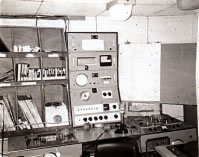
The Radio 270 studio.
|
“The Radio 270 studio, a view of the control panel, Revox tape deck to left, EMI studio tape recorder to right, corner of gimbals supporting two Garrard turntables
just visible at extreme bottom right, playlist board to right of panel, Bulova electronic watch in circular gilt wall-mount housing towards left of panel containing two small knobs at right side. The air conditioner
outlet was a shaft immediately above the disc jockey's head, leading to a standard window-type air conditioner mounted in a weatherproof housing above the deck. This photo was taken from the doorway from the recording
booth, indicating the cramped size of the studio. The bulkhead behind the panel was set alongside the port side of the ship's hull, just below water level.”
|
|
|
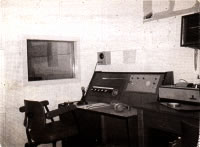
The Radio 270 news booth.
|
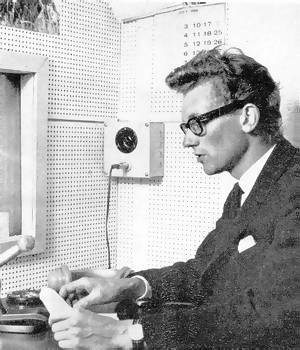
“The recording/news booth with double-glazed window into studio. Desk with domestic Grundig tape recorder and typewriter (out of frame) at right. The studio and
booth were enclosed in a Faraday cage to screen them from radiated interference from the transmitter next door and the aerial mast immediately above. The messroom is the other side of the right hand bulkhead,
i.e. for'ard with the crew's quarters in the foc'sle. The heads and showers were aft of the transmitter room.”
|
|
|
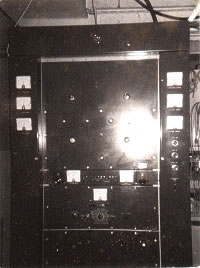
The Radio 270 transmitter.
|
“The RCA transmitter in its own room immediately aft of the studio and recording booth. The aerial mast was immediately above the bulkhead between the transmitter
room and studios, mounted on a vertical steel girder stepped into the keel below. This girder was visible running down the aft end of the mess room and into the space below.
The transmitter room, studio and messroom were located in what was originally the ship's fish hold, though fortunately the smell had been successfully eliminated during the conversion. Entry to the lower deck was via
a companion way leading down into the galley, from which a door led immediately into the messroom, and by a second companionway aft of the transmitter room. The mess table and banquette seating were arranged across
the middle of the messroom with curtained-off sleeping bunks arranged along the port side and the for'ard end. Massive storage heaters were located at each end of the room and were necessary because except in the
warmest weather, the temperature was that of the surrounding sea water. The starboard side of the messroom served as part of the passageway alongside the entire length of the lower deck. This was unenclosed, exposing
the painted steel skeleton and plating of the hull.”
|
|
|
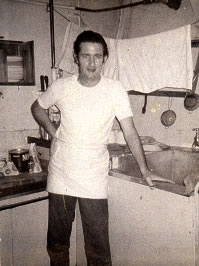
The Radio 270 galley.
|
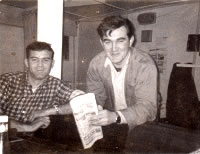
“Left: The cook in the galley (not the original cook, Norman). I don't remember his name but he was the one for whom a crew member sent out an unauthorised mayday
call for a lifeboat when he cut his finger! The galley was located immediately for'ard of the messroom and also contained the main companion way up to the deck.
|
|
|
A Radio 270 coffee break.
|
|
|
|
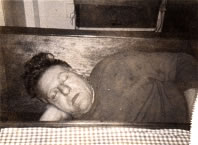
It is all go for the hard working crew!
|
“The crew were a very hard-working band of men, always on the go and an inspiration to all. I have never seen a fitting tribute to the deck crew for their heroic
efforts on the Sunday morning when we almost lost the transmitting mast for the second time. We were slowly steaming out to sea to put as much space as possible between us and land as the Oceaan 7 battled the worst
storm in the North Sea for 75 years. Suddenly the ship gave an almighty lurch that threw me out my chair. I was just getting back into it when Noel Miller put his head in the door and told me were off the air. I went
up the aft companion way to the deck and, from the shelter of the hatch cowling watched the crew risking their lives trying to catch a half-inch steel transmitting mast stay cable that was thrashing around in the gale,
its deck shackle having fractured under the strain. Any of those men would have been cut in half if the cable had hit them.
|
|
|
Hal Yorke in the news booth.
|
I have a vivid memory of Tommy eventually managing to grab the end of the cable and being lifted off his feet as he struggled to control it while others went to his aid. After
what seemed an eternity, they succeeded in lashing it to the main steel deck rail running along the side of the ship. They then tackled the mast itself, which had sheared off from its supporting post girder and was
dancing alarmingly around the two-foot square mounting plinth. The crew gradually eased it back into position with crowbars and temporarily secured it with wooden wedges. All this took place with the ship rolling
and bucking violently in the storm, the movements much wilder and more unpredictable than on a normal vessel because of the pendulum effect of the 150 foot radio mast.
Fortunately the storm began to moderate, the skies rapidly cleared to a bright, cloudless blue and throughout the afternoon the enormous waves gradually subsided to a heavy swell as we limped slowly down the coast
and, in the evening, into Bridlington Harbour, which from then on became the ship's main shore base.
It is not too much to say that the efforts of the crew that day almost certainly saved the ship and everyone aboard. It certainly put into sharp perspective the schoolgirl hysterics of one group of DJs who panicked
when they heard there was water in the bilges - a perfectly normal situation with any ship and which is why bilge pumps are fitted and used on a daily basis!
Main electrical power was provided by two Dale diesel generating sets in their own machine room aft. These were products of the company founded by Radio 270 director Leonard Dale. A month after leaving the station
and joining Radio Hong Kong, then located in the headquarters of Cable and Wireless in the middle of Central District, I was being shown around by the station's chief engineer. We went down to the basement to see
the standby generators that would keep Hong Kong in touch with the rest of the world in an emergency and I found myself looking at two identical Dale generator sets. I was able to tell the chief engineer that only
weeks before I had been a friend and employee of the man whose company made them, thus gaining at least a hundred brownie points.”
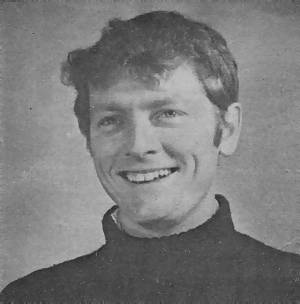
Next up, it is one of Radio 270's longest-serving and most popular DJs, Mike “Mikey-Mo” Hayes:
|
|
|
Mike Hayes.
|
“270 wasn't only having fun, it was getting satisfaction: the satisfaction that it contributed to brightening up the lives of hundreds of thousands people in the north-east.
And now the satisfaction that, after 40 years, you still remember us!
I was broadcasting on the Aden Forces Broadcasting Association (1963-1965) when a young airman came to the studio looking to join the station. His name was Paul Burnett and we finished up
doing a comedy-cum-satire programme together. I didn't know it then but Paul and I were to be opposite numbers on 270.
I remember going out to the Oceaan 7 with Noel Miller. I was feeling very apprehensive and nervous. Stage fright has always been a major problem with me. Noel was great and patient. After
an hour or so the nerves were gone. I was allowed to stay and ‘Mikey Mo’ was born.
Life on board was easy-going. Crew, technicians and DJs all messing together. It wasn't a large ship so you had to. I remember the grub was good and, now and then, we'd get spoiled by returning fishermen who gave us
some fresh fish or crabs or, if we were lucky, lobsters.
The turntables were mounted on gimbals to ensure that they remained horizontal while the rest of us were in motion. After three hours in the studio you were convinced that you were sitting still while the turntables were
going absolutely wild. And they had to work hard sometimes. I seem to remember force 10 easterlies which put the fear of God into me. A new DJ, whose name I’ve forgotten, was so sick that after two days on board
the local lifeboat had to come and get him. He was never seen again. Touch wood the sea-sickness never got to me.
On shore we had fun compèring the 270 gigs with the pop greats of that year: the Troggs, Manfred Mann and many others. Another giant plus for the ‘pirates’ was the fact that we stimulated the pop industry,
increased record sales and helped many a new group on their way to fame and fortune. One of my high points was being the first (don't laugh) hippy DJ. Dressed in my floral trousers, golden shirt and ‘mink’ belt,
I recited my freshly written poetry while the audience threw flowers. Dangerous though, luckily, just in time I saw the rather long and heavy sun-flower spearing my way and ducked. So much for flower-power.
The end came too soon. As it happened I was on shore on the last day and arranged for a Scarborough lobster boat to take me to the ship. It was foggy and the tender wouldn't leave the harbour. So we left on the lobster
boat not knowing that 270 had moved south of Flamborough Head in the night. So I spent most of the day curled up and miserable in that little boat. Back on shore I had an idea. I rang RAF Leckonfield and asked if one of
their helicopters would fly me out and winch me down. No, the weather was too bad but they would take a parcel. So I got a tape recorder organised, recorded my message and packed it in a large, waterproof box with the
message ‘don't mention the RAF!’. Well, it just missed the ship and the RAF was mentioned. The then Prime Minister, Harold Wilson, was angry and ordered a full enquiry. I sent him a telegram explaining but
I doubt he was impressed. I never did get to meet the pilots and thank them.
So ended a great period in modern British history. A period which, in the end, got the British people what they wanted: a free choice of radio. I left, went to Berlin and then on to Amsterdam where I stayed till now.
Thank you all for the times I had in the north-east and thanks for remembering.”
|
