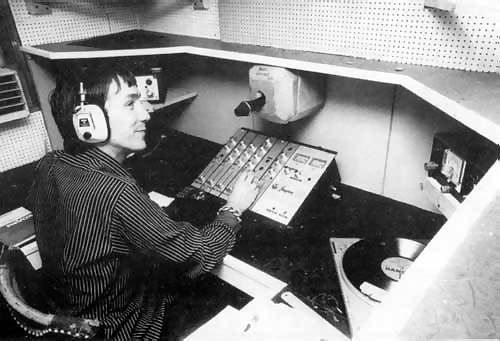
Tony Allan was one of the most talented broadcasters to emerge from the offshore radio scene of the sixties. Although loved by his listeners and respected by his colleagues, Tony largely chose to
work in the world of unlicensed radio so never achieved the acclaim and fame enjoyed by some of his, often less talented, contemporaries.
|
|
|
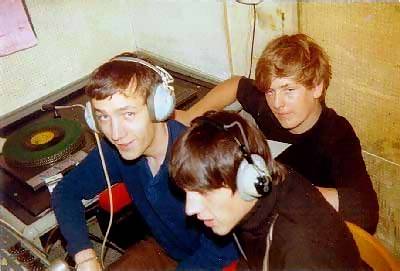
Tony in the studio of Radio Scotland, with Mark West and a crew-member. Photo by Bob Donnelly, reproduced by kind permission of Alan Beech. There are more of Bob's photos of Radio Scotland on
www.rossrevenge.co.uk.
|
Like many teenage boys growing up in London in the sixties, Tony was fascinated by the offshore stations. Whereas most lads were happy to just listen to them, Tony was determined to take part.
He began hanging around Caroline House, the offices of Radio Caroline. He helped about the place after school, sorting mail, stuffing publicity photos into envelopes and doing odd jobs but, whenever he raised the
subject of joining the station as a DJ, he was told that, at 16, he was too young. Rebuffed by Caroline, he approached some of the other stations and finally landed a job with Radio Scotland.
 Tony opens Radio Scotland for the day (duration 49 seconds)
Tony and Mark West promote a Radio Scotland Clan Ball (duration 48 seconds)
Tony singing the praises of Radio Scotland T-shirts (duration 1 minutes 30 seconds)
Some clips of Tony on the Sixpenny Snowball Requests programme on Radio Scotland from 7th August 1967 (duration 4 minutes 52 seconds)
Tony on the last day of Radio Scotland (duration 42 seconds)
|
|
|
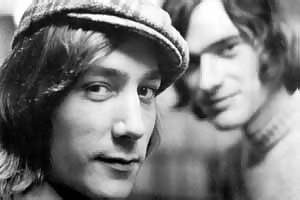
Tony with Dave Rogers on Radio Northsea International. Photo from the RNI Souvenir Book, published by Hit-Publications, Switzerland.
|
Tony stayed with Radio Scotland until it closed down on 14th August 1967. Most of that final day's programmes were pre-recorded so that the disc-jockeys could attend the last Clan Ball in
Glasgow but Tony and Mark West stayed on the ship, playing out the tapes and presenting the last live shows.
Following the closedown Tony worked as a television continuity announcer for Grampian TV, LWT and Granada.
In 1970 the Swiss-owned offshore station Radio Northsea International began broadcasting. It did not have an easy time and closed a few months later. However in February 1971 it returned to the air and Tony joined the team.
Tony on the last day of test transmissions for Radio Northsea International, 21st February 1971 (duration 44 seconds)
Tony on the first ‘Super Hit 50’ chart show on Radio Northsea International, 21st February 1971 (duration 2 minutes 25 seconds)
A Tony Allan promotion for the Paul May show. The disc-jockey who can be heard at the end of the clip is Terry Davis (duration 40 seconds)
A Tony Allan public service announcement (duration 39 seconds)
|
|
|
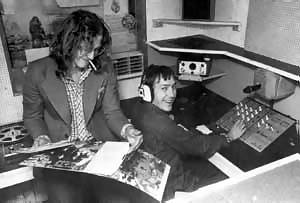
Tony with Johnny Jason in the Radio Caroline studio. Photo from ‘Caroline - A Story In Pictures’, published by Threemaster Productions. Thanks to Jelle Boonstra.
|
30th September 1972: Radio Veronica moves from 192 metres and Radio Northsea immediately grabs the wavelength for RNI-2. Tony Allan opens this new, and very short-lived, service (duration 5 minutes 16 seconds)
Tony's career with Northsea was erratic. He left in June 1971, rejoined in August, and then left again five days later. He worked in Paris for a while, returning to Northsea in February 1972, as
DJ/head of news. In October 1972 all the RNI English DJs, including Tony, were fired. In the meantime Radio Caroline had returned to the air, broadcasting from the mv Mi Amigo off the Dutch coast. Tony finally achieved his
ambition. He became a Caroline DJ, joining them in January 1973, although initially he only stayed six weeks.
Tony Allan, from his first show on Radio Caroline, 2nd January 1973 (duration 4 minutes 59 seconds)
During the late sixties Abie Nathan, an Israeli restaurateur, sold his restaurant and all his property and threw his energies into a new venture, an offshore radio station that would speak to all
the people of the Middle East, Jew and Arab alike - the Voice of Peace. He began fund-raising in Holland and the Dutch Council of Churches donated a ship. It was a long slow process but eventually some £29,000 was
raised in the Benelux. The boat was then sailed to New York in an effort to raise further funds. Tony was fascinated by the project and signed up for it. He left Caroline and joined the Peace ship which, at this stage,
was still in New York harbour. He crossed the Atlantic on board and presented programmes when she finally reached the anchorage off the coast of Israel. He stayed with the Voice of Peace until 22nd September 1973 (his birthday),
returning to the Mi Amigo the following day where the station was now broadcasting under the name Radio Seagull.
Tony's station identification for the Voice of Peace (duration 26 seconds)
Tony on Radio Seagull in 1973 (duration 40 seconds)
|
|
|
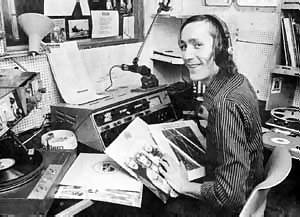
Tony in the Radio Caroline studio. Photo from the ‘Radio Caroline Picture Souvenir Book’, published by MRP Books.
|
Tony left Radio Seagull for a time and worked in Dutch clubs. He moved back to the Mi Amigo in June 1974, where the station was now called Radio Caroline again. In August the Dutch
government passed a new law making offshore radio illegal, just as the British had done seven years earlier. The other Dutch-based stations, Veronica, Northsea and Atlantis, all closed down but Caroline continued. The
ship raised her anchor and steamed back to Britain. And at midnight on 31st August 1974, as the new law came into effect, it was Tony Allan at the microphone.
In the first minutes of 1st September 1974, Tony Allan takes Radio Caroline into a new era (duration 2 minutes 25 seconds)
Tony was gay. This was not frequently mentioned on air although Tony did not make any effort to hide the fact. When a new jingle package was recorded for Radio Caroline, a few joke jingles were made
as well. These were never intended for transmission, just for the disc-jockeys' amusement. One of them had the words “Tony Allan is gay”. Tony loved it and immediately started playing it on the air. He was
asked to stop by the station boss, but that only encouraged him! Tony was probably the first openly gay broadcaster, a fact of which he was immensely proud.
The ‘Tony Allan is gay’ jingle (duration 2 seconds)
Tony Allan on Radio Caroline from November 1974 (duration 1 minute 40 seconds)
Tony was an inveterate traveller. He never stayed in one place for long. He left Caroline in May 1975 to join Edinburgh's Radio Forth. This was the only time he presented programmes on legitimate
radio. He hosted the afternoon show but it did not work out and in November he moved on. He rejoined Caroline in May 1976 but at the end of June was off again, to London where he worked as a freelance voice-over. For the
next couple of years he alternated between Caroline and the Voice of Peace, returning to Caroline in October 1978, just as generator failure closed the station down. After a long period of silence and, for a brief time,
the abandoning of the Mi Amigo to the elements, Caroline surprised even the most diehard fans by returning to the air at Easter 1979. Tony's was the first voice to be heard, pointedly playing Chris Rea's
Fool, If You Think It's Over.
Tony Allan reopens Caroline at Easter 1979 (duration 1 minute 42 seconds)
|
|
|
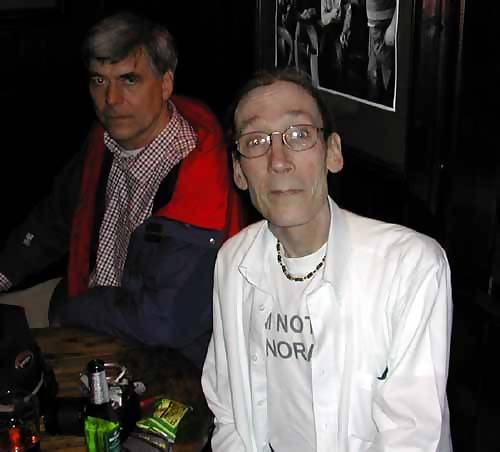
Pale and weak, from both the cancer and chemotherapy treatment, Tony still turned up to help celebrate Radio Caroline's fortieth birthday in March 2004. Pictured here with engineer
Peter Chicago.
|
In August 1979 Tony left Caroline for a holiday in Ireland and did not return. He discovered a thriving landbased pirate radio scene and a number of opportunities for a man with his knowledge
and experience. Tony stayed there for the rest of his career. Radio Nova, in particular, benefited but he was also heard on many of the other stations.
Tony Allan on Radio Nova, February 1985 (duration 1 minute 22 seconds)
Tony had always been a brilliant producer, as well as presenter, and the Irish radio scene allowed his skills full rein. Chris Cary, owner of Radio Nova, wrote
“much of the success of Radio Nova was down to Tony's dedication, talent and professionalism.” Like many highly talented people, Tony did not suffer fools gladly and could at times be difficult to work with.
Many former colleagues tell dramatic stories of blazing arguments but they usually also have memories of his warmth, kindness and genius.
There are a number of recordings of Tony from his time in Ireland on the web, notably on The DX Archive site.
Tony returned to the UK. Diagnosed as suffering from throat cancer, he lived in a flat in Camden, north London, while undergoing the unpleasant chemotherapy treatment. Despite frequently being in great pain, he still
showed as much interest in music, radio and the world about him as ever. He was regularly to be seen checking out new bands playing the many live music venues near his home and was determined that his illness was not
going to stop him making the most of the time he had left. He appeared on the satellite version of Radio Caroline and was there to help celebrate the station's fortieth birthday. He fought the cancer bravely and without
complaint, surviving much longer than his doctors had anticipated, but eventually he couldn't fight it any longer. He passed away in the Marie Curie Hospice, Hampstead, just before noon on 9th July 2004. Tony was 54.
There is an excellent report on Tony's funeral, and the gathering afterwards, on the Media Guardian website.
The audio on this page comes from RBL, Offshore Echo's, www.azanorak.com,
The Offshore Radio Archive, Scott Sullivan, GJB Sales, The Offshore Multimedia CD-ROM and Lynne Sims, with recordings from Martin Lynch's collection. Many thanks to all.
|