It is not known why the owners of Radio Northsea International chose 1610 kHz, 186 metres, for the medium wave outlet of their station. Whatever the reason, it was an unfortunate choice. Not only
was it off the end of the dial of some receivers but it caused intererence to the emergency services. The Dutch pilot service was forced to move its transmissions from 187 to 182 metres and, in the UK, lighthouse
communications had to boost their power because of the interference being caused by RNI.
|
|
|
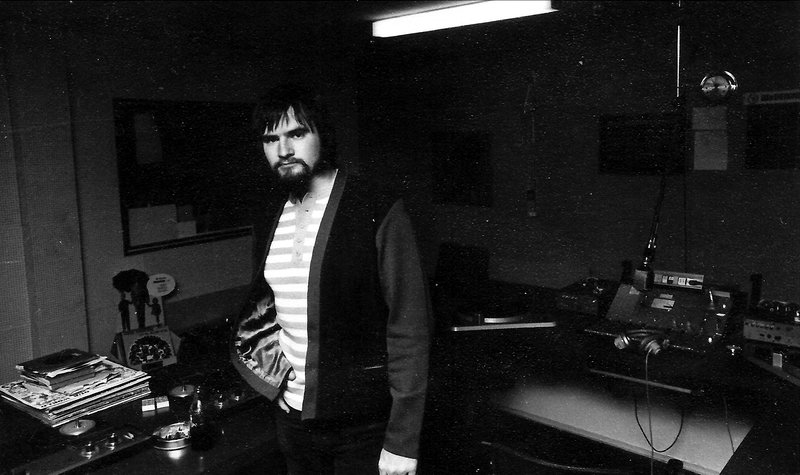
Carl Mitchell in the RNI studio. Photo published by the Free Radio Association from the archive of Rob Olthof, kindly donated by Hans Knot.
|
The station, which did not broadcast in Dutch at this time, was not particularly welcomed in Holland and, as British listeners were complaining that RNI's signal was disappointing in the UK, the
owners decided to move the ship closer. On Sunday 22nd March, after just a month on the air, they announced that the Mebo II was to travel to Britain. This proved to be another bad decision.
 Carl Mitchell on Sunday 22nd March, playing a record produced by one of his RNI colleagues, Mark Wesley. Sadly the 24 hour a day broadcast planned for
the Easter weekend that Carl mentions, never took place. This is an edited version of a recording made available by The Offshore Radio Archive (duration 4 minutes 14 seconds)
Carl Mitchell on Sunday 22nd March, playing a record produced by one of his RNI colleagues, Mark Wesley. Sadly the 24 hour a day broadcast planned for
the Easter weekend that Carl mentions, never took place. This is an edited version of a recording made available by The Offshore Radio Archive (duration 4 minutes 14 seconds)
At 7pm the next day the anchor was raised and, broadcasting as she went, the ship circled the rival Radio Veronica ship and set off for her new home.
Alan West during the evening of Monday 23rd March 1970, as the Mebo II raises her anchor and sails for Britain. The “special announcement” is from Carl Mitchell. This is an
edited version of an FM recording shared by Harm Koenders on The Offshore Radio Club Forum (duration 3 minutes 40 seconds)
|
|
|
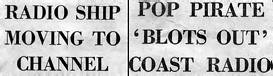
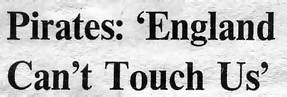
‘The Daily Telegraph’ reports on the move to England. Click on the headlines above to see both these and other articles.
|
The anchorage turned out to be six miles off the Clacton, Essex, coast and as soon as the Mebo II arrived a deluge of complaints flooded in. RNI's medium wave frequency, 1610 kHz, was used by lighthouses,
lightships and coastguards and the station's signal was blotting out these essential transmissions. Because of the interference it was causing, RNI closed down medium wave broadcasts on Good Friday 27th March. A few days
later station boss Edwin Bollier visited the headquarters of the Royal National Lifeboat Institute in London. He apologised for the inconvenience that his station had caused and offered a large donation to the fund. This
was refused because of concerns that accepting it would contravene the Marine Offences Act.
THE JAMMING
On 10th April RNI was back, on a new frequency, 1578 kHz, 190 metres.
Duncan Johnson at 1pm on 10th April 1970, RNI's first day on 1578 kHz, 190 metres. This recording was made by the late Buster Pearson and donated to
www.azanorak.com by Keith King. Our thanks to Buster, Keith and Ray Robinson (duration 2 minutes 38 seconds)
|
|
|
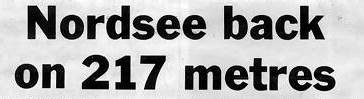
‘Record Mirror’ reports on the change to 217 metres. Click on the headline to see this article and another from ‘The Daily Telegraph’.
|
|
|
|
‘Rolling Stone’ reports on the Mebo II arriving off the UK. Click on the headline to see this article.
|
Immediately the Post Office, then responsible for policing the UK airwaves, announced that it had received protests from Norway and Italy, the two official users of the frequency and,
on 15th April, a Government-authorised jamming signal started to interfere with RNI's AM output. Another wavelength change was announced, to 1385 kHz, 217 metres.
On 30th April the station re-opened on this new wavelength. Also the FM frequency was altered to 100 MHz. Unfortunately a fault developed in one of the transmitters and a fire broke out on board. This was easily subdued
but once again RNI was silenced.
On 13th May it was back, this time on 1230 kHz, 244 metres, medium wave and 100 MHz FM. Both shortwave transmitters were still out of action. Reception for this new medium wave frequency was excellent until 23rd May when
the Post Office resumed its jamming. A high-pitched tone was broadcast from a ten kilowatt transmitter located in a naval base near Rochester, Kent. Although this made listening to the station extremely unpleasant, RNI
continued. The jamming also caused problems for people living near the naval base who were trying to listen to BBC Radio One (then on 247 metres, 1212 kHz).
| RNI PROGRAMME SCHEDULE MAY 1970 |
5.30am Hannibal or Axel (German)
7.00 Roger Day or Mark Wesley
9.00 Andy Archer or Alan West
12.00pm Carl Mitchell or Duncan Johnson (Sunday: Top 30)
3.00 Mark Wesley or Roger Day
6.00 Alan West or Andy Archer
8.00 Hannibal or Axel (German) (Sunday: Top 30)
11.00 Duncan Johnson or Carl Mitchell
2.00am closedown
|
|
|
|
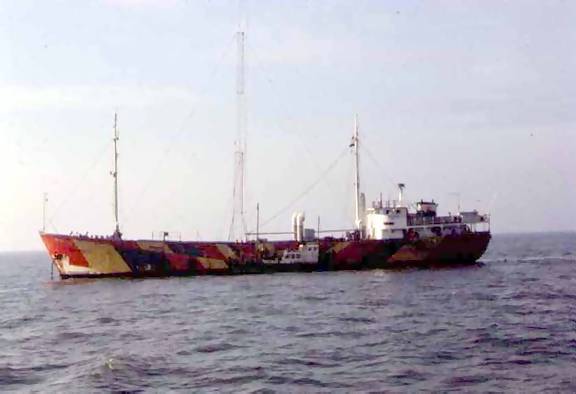
The mv Mebo II. Photo kindly provided by Duncan Johnson.
|
|