In 1965 Tony Rock had just joined RCA Great Britain as an engineer. His first assignment was to construct and install the studio sound desk for a new offshore radio station - Radio
Scotland. The station's ship, the Comet, was fitted out in Guernsey, in the Channel Islands. Transmitters and studio equipment were supplied by RCA. The owners were keen that the station should launch on Hogmanay,
31st December 1965 so there was a deadline - and considerable pressure on the engineering team. The Pirate Radio Hall of Fame is grateful to Tony for allowing us to publish his photographs
and memories of these exciting times. He says: “The installation was like a comic opera and has a place of honour in my compilation of anecdotes spanning 40 years of international field engineering.”
|
|
|
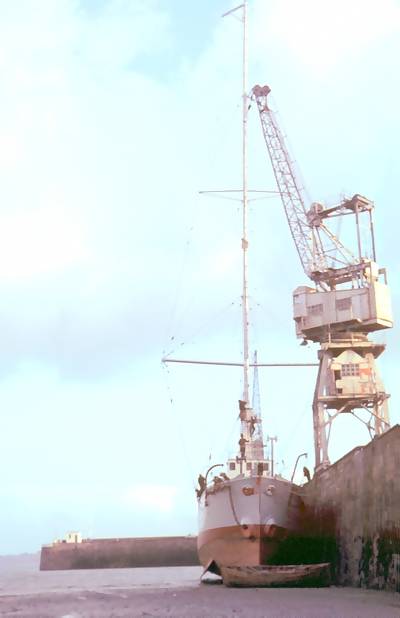
Installing the aerial mast. Photo kindly provided by Tony.
|
“At the time, RCA, being an American company and not subject to British or European government sanctions, was one of the only available sources of broadcast transmitters to
these stations. I had just joined RCA UK Division, in Sunbury on Thames, and my first project was to construct an audio console in Sunbury, and install it on board an old lightship, the Comet, which had been retired
from its post off the Irish coast. This old veteran had been towed to St Peter Port in Guernsey (* see below) where it would be fitted out as a radio ship.
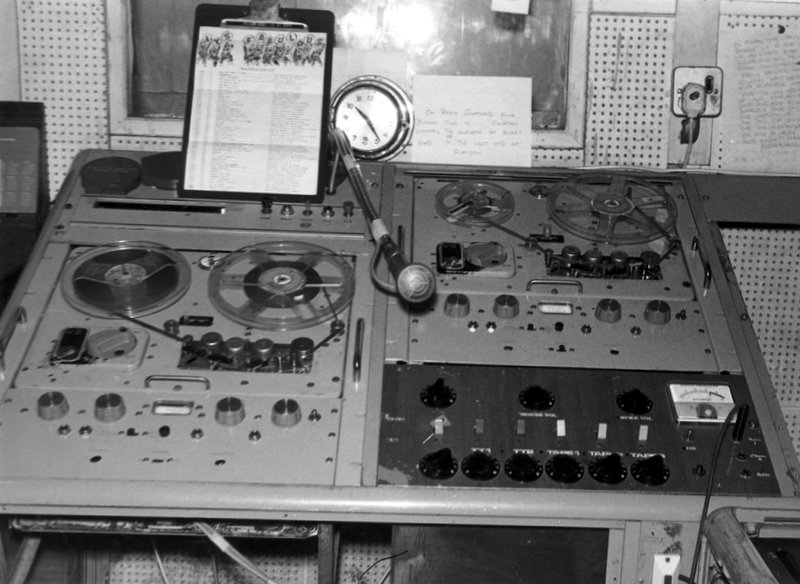
The sound desk was built from scratch in Sunbury, and consisted of a U shaped console with a custom-designed mono control panel, Wearite tape recorders and two Garrard transcription turntables on a separate gimbal-mounted
table. A very simple system by today's standards but it should be remembered that vinyl discs were largely mono recordings at the time and there was no stereo pop radio.
The pressure was on for Radio Scotland to sign on in time for New Year 1966. Progress of the job was not helped by hourly visits by the Divisional Manager, trying to expedite things. A wise man once correctly defined
‘expedite’ as adding commotion to confusion and his constant interference did nothing to speed the job along. We were halfway through checking out the system when a prospective disc jockey, together with
his Chief Engineer, arrived to inspect the equipment. The DJ insisted on a number of design alterations which put us back a further week on the delivery.
|
|
|
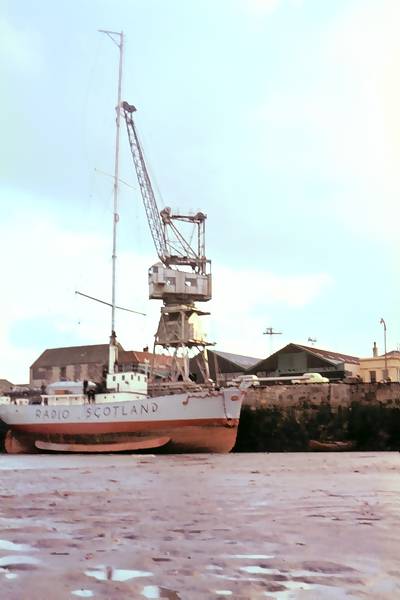
Rigging the aerial mast. Photo kindly provided by Tony.
|
I finally flew into Guernsey, with my co-worker Stan, and joined the rest of the installation crew at the hotel, ready for an early start next morning when the equipment
would arrive. At this point in time there was nothing to suggest that the job would turn out like a comic opera. Several other engineers from RCA had been on the island for a week, pre-wiring the transmitter and equipment
racks in a warehouse on the island. One of these, Fred, had cut himself on the cable lacing twine used at the time and had a painful poisoned finger as a result. The project leader who we will call John, a man with a
dry sense of humour and great compassion, arranged for the hotel to give Fred a wake-up call at 3am with a pint of draught Guinness!
We duly arrived at the ship next morning early, to find the enormous aluminium mast laid out on the dock, ready to be set in the stub where the old ships light had been. It was about 250 feet in length and would be the
last thing to be installed before the ship was towed to its station. The tide was out at the time and the Comet was high and dry on the harbour bottom. The tide in Guernsey runs thirty or more feet and, while we had to
use a ladder to get on board in the morning, by the time we finished for the day we were able to step down on to the dock with a gangplank.
We went on board and made our way to the old Captain's sleeping quarters, a room about twelve feet by fifteen, with a beautiful old repeater compass mounted upside-down on the ceiling. My first comment was that the
equipment wouldn't fit into the space available. This suggestion was rejected by John, who reminded me that the room had been carefully measured before-hand, and the sound console built to fit exactly. I asked if the
room had been measured before or after the walls had been lined with acoustic tiles? A tape measure was quickly produced and, sure enough, the room came up two inches short!
|
|
|
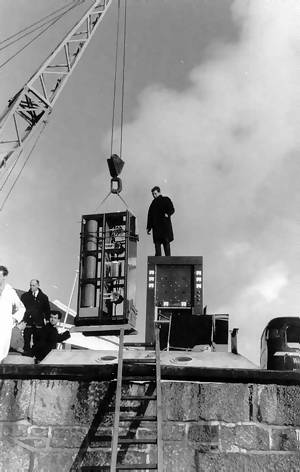
Installing the transmitter. Photo kindly provided by Tony.
|
As well as the removal of the tiles, a wood and glass partition, which had been built across the end of the room, would also have to be torn out and reconstructed before the
sound desk could be lowered into the room. Meanwhile the gimballed turntable stand had been lowered into the room through the skylight. It was a wonderful piece of engineering, constructed from heavy alloy ‘U’
channel frames, mounted on ball bearing pivots. The inside frame supported the deck which contained two transcription turntables with SME pickup arms. These lightweight arms would probably need to be weighted with coins
to prevent them from skittering across the discs in heavy weather. A three hundred pound steel block counterweight hung below the turntable deck, which would keep the turntables level however rough the sea became but
could not compensate for sudden sharp movements. A gentle push would start the thing oscillating and rocking for about five minutes. There was no damping on the gimbal bearings and the frames had been so finely machined
that they produced a guillotine like effect which seemed likely to sever any stray fingers which might be in the way when the ship was moving in heavy seas!
Stan and I began the final assembly of this, chatting to the carpenter and his assistant, who stood watching the electrician wiring the electrical outlets on the wooden partition. The electrician had worked most of the
night to get the job done by the deadline given him and was tired and grumpy. After about fifteen minutes, he learned that the carpenter was waiting for him to get out of the way so he could tear down the partition!
Swearing furiously, he tore out the wiring he had just completed and stormed up to the other end of the ship to help the other electricians working on the generators.
|
|
|
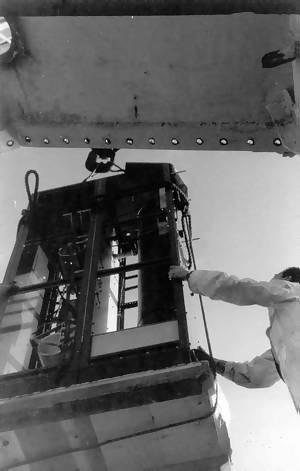
Installing the transmitter. Photo kindly provided by Tony.
|
The old lightship had operated on a 60 Volt DC electrical system fed from a number of little Lister twin cylinder diesel generators, cooled by seawater. This supply was
totally inadequate for the radio transmitter so, in an act of criminal vandalism, these beautiful old antiques had been smashed up with sledge hammers and thrown into the bilges as extra ballast. The replacement generators
were a pair of Deutz, 30kW radiator-cooled Diesels. A team of riggers was working on getting these heavy generators into the ‘engine room’ through a narrow doorway, opposite the galley. First they had to cut
out and remove the steel companionway, leading down into the engine room, and then, using levers, rollers and chain-falls the two big units were moved into position. Between them they more or less filled up the available
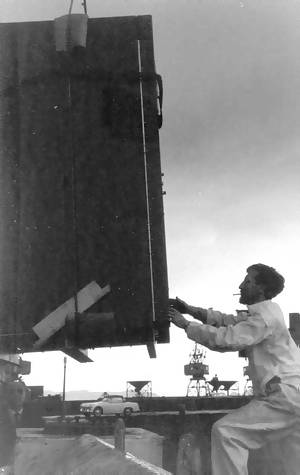
space. It took all day to accomplish this, during which time, the actual transmitters had been lowered into position by the dock cranes and the carpenter had rebuilt the partition in the control room.
We finished work in the evening, after dark, and returned to the hotel and an excellent dinner of local fish followed by some medicinal ale in the bar. The next morning we completed the assembly of the sound console and
started to check it out. The only records available for testing the turntables were two 45 RPM singles. One of these was Help
by The Beatles and the other was Zorba's Dance, the theme tune from the movie ‘Zorba the Greek’. Both of
these had been chosen because the average audio level of the recordings was fairly flat. After a whole day of checking the system it was hard to resist the temptation of throwing the two records into the harbour! Meanwhile the
electrical fitters had been busy overnight and almost had the new generators wired to the transmitter.
|
|
|
Installing the transmitter. Photo kindly provided by Tony.
|
It would not have been possible to test the transmitter in Guernsey. There was a Post Office monitoring van parked close to the dock and the minute that the exciter of the
transmitter was energized, the whole ship would probably have been impounded by the government. Transmitter testing would have to wait until the Comet was outside the three mile limit.
During the day two other characters associated with the job came to my attention. One of these was the ship's Captain who, having nothing else to do, remained in his tiny cabin and, rumour had it, spent his time doing
quality control tests on a variety of Scotch whiskies. The insurers required a Master Mariner as captain of the vessel, despite the fact that she had no engines with which to manoeuvre and would remain anchored in one
spot off the coast of Scotland.
The other character was employed as a night-watchman and was a retired fisherman, born and bred on the island. Given the opportunity and an audience, he would yarn for hours about his younger days. During WW2, when the
Germans occupied the Channel Islands, he and a friend had sailed their small fishing boat across the channel to England, having first put into France to collect their girlfriends. Due to adverse winds, it took them over
six hours to clear the Channel Islands. Since there were no engines on the local fishing boats, the Germans had apparently discounted the possibility that anybody could make it across the English Channel under sail,
given the usual heavy sea conditions that were normal for the area. They made it, never the less, putting into Weymouth the following day, the first people to escape from the occupied islands.
By the morning of the third day the fitters had replaced the companion-way in the engine room and were ready to start up the new generators for the first time. This was done and, within five minutes, the temperature
in the engine room rose above 120 degrees Fahrenheit. Apparently nobody had considered the need for ventilation since none had been required for the old generators. In order to run the big Deutz diesels the engine
room door had to be left open. This being directly opposite the galley door, the commotion from the generators was channelled directly into the cramped galley, where it was now impossible to have a quiet conversation.
Shouting was the only means of communication.
|
|
|
The central part of the studio console built by Tony. The two turntables were on the DJ's right. Photo courtesy of Jimmy Mack.
|
The only thing remaining to be done in Guernsey was to mount the new mast and, in anticipation of this, one of the RCA crew spent all night doing fine adjustments and bridge
measurements on the transmitter combining unit and the antenna tuner. The next morning, for the first time, a shipwright became involved in the job, supposedly to assist with the mounting of the mast. He spent a short
while working on his slide rule before announcing that the proposed mast was too tall for the weight of the vessel. The sway would be so slow that she would spend half her time on her beam ends and would be dangerously
unstable in the event of a serious gale. The solution would be to add about 30 more tons of ballast to the bilges, which would result in about three inches of freeboard during a flat calm. Alternatively take fifty feet
off the mast. The last suggestion was the only practical course of action but it meant that all of the combining networks and tuners would have to be re-adjusted for the impedance of the shortened antenna system.
In order to meet the New Year on-air date, the ship would have to leave as soon as the mast was seated, so the RCA divisional manager tried to coerce three of the engineers to remain on board over the Christmas period
and finish the work while the ship was under tow to its final station, off Dunbar. This idea was vetoed by the insurers, to the relief of the chosen victims.
In fact the voyage to Dunbar was far from easy. The old Comet broke her tow-line in rough seas and it took the tug two days to recover her. My involvement with the project ended when I left Guernsey, but I did hear
that the station made the on-air date with just minutes to spare.
The engineers left Fred on board to finish up a few odd things, expecting him to leave that evening, but the weather turned foul and I am told it was two weeks before the supply boat could get back to them. During
this period the fresh water tanks somehow became contaminated and everybody on board got the ‘skitters’, as they would say in Scotland. Later I heard that a disc-jockey nearly lost a finger in the turntable
gimbal - just as I had predicted when I first laid eyes on the Heath-Robinson design!”
Many thanks to Tony. He owns the copyright on all the pictures he provided. The photo of the studio mixing desk is copyright Jimmy Mack. There are more of Jimmy's photos here.
More memories of Radio Scotland here.
* Robert Clancy of the Guernsey branch of Monitor Magazine has been in touch: “Just a slight correction to your Radio Scotland article. The harbour was in fact St. Sampson's and not St. Peter
Port. The Comet was done at the Marine and General Ship Repair Yard slipway bit of St. Sampson's. The crane operator was Harry Bichard.” Thanks to Robert for that information.
|
