The fort-based sweet music station Radio 390 was a huge success but, broadcasting from a fixed site in the Thames, it was vulnerable when the law governing the territorial
limit in marine estuaries was changed. There was a long drawn-out legal battle as the two sides argued over the exact point from where the three mile limit should be measured but ultimately the pirates lost. In March
1967 the Post Office applied for an injunction to force the station to stop broadcasting. This was granted but Estuary Radio, the operating company, was given leave to appeal. This appeal was heard on 28th July 1967.
The company lost again. This time there was no alternative. The station had to close.
Radio 390 announcer Graham Gill was on board at the time and remembers the sad day:
“I was on the air with ‘Teatime Tunes’, the time was 16.38 and I had Herb Alpert and his Tijuana Brass spinning on the turntable, and coming up Summer Moon by Karl Werner
and his Orchestra, then Music to Watch Girls By - Bert Kaempfert & his Orchestra. Then we had the 390 Bike Offer and more music etc. etc.. After that I said ‘well that's all for Tea Time Tunes. This
is Graham Gill wishing you a very good afternoon’. I hit the gong and then said ‘This is Radio 390, your British family station. Here are the news headlines read by Graham Gill.’ After the bulletin
I started the tape of ‘On The Scene’ presented by Christopher Clark. Just after that, Chief Announcer Edward Cole came in and read the closing
text which gave instructions to close the station down immediately.”
 The end of Radio 390, 5pm, 28th July 1967. The news bulletin made no mention of the impending closedown as instructions from land arrived too late to be included (duration 2 minutes 30 seconds)
|
|
|
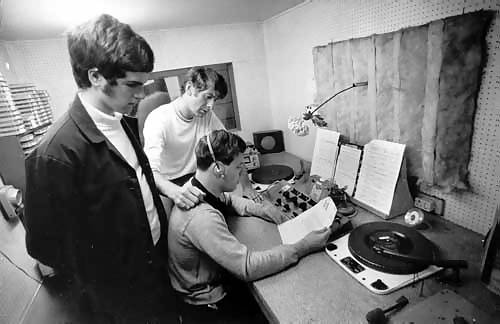
Edward Cole, flanked by Roger Scott, left, and Graham Gill closes Radio 390 for the final time. Photo copyright ‘Sunday Express’ kindly provided by Roger Scott.
|
The announcers on Red Sands knew that the end might be looming and had been working on a closedown programme. But when instructions arrived from the office on land, they were told to close the station
immediately. There was to be no time for a formal final show.
So the announcement was made, the engineer switched off the transmitter and the broadcasting team got on the tender home. The tapes for the incomplete final show were left behind, abandoned, on the fort. However they were
discovered some time later and copies circulated among fans of offshore radio. One of them, Martyn Webster, has kindly sent copies to The Pirate Radio Hall of Fame.
Edward Cole on the never-transmitted farewell show from Radio 390 (duration 1 minute 58 seconds)
Graham Gill says his goodbyes for the same programme (duration 3 minutes 34 seconds)
Roger Scott adds his final comments (duration 6 minutes 4 seconds)
|
|
|
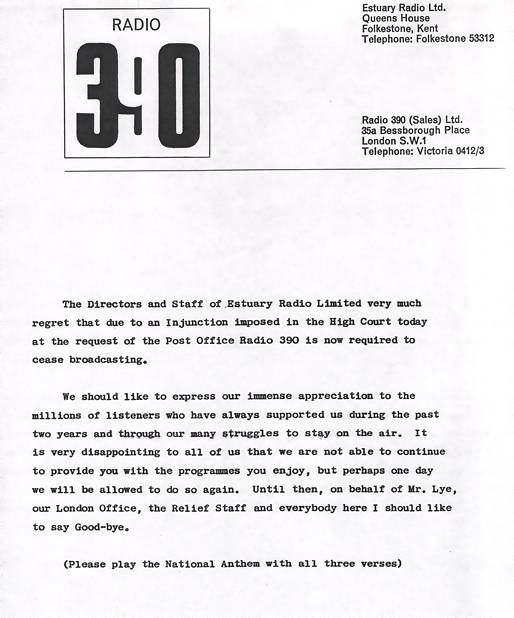
Edward Cole kept the closedown script as a souvenir. This is a photocopy of that document, kindly provided by Martyn Webster.
|
We asked Roger Scott for his memories of Radio 390's last day.
“One of the thoughts that I had in my mind on 28 July was that, as a listener, as well as a jock, I would be deprived of 390's type of music. Never, to this day, has any UK radio
station seen fit to format quality commercially recorded ‘standards’ and traditional easy-listening music, so the closing of 390 was particularly tragic in radio terms. Ironically, in the early twenty-first
century, it is young people who are discovering and enjoying that brand of output - on bar and pub music systems. No radio programmers are going to notice though! Radio 2's idea of Easy Listening, right from the day
that they were supposed to be a substitute for the stations broadcasting from the seas, has always been dodgy (largely the easier listening pop and rock of the day).
The description of myself as a jock is, in the context of Radio 390, exclusively shorthand. Although the worst excesses of camp and treacly presentation were finished by the time I reached Red Sands and we were allowed
to actually mention our names on air (only at the start and end of programmes, mind!) we were announcers and presenters and even I had to hold the waffle. Lee Gilbert had the most polished
and sublime ‘that-was-this-is’ act going.
Departing the fort (see photo of sad men on boat in my photo album), I was leaving behind not just the enjoyment of live broadcasting on such a sexy, beautifully received frequency at the lower
end of the medium wave band (773 kHz - although in those days I think we might still have been on kilocycles not kilohertz). I was also, with Ross Brown and Peter Berkeley, a librarian. Being
responsible for building programmes, we were, of course, more accurately, producers.
Apart from the sadness of the occasion, it was the fort itself that was about to become a sorrowful place, a shell returning to the echoes of the sea and of the towers' own history; its part in man's inhumanity to man and
in man's desire to bring a little harmless recreation and friendship to millions of other men. And women of course.
As for the unbroadcast final programme ... we were all aware of our place in history but my prediction of personal history about to unfold was wide of the mark. I never did follow David
Sinclair to Canada.”
|
|
|
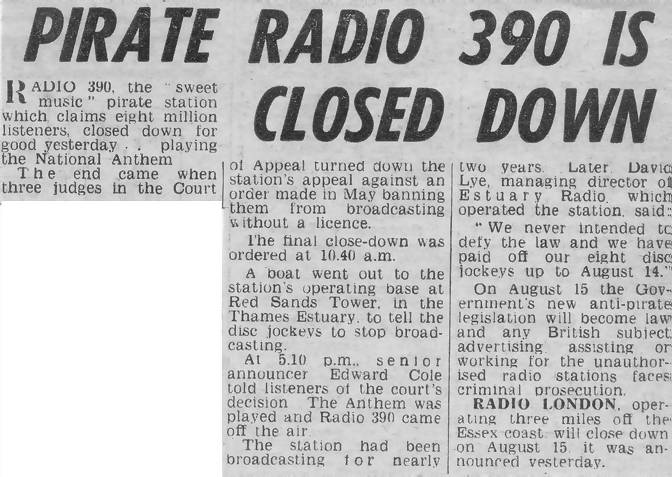
Radio 390 closes down. Cutting kindly provided by George Morris. Click to enlarge.
|
Graham Gill remembers some of the funnier moments from his time on 390.
“I can recall on one evening when Jack McLaughlin was doing an evening shift. We always closed down with the National Anthem which was on a tape cartridge. Jack
did the usual close down pressed the Spotmaster button (which had the anthem on it) and left the studio. We later found out that it had been playing most of the night as the transmitter for some reason or other had
not been turned off. A report of this incident was published in the Daily Mirror the following day.
Once I was a bit naughty when I was presenting ‘Lunch Break’. I came on air and said ‘This is Radio 390, your British family station. Now it's time for Lunch Break - music while you munch at your
lunch’. Next day I got a reprimand from the office in Bessborough Place!”
|
